Showing posts with label geothermal springs. Show all posts

Wednesday, October 10, 2018

Slim


Continuing with our soaking recherche of Georgia, Sascha now introduces us to Nokalakevi hot spring, in the northwest of the country.
Wikipedia enlightens us on the relevance of Nokalakevi :
'Nokalakevi (Georgianნოქალაქევი) also known as Archaeopolis (Ancient GreekἈρχαιόπολις, literally meaning ancient town) and Tsikhegoji ("Fortress of Kuji"), is a village and archaeological site in the Senaki municipality, Samegrelo-Zemo Svaneti region, Georgia'.
Absolutely no mention of hot springs are made.

But Sascha knows better: 
'These hot springs were mentioned by Lonely Planet.  
Drive first to the beach of Nokalakevi (on the left hand side, there is a hotel, the only one in the village). From here, continue the road up for around 1 km, on your right hand side there is a spring sign and a small gravel road that you need to take that leads down to the river. The last part of this way is very rocky and steep, a high clearance car is recommended, otherwise walk the last 200 m down to the river.
You first reach the 2 springs that have boiling temperature and therefore a fence surrounds the hot springs. The thermal water flows into the river on two points'.
Photo:


Two points, two options for soaking:
'Head first to the pools on you left hand side and check if there is some place free.
There are some small pools near the river and the water is only around 37/38° warm. However, warm enough to relax for hours in the small pools. Unfortunately, the pools are not very deep, you must be either very slim or only half of the body is covered by thermal water.
The river invites for a refreshing soak.
Some even flow with the river to Nokalaveki beach'.
 
Or:
'The second option is to climb down the stairs right from the little bar down to the river. 
On your right side, the hot water creates a cascade. Many man-made pools nearby the river can be found, but the hot water comes also from the ground which made the pools to hot by the time of visiting in July'.
Nikita Tiunov at Nokalavaki:

DSC06912
Stones
As accustomed in the other Georgian hot springs there's little to add / find in the internet. 
The said Lonely Planet lets us in own some info:

'Some 60km from Zugdidi via Senaki, Nokalakevi is a picturesque and historic ancient Colchian royal town and fortress. A tunnel leads down to the Tekhura River from the grassy grounds, and admission includes an interesting archaeological museum. Excavations are ongoing (see www.nokalakevi.org). About 1km upstream on the Tekhura you can take a dip in soothing thermal pools'.
The website Eurasia adds:

'Beyond a house a tiny path leads up to a fort on a hill (as opposed to the citadel, higher up and reached by a jeep track to the north, a pleasant walk of an hour or so each way); at the northern end of a very solid 19th-century girder bridge (for pedestrians and bikes only) across the river are the remains of a 5th-century bathhouse (with three rooms for three different temperatures, and red ceramic heating elements). As in most Georgian forts, there's a tunnel down to the river, to get water during a siege. On the far side of the river is a popular, if stony, beach, and a road leading up into a dramatic gorge with popular hot springs a kilometre or two along. It's possible to stay at the archaeological base if it's not full'.
A youtube find:

 And finally, Thermalsprings.ru jots down the details :
Location: near the Archeopolis Nokalakevi on the right bank of the River Tehura.
Infrastructure: two wells.

Description: Old self-flowing wells, most likely drilled in the 1970s. Pillows of carbonate sediments formed around the wells, which descend along the river terrace to the river bed. Next to the riverbed laid baths of boulders in which you can soak in the warm water.
Water type: pH = 6.9, fresh M = 879 mg / l, T> 62.7 ° C.
gogeorgia_ at Nokalaveki:
#горячиеисточники#нокалакеви #сернаявода#лекарстводлятела #турпогрузии#Gogeorgia

Wednesday, October 19, 2016

Victims

Hveravellir 
 
It's off to Iceland for a two part Sascha special. No less than seven hot springs are up for evaluation. 

Starting off in the southwest of Iceland, closer to Iceland's main port of entry and capital Reykjavik. Note that these Icelandic hot pots are also some of the best visited due to ease of access from Reykjavik. Thus more people to share the soaks with ...

In the evaluations Sascha often refers to the Icelandic soaking bible by Jon Snaeland (Thermal Pools in Iceland) a trusty companion to your Iceland travails. 
Note that internet knowledge is getting ever better and you may well be better off seeking advice here (or I mean on internet in general, f.i. Hotpot Iceland), but heed, that once in Iceland's backcountry, there's little mobile reception, so the book will prove to be of more value.

Over to Sascha, who starts off with his harsh opinion on the hot spring by the name of Klambragil, which is very often (if not more often) referred to as Reykjadalur; it was previously highlighted on this blog two years ago.

  • Klambragil 
Klambragil was definitively a great place in the past, but is it still the case today?

Klambragil is more a river than a hot spring with different temperatures. 

To get here, head first to the town of Hveragerdi, drive through the town and park your car at a big parking place (free of payment). In the town, there are gas stations, a bakery, a supermarket and a tourist office that seems to explain 500 times each day the way to the hot river. Then follow the masses of tourists (that are often coming here by buses from Reykjavik) on a hiking path for about 40 minutes to reach the place where the river is accessible and has the right temperature (around 35°C-45°C depending on the place). There are changing facilities and a wooden path. 

Klambragil is a good example, which shows that Iceland is becoming more and more a victim of its own success. 


My evaluation for Klambragil: 3 stars (of 5).

Rush
Let's continue as Sascha has another couple of hot pots, coming up with Hrunalaug first, again prior blogged here. 
  • Hrunalaug
Before Jon Snaeland published Hrunalaug in his book (according to locals, he forgot to inform the landowner), the hot spring was unknown for most of the people and in particular for tourists. This changed completely, so better get there early in the morning when you want to stay alone. 
Today, the spring is part of tour operators and the landowner requests a donation that helps to keep the place clean. Not sure, if many people put money in his box, in any case the place was no littering when I visited the hot spring. Overnight camping strictly forbidden. 

To get here, head to [the village of] Fludir and then drive to Hruni where the hot spring is indicated. Hrunalaug has two pools, the smaller one at the grass covered hut is colder, around 35°C but with a better view [see photo below] than the bigger one which is around 38°C. In former times, the pools were used to wash the sheep, today it is a good place to start or finish the Iceland trip because it is not too far from Reykjavik. 


My evaluation: 4 stars.
  • Hveravellir 
This hot spring is quite popular because it is situated close to road F35 that crosses the island over the highlands and is a common stop for tourist buses. A camping site and a lodge with a restaurant are nearby. 

Nevertheless and apart from the fact that the hot springs can be overcrowded, it is nice to soak inside because the pool is quite deep and the temperature varies from 30°C to 44°C. On one side of the pool, 80°C hot water flows in and it is advised to mix the water to get the right temperature. Guests of the lodge are permitted to use the changing rooms, all other tourists have to change their clothes outside or have to pay 500 ISK, around 3,50 EUR. 

About one hour drive to the south is the Kerlingafjöll hot spring that looks interesting on pictures, but has only a temperature of around 32°C. As it was snowing I was not really in the mood to try it out.

 
My evaluation for Hveravellir: 3 stars. 

Next week: part 2 of Sascha's Icelandic soaking saga.

Saturday, July 9, 2016

Mythical


There's little to add to the previous European Natural Soaking Society entry on Kamena Vourla and the local hot spring of Koniavitis.

That's if one failed to continue onwards from the Koniavitis spring along the same road (north) for another couple of hundred meters. 
There along the road side are another couple of pools, two changing cubicles and beyond the cubicles another


What transpires is that this location houses two separate hot springs, the southern most tubs are the named Kallyntika / Kallintika. Which translates as cosmetic. Cosmetic what?   
While the northern most heart shaped tub is referred to as Aphrodite (source: KamenaVourla.gr).

The greektraveller delves this bit of info:
'The thermal radio-springs [of Kamena Vourla] were known to the ancient Greeks; even a sulfur spring was named after Aphrodite because in Greek mythology the goddess took her cosmetic baths there'.
Hmmm, anyway there are two springs, convenient. There were also two nice ladies enjoying the cement hot pools, apparently the cosmetic named refers to the qualities attributed to the spring: more popular for women apparently.

The heart shaped Aphrodite pool lacked any bathers so I started off testing the soaking here. It was coolish. I read somewhere just 26 degrees which possibly doesn't qualify it as a hot spring.


Much to the delight of my fellow soakers in the cosmetic pool, I joined them. They were much enthused to host a tourist and one who looked like a German even though I insisted to hail from the Netherlands. How weird. They also overemphazied their love for Ms. Merkel, don't know what to think of that.  


Anyway this pool was somewhat warmer, did I read it was 32 , still not very hot. 

Out on internet other than mentioned before there's very little to add. 

Saturday, June 4, 2016

Stunner


Part two of Sascha's Jordan soaking review focuses solely on Hammamat Ma`in hot springs, arguably one of the globe's top hot springs. For instance it was the winner of World's Best Mineral & Hot Springs Spa 2015 (source). And there are many more accolades, mostly due to the stunning surroundings of this hot spring.

Aside from Sascha's rapport, there's a lot of additional info out there. Here are just a few:
Dead
Here's Sascha's report: 
These hot springs are the most well-known hot springs in Jordan, and are probably the most beautiful. The particular aspect of this hot spring region is that each hot spring has a different presentation. 
The best way to discover the Ma`in hot springs is driving to Hammamat Ma`in where you have to pay an entrance fee of 15 JD (around 20 EUR) and per person (which is definitively overpriced, but Jordan is in general not a cheap country).
This entrance fee gives [you] the right to [access] several public pools which are fed by a hot waterfall. The pools are around 40°C warm, but the unique thing is that the water falls directly on a bank where you can lie on. Depending where you decide to lie, the hot water gives a rainfall effect or a strong massage effect.
The combination of the hot waterfall and cooler winds that come from the Dead Sea, is extremely relaxing and you do not want to leave this wonderful place.
Apart from the hot waterfall and the pools, there is also a sauna cave behind the waterfall. This whole area is accessible for men and women, a second small waterfall exists exclusively for women.
Rapid
The waterfall is accessible to the public from 8 a.m. to 10 p.m., but if you stay in the Hammamat Ma`In [Hot Springs] Resort and Spa close the waterfalls, you have already access from 6 a.m. and you can be sure to be alone. I can only recommend to stay some nights in the hotel which is quite comfortable and offers a good buffet. Try to avoid Fridays or local holidays and negotiate the price in the hotel. Hotel guests do not have to pay the entrance fee and have in addition access to another hot spring pool that belongs to the hotel. The hotel pool is nothing natural except the thermal water (40°C), but staying in the hotel gives the opportunity to hike to river which is fed by warm water (around 35-38°C).
 
As the only access seems to be by passing the official hotel entrance, there is no littering and you will probably alone. The water flows quite rapidly, i.e. there are not a lot of pools, however, the advantage of that is there are only few algae on the ground. No sulphur smell at all. The landscape is quite stunning and it is a real pleasure to find your own place in the hot river.
 
My evaluation: 4 of 5 stars

Monday, May 18, 2015

Going public

Journalist and publicist Giovanni Faperdue is a true Viterbian: with being a citizen of the town of Viterbo (Lazio, Italy) comes the love for its surrounding naturally occurring hot springs. With a keen interest in local history, he takes special interest in the Termi del Bullicame. 
This translates into Giovanni taking up the presidency of the Associazione Il Bullicame: a group of interestees in the public cause of the Bullicame hot spring source as well in the conservation of other local springs. High among their priorities is keeping the hot springs public and free for all to use. 

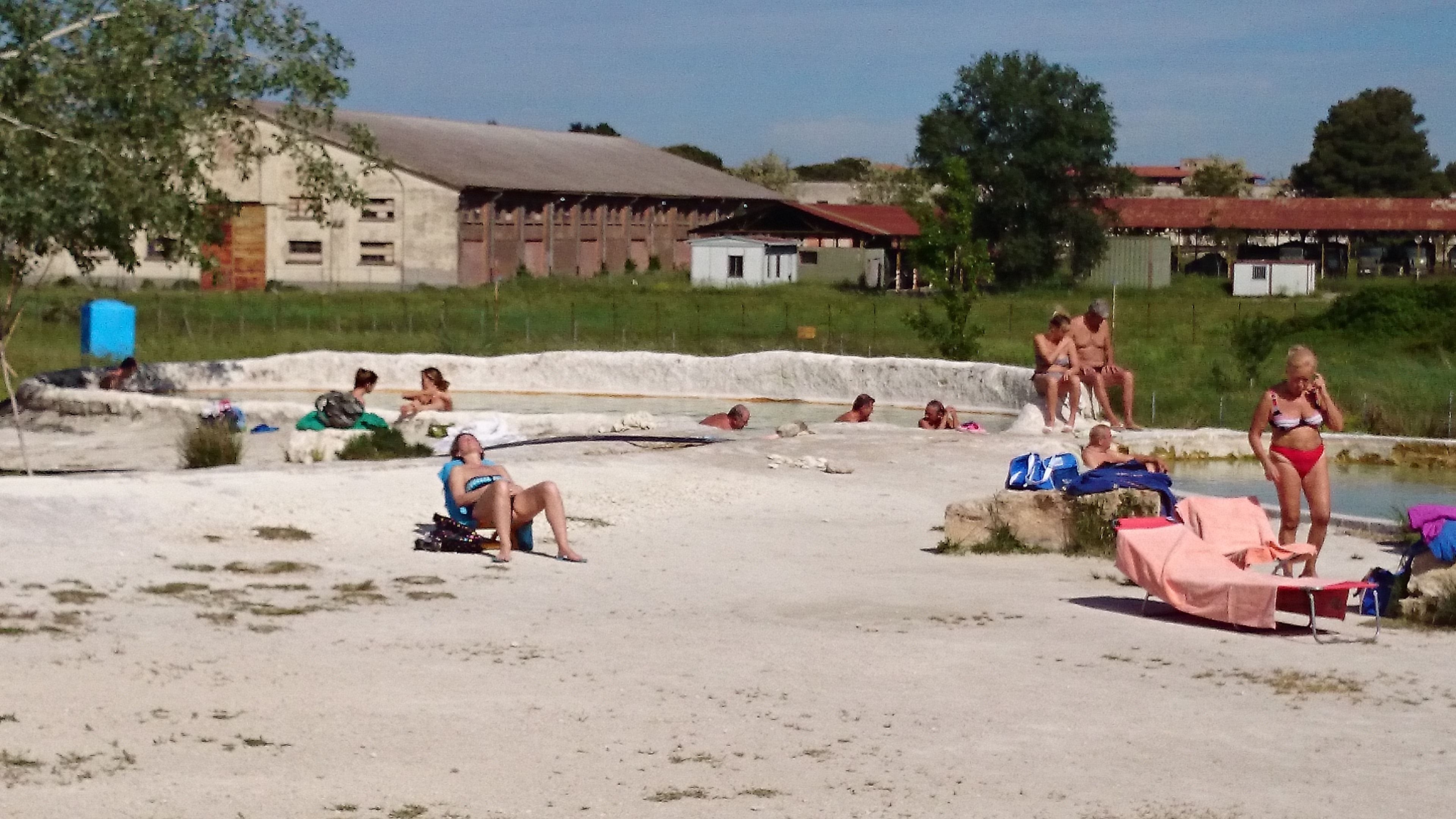
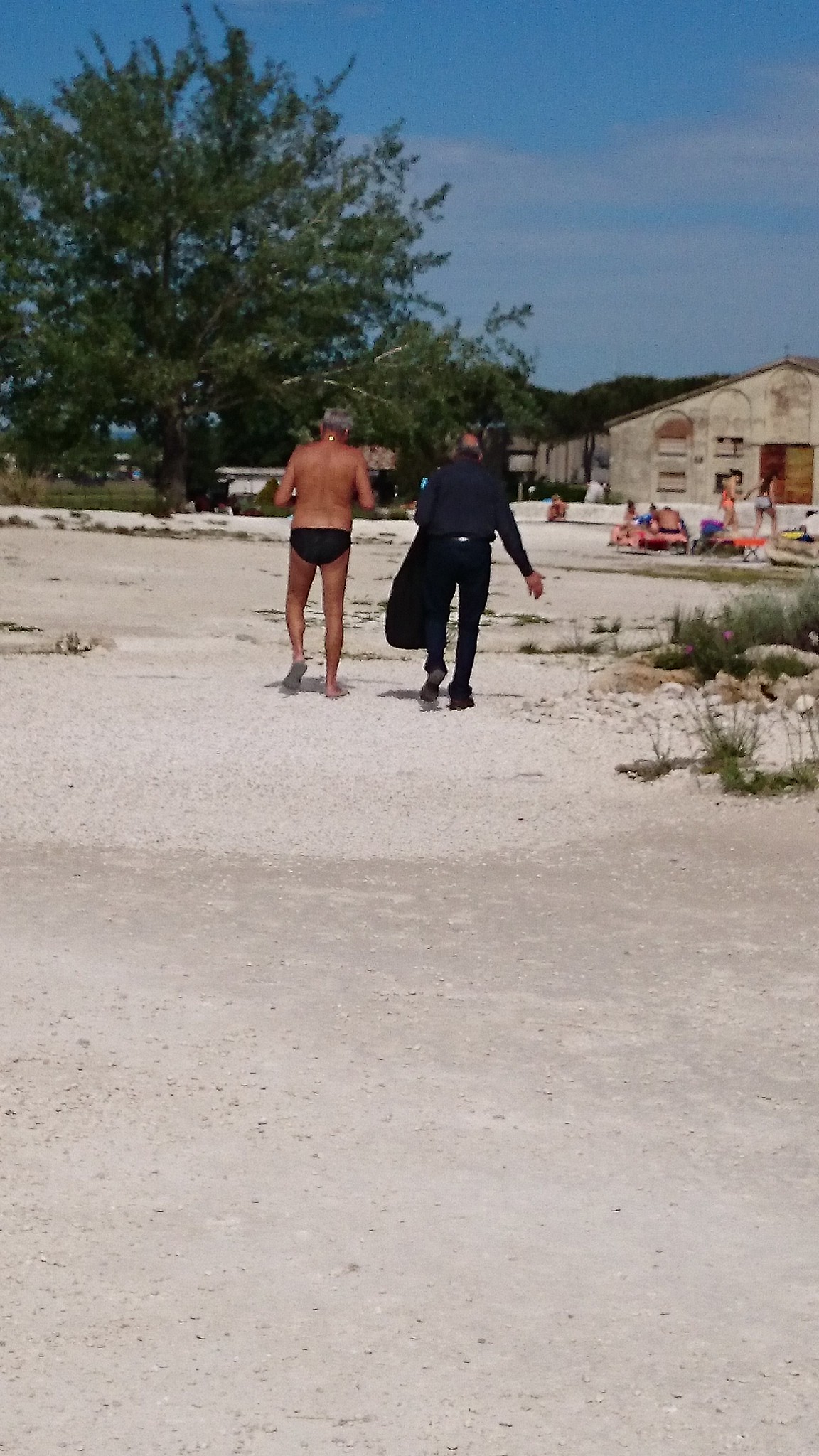
I met Giovanni on a sunny Friday mid-morning earlier this May at the site of the Bullicame hot springs. Dressed in black, he contrasts greatly with the swim wearing soakers and sun-worshipers who have descended on Bullicame to use the springs and surroundings as Viterbo’s public beach. 

“Welcome to Il Bullicame. The hot springs of Il Bullicame have been used for a long time. Il Bullicame was referred to in Dante’s Inferno”. 
How did the association come into existence? 
"Well people have been coming to Bullicame for a long time. From the times of Etruscans and Romans. Some time back we became concerned with the state in which the terme was. Especially when we noticed that the hot spring was in full swing but the waters flowing to Bullicame were lower than before. We looked into this and concluded that the commercial operation called Terme dei Papi was extracting more water than it would be legally permitted. Together with the local government we have been trying to get the Terme dei Papi to be held to its restricted amount.
Besides this we raised awareness about the situation in which the springs were to be found. Consequently the government has found funds to enclose the surroundings of Il Bullicame so as to improve the management and upkeep of the site, as well as re-designing the pool areas. Now volunteers from the association keep the terrain clean, keep order and with some facilitation by the local council keep the small and large pools clean. As per our associations statute I have been voted president for a term of five years. We have 600 members, unfortunately though many are not paying their membership fees otherwise we would be able to expand our activities. Now we are mostly dependent on cooperation with authorities.
 The Piscine Carletti pools and car park
The association also have the management of the hot springs by the name of Piscine Carletti, another local hot spring no more than 1 km away. Here the local government has problems keeping the site clean. The overflowing trash bins are only cleaned once a week.
Another further two sites have been earmarked for future projects mostly in the sense of conserving the surroundings, so as to ensure that these sites which are now on private land will enter the public arena. Do you have time?” 
Taking care of soaking business.

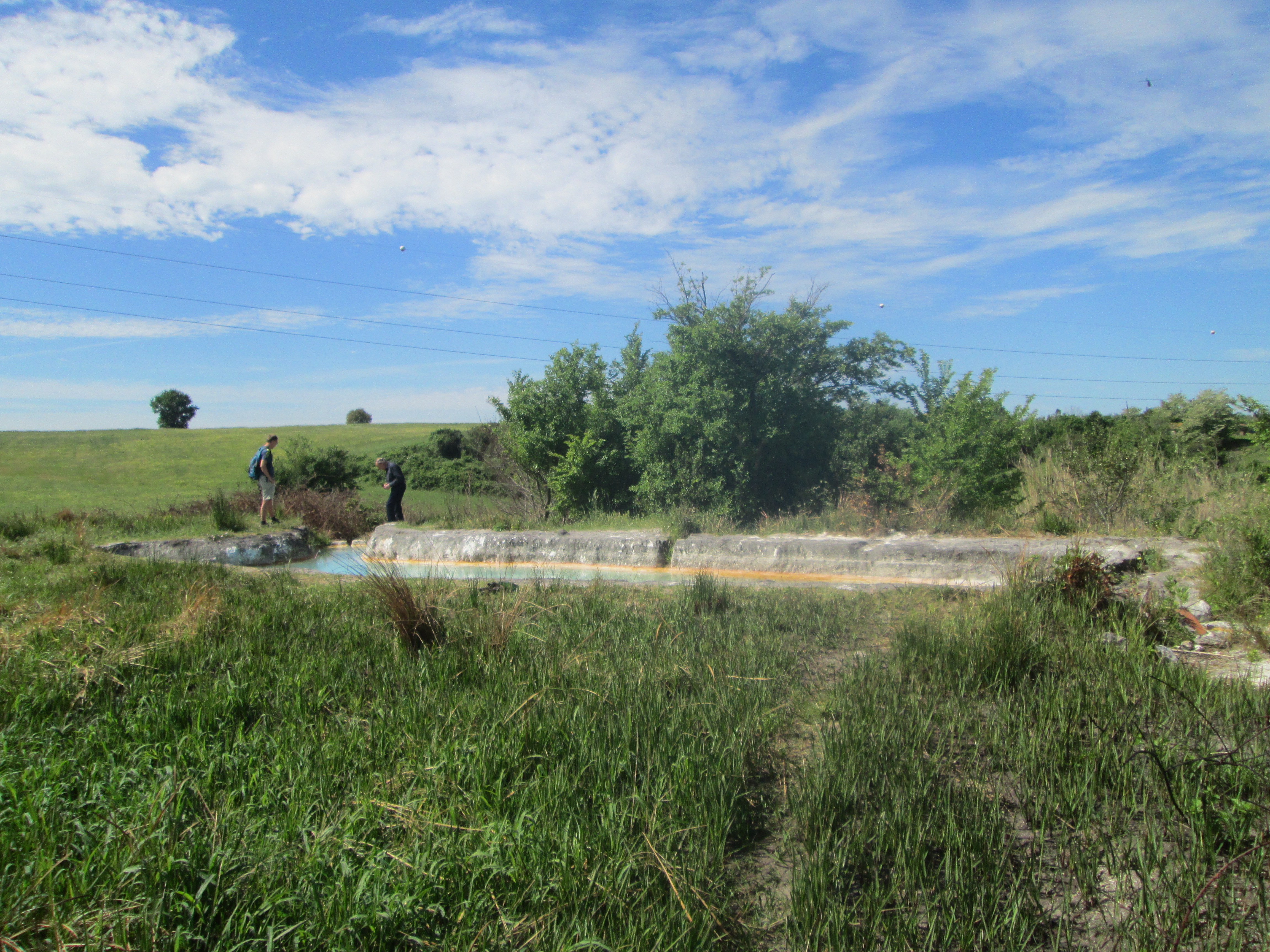
We do, but when Associazione Il Bullicame president visits the hot springs he always has to address a number of issues. These heard / resolved, we speed away. Ten minutes later we park the car along a winding country road. There is a small path which we follow for 25 meters to a scrub-lined hillock. On top is a 5 by 2 meter whitewashed pool which emanates the telltale signs of sulfur. Here the Romans were known to bath. But since, it has degraded somewhat and now this bath stands on private land with the only potential soakers some cattle and those in on the secret. The landowner has no interest in restoration nor in any visitors. We could see evidence of a soon to be resurrected barbed wire fence. Giovanni explains that this place is called Asinello. 
“The water here is the same source of that of Bullicame. Below Viterbo is a big underground lake of hot water, because at the site here, at Il Bulllicame, at the pools of Carletti, at Bagnaccio and San Sisto [roughly 20 km apart] the temperature is just below 60°C with the same mineral qualities. Here at Asinello the flow is probably just 3 liter / second and intermittent so the pool is not too hot”.
The Asinello pool.
 
Earlier evidence points to a cooling system which just hints that Asinello has seen better times. 
“As an association we want to keep the hot springs of Viterbo free. In for instance San Sisto they have been charging entrance fees even though they have no concession to do so. This is not right. The government does nothing against this. We should do more to ensure rules are adhered to and public access is guaranteed”. 
After a thorough exploration of this pool we return back to Bullicame where our roads part.

Giovanni, thank you for being so welcoming and able to discuss and clarify the affairs of Viterbo's hot springs, it was really appreciated. Having just spent a week in Viterbo I have had a great introduction into the significance of hot springs for Viterbo's touristic future. 
Let's hope that these remain open for all to enjoy. 

Wednesday, April 16, 2014

Hidden


It had been a tiring day, leaving Reykjavik early, heading through the snow eastwards along the south coast of the island. The further eastwards we got the deeper the snow was. Past Skógar we stopped at a few places, taking sideroads through the virgin snow and also went up Solheimajökull glacier, not with the expected cramp-ons, but with snow shoes so as to deal with all the fresh snow. It had been the best of snow of the season they said. After catching our breath, we headed to Skógafoss and as the heavens closed there was still the need to visit to hot spring.

The hot spring of Seljavallalaug is up a valley heading towards the  Eyjafjallajökull mountain.  From Iceland's highway 1, it's an easy 5 kms up side road 242. Continue as far as possible to where there's a small car park. From here it's a 15 minute walk upstream to Seljavallalaug, which is hidden from those heading there, behind a cliff.

Where art thou? 
The path is obscured by the now slowly falling snow. There are still a few persons returning, but we seem to be the only ones heading the other way and  intending a real winter soak. The path scrambles over some flat scree (?) and past a rock strewn side valley which also entails a jump or two over a small stream to reach the other side.

After this crossing, one skirts a big rock cliff and wanders along the pool and can feel the heat from the source at this end. At the far end, the changing rooms are empty save for some refuse. A quick strip and a jump into Seljavallalaug.

Looking south, from the changing rooms, the hot spring is at the far end.

What I hadn't read was that the waters were just 30 degrees, meaning a lot cooler than expected! A quick length is made to the heat source at the other end, but Seljavallalaug is something more to be savoured in summer ...

Lessons learnt
Originally the bassin at Seljavallalaug was constructed so as to afford swimming lessons. Snaeland & Sigurbjörnsdóttir (2010) add that construction took place in 1923 and the pool size is 28 by 10m. 
If one follows the link to this photo of those first swimming lesson days group shot. 

More history:
'A local man, Björn J. Andrésson, had been appointed to teach sports and swimming. He decided that a swimming pool should be built above the farm of Seljavellir, where geothermal springs flowed from the rock. He gained the support of local farmers, promising them free swimming lessons when the pool was completed. Twenty-five men took part in the task.
The original Seljavellir pool was built of traditional Icelandic construction materials, rock and turf, in 1922.  Nine metres long and 4-5 metres wide, the original pool took two days to build. Swimming lessons were due to commence three days later. Twenty-five people were registered for the first swimming/sports course, during which they camped at the swimming pool in tents.
The swimming pool was such a resounding success that the following year a larger concrete pool was built on the site, inventively constructed using the rock face as one side of the pool. It was the largest swimming pool in Iceland at the time'.
The changing rooms: a little tired?

Since the nineties it's role of catering to summer guests swimming needs has been take over by a more recent construction, downstream. Volunteers though have been maintaining the facilities, but there is only so much they can do. Once a year the whole pool is scrubbed down, so it's hoped that the current users have the sensibility to not pollute the waters. Or the changing rooms.

As Seljavallalaug lies at the foot of Eyjafjallajökull, after the 2010 eruption, these volunteers took great efforts to empty the pool (photo).

Privilege
Once more Seljavallalaug is also rated as one of Iceland's best hot springs (source). Britain's Guardian (20 July 2013) also rates Seljavallalaug in it's 10 of the world's best swimming pools:
'At the bottom end of the valley, the amazing Seljavallalaug geothermal pool was built in 1923, making it the oldest in Iceland; and it was its largest until 1936. It is now partially filled in with the ash of the 2010 eruption of Eyjafjallajökull but the scenery is fantastic and the water naturally nice and warm'.

Seljavallalaug gets four and a half stars from Tripadvisor which is not too bad for a natural attraction with only the visiting public needing to maintain the site itself.


A good blog entry on Seljavallalaug comes from the wonderful unknown:
'I've been having doubts about sharing the Seljavallalaug swimming pool. Although it's very close to the Ring Road where thousands of tourists pass every day towards the nearby Skógarfoss waterfall, nobody seems to know it. Except the locals and a few foreigners. And that's a good thing because the atmosphere around this pool is created by it's solitude. We've had the privilege to enjoy it all by ourselves with the surrounding mountains as our only companion and it wouldn't be the same when crowded.' 
Another nice entry comes from iheartreykjavik which also has more background on the need for swimming instructions back then.

Finally, here's a video of Seljavallalaug.

Note:
Snaeland, J.G. & Þ. Sigurbjörnsdóttir (2010) Thermal pools in Iceland. Skrudda, Reykjavik, Iceland


The return journey

Saturday, October 13, 2012

More modern


Fortunate fame
Forming the border between north Portugal and Galicia, Spain, the Rio Miño (Minho) flows through a depression which sees many hot springs. Deeper in Galicia, the city of Ourense, on the upper banks of the Miño, seems a magnet for Spain’s hot springs with 8 hot springs surrounding the city. Furthermore there are possibly hot springs Os Baños.

The Portuguese side have fared less fortunate in the possible soaking section. However the two towns of Monção and Melgaço are known throughout Portugal for their hot spring fame.

Commercial
Monção is a former rampart town, set on a cliff just south of the river. Through the centuries it served to exist in turning away the northern invaders, hoping to maintain it’s allegiance to Lisbon. The town is now a commercial center in the surprisingly green rolling hills, jam-packed with vineyards producing the light white wine which is the famed Vinho Verde. Eastwards of the village however a thermal center has existed for some time.

On my visit it seemed to be a more public facility, but still entrance requires a doctors' visit. This rules a recreational visit for 2 over-expensive. Despite this though we could observe other visitors (patients?) visiting the facilities. 
For a moment we are hoping that towards the Rio Minho is a more public and inexpensive facility. But no, the kids jumping in this pool are jumping in a normal swim pool, not fed from any spring. Surrounding the facilities is an extensive park with café, playground and fitness park. Lots of visitors here.


The termas themselves, are run by the Spanish wellness company Tesal which claim that they are possibly the most modern spa of Portugal. Opposite the soak is the hotel, called Bienestar. Tripadvisor gives it a meagre 3 stars, while booking.com offers 7.4.

There is a youtube intro film of the hot spring facilities themselves. 

 One of Melgaço's springs

Swinging
Twenty km upstream of Monção is the smaller town of Melgaço, set at the foot of the mountains of Serra de Peneda. Just outside the town, actually part of the village of Peso, is a fin-de-siecle park complete with buildings forming the thermal station. As is customary in other Portugese soaking sites, there is a huge building with the the opportunity to sample the waters by consuming a plastic cup fill. 

 
Opulent constructions for a plastic cup of pure water.

Seeking the soaking building it becomes apparent that these are being rebuilt / refurbished and as such closed. The action was in full swing, so expect these to open up, in the near future. Termas de Portugal suggest 2013. And then these will be the most modern soaking facilities of Portugal (?).

Entrance to the buvette.
 
More info is available from the Portuguese wikipedia website for the Melgaço, facts which include that the development of the site started from 1884. This website adds that the termas are situated on a 2 ha park which includes a campsite. 

 
The main soaking building (under reconstruction)

Jornal de Noticas mentions in an article (18/05/2012) writes the following:
´In this first phase was invested one million euros in landscaping and in the recovery of sources, plus the installation of a mini-golf and rehabilitation of a small stream.The remaining investment, over 3.7 million, is reserved for the contest that the management of the Northern Regional Operational Programme - "ON2" - opened in April, with 80% of this money will be supported by EU funds."It involves the recovery and expansion of the resort, now in ruins, but keeping its architectural as well as the construction of a Museum Thermal," explained the mayor of Melgaço, Rui Solheiro, Lusa.The complex is owned by Unicer group, which also operates the capturing and bottling that water, but that has delivered management space, with an approximate area of ​​59,600 meters square, to the municipality.All these works are the responsibility of the municipal company formed by the local authority and private, that after the investments will be in managing the Thermal Park Melgaço for 25 years´.


Monday, September 3, 2012

Feel free


Within Europe there are great contrasts in the way hot soaks are regarded and/or experienced. Some countries have managed to transform the natural phenomena into spa's which nowadays only vaguely refer to their natural origins. Other countries have medicalized their waters and restrict their use to 'patients' (see Aquistas).

Spain though, despite it's cultural forwardness in prior times (Romans, Moors, conquistadores) has let many a soak fall into disrepair / neglect. Notes in case are Tiermas, Santa Fe, Hedionda, Alhambra and Arnedillo (Rioja) to name a few.

Included in this listing should be the termas of Bande or as they were known in the Roman time as Aquis Querquennis: a Roman camp with an adjacent thermae. And such is the wish of the local tourism office, they would like the name to stick; but Bande is much more easier to pronounce (and spell) ...

Termas de Bande or Baños de Bande are located in Ourense province, along the Conchas reservoir on upper reaches of the Rio Lima

Background info in English on these soaks is scarce, so we'll have to make do with what's available in Spanish (or Galician) and pray google translate is able to come up with something remotely understandable.
A good point to start with an internet search is the blog site of Las Termas de Bande. Oddly, it only contains two entries which does not help us much, as well as the rather short text. A summary: better in winter, it's then quieter and there's a lower level in the adjacent reservoir?

More pictures from the termas while the reservoir levels are lower on this blog published in Portuguese.


More info comes with assistance of the all-natural soakers. Lugaresnaturistas has an entry on Bande termas. Noting it's temperature of 40C, it adds:
 '... you can sunbathe in the most naturalist, because nobody looks at anyone here and the feeling of freedom is full'. 
Or as this website puts it, au-naturel bathing is habitual:
'En las termas la mayor parte de la gente toma los baños desnuda ya que es algo habitual y luego, como zona de playa, está las proximidades a estas termas'.

Down stream
Downstream of Bande hot springs closer to the border with Portugal are the hot springs of Torneiros and the Lobios Caldaria thermal spa resort.
Starting with the former, this 85 rooms, 4 star resort features a hot spring and belongs to the Caldaria concern:
'The Thermal Spa has two entries one directly to the hotel and one that connects with the exterior. The treatments follow the line of those of Thermal Spa Laias Caldaria**** and Arnoia Caldaria***.
The water is hyperthermal, with low mineralization, bicarbonate soda, chlorate, and it appears with a spring temperature of 77,1º Celsius, and can be drank or used topically after being submitted to a naturally cooling process. The Riocaldo river waters are specially indicated for chronically digestive problems, respiratory and rheumatic affections, skin problems and dieresis cures. Besides that its specific characteristics make them ideal for the development of aesthetic treatments and Stress cures. The Thermal Spa is divided is two floors: in the upper floor one can find the hydro therapy techniques. In order to increase the communication among our clients, we made a Termarium, a place where different group techniques can be developed – dry and moister heat cabins, aromatic showers, tonus massage, jacuzzi, relax thermal spa swimming pool and warm couches. At the Termarium we reproduce ancient techniques that were commonly used by the Romans. In this floor we also have the inside thermal spa swimming pool, equipped with swan neck jets, underwater jets and a marvelous view over the Xurés Natural Park mountains.
In the lower floor there’s a quiet ambience for a correct use of the mass therapy and aesthetics. Besides the massage and aesthetics rooms our clients can also find a small gymnasium where physiotherapy techniques can be developed as well as physical exercise tabs (bicycle, mechanical walking, etc…)'.
Objectively, this resort scores a 7.8 on booking.com, garnered from 28 reviews; heed that tripadvisor's reviewers are less enthusiastic.

Torneiros looks like a great natural soak. A couple of pics from this blog. More extensive is this Portuguese website.....

  'A piscina e as termas'.
Aquis
More info on the surroundings of the Bande termas.
There is quite a bit of info on Aquis Querquennis (AQ). Mostly in Spanish and focussed on the non-soak site, there is still quite a bit of info both on the history as well as current conditions of the hot spring. Why the camp here? According to Europeanheritage.org:
'The place was chosen because it’s an easy place to access, with pastures, big amount of firewood and thermal springs'. 
Other data are the origins (around the year 0) and the fact that the archaeological digs started in 1975.

The camp site reminders

Originally there was a village in the reservoir, Baños de Bande was submerged in 1947 (source).
Access to the hot springs and archeological site is very straightforward, highway OU-540 which goes straight from Bande to the Portuguese border. There is an official website concerning the Aquis camp remains and museuem.

So my personal experiences ...
Coming from Bande, in the hamlet of Portoquintela there's a turn down a narrow alley which after 200m opens up to a broad street. To your right is a good (snack)bar, left a cobble stone street heading to the AQ museum and ahead is a treelined parking space. The museum is a very flash affair, free entry though.

Despite the emphasis of the museum of the roman camp, two signs on the entrance door sufficiently emphasize that the visitors are mostly coming for the hot springs. One sign reads 'aguas de banõ de calidade insuficiente' (bathing water of insufficient quality) the other 'recoméndáase non bañarse' (recommended not to bathe). We shall see ...


Inside the museum, are a great amount of halls dedicated to the archaeological finds further down the street. In all, it certainly provides tremendous heaps of info, if only I could read Spanish ....

So after the museum (we were 'forced' to follow the complete tour by the singular lady at the reception. Despite being the only visitors, ambling randomly was not an option!)
Where was I? So after the museum, down the street, towards the reservoir, where the Roman camp once existed. Continuing from the camp site remains onwards one comes to ruins of a Roman villa and then the hot springs themselves, located at the top of an inlet of the reservoir.

The Roman villa. Far side is where the hot springs are ...

There's separate access here, a few locals were checking out the scene, having a soak or setting up camp themselves, it was a Sunday after all.


So despite all the warnings locals keep soaking ...


On my visit, most of the sources were submerged, rendering them mostly lukewarm soaks in the otherwise chilly reservoir. One source though was not submerged and was very hot and afforded a great soak.

Author mentally preparing himself for ensuing soak (or adjusting the feet to the temps ...)

Termas de Bande, a great place to feel free(dom) and soak.