Showing posts with label bathing. Show all posts

Wednesday, October 19, 2016

Victims

Hveravellir 
 
It's off to Iceland for a two part Sascha special. No less than seven hot springs are up for evaluation. 

Starting off in the southwest of Iceland, closer to Iceland's main port of entry and capital Reykjavik. Note that these Icelandic hot pots are also some of the best visited due to ease of access from Reykjavik. Thus more people to share the soaks with ...

In the evaluations Sascha often refers to the Icelandic soaking bible by Jon Snaeland (Thermal Pools in Iceland) a trusty companion to your Iceland travails. 
Note that internet knowledge is getting ever better and you may well be better off seeking advice here (or I mean on internet in general, f.i. Hotpot Iceland), but heed, that once in Iceland's backcountry, there's little mobile reception, so the book will prove to be of more value.

Over to Sascha, who starts off with his harsh opinion on the hot spring by the name of Klambragil, which is very often (if not more often) referred to as Reykjadalur; it was previously highlighted on this blog two years ago.

  • Klambragil 
Klambragil was definitively a great place in the past, but is it still the case today?

Klambragil is more a river than a hot spring with different temperatures. 

To get here, head first to the town of Hveragerdi, drive through the town and park your car at a big parking place (free of payment). In the town, there are gas stations, a bakery, a supermarket and a tourist office that seems to explain 500 times each day the way to the hot river. Then follow the masses of tourists (that are often coming here by buses from Reykjavik) on a hiking path for about 40 minutes to reach the place where the river is accessible and has the right temperature (around 35°C-45°C depending on the place). There are changing facilities and a wooden path. 

Klambragil is a good example, which shows that Iceland is becoming more and more a victim of its own success. 


My evaluation for Klambragil: 3 stars (of 5).

Rush
Let's continue as Sascha has another couple of hot pots, coming up with Hrunalaug first, again prior blogged here. 
  • Hrunalaug
Before Jon Snaeland published Hrunalaug in his book (according to locals, he forgot to inform the landowner), the hot spring was unknown for most of the people and in particular for tourists. This changed completely, so better get there early in the morning when you want to stay alone. 
Today, the spring is part of tour operators and the landowner requests a donation that helps to keep the place clean. Not sure, if many people put money in his box, in any case the place was no littering when I visited the hot spring. Overnight camping strictly forbidden. 

To get here, head to [the village of] Fludir and then drive to Hruni where the hot spring is indicated. Hrunalaug has two pools, the smaller one at the grass covered hut is colder, around 35°C but with a better view [see photo below] than the bigger one which is around 38°C. In former times, the pools were used to wash the sheep, today it is a good place to start or finish the Iceland trip because it is not too far from Reykjavik. 


My evaluation: 4 stars.
  • Hveravellir 
This hot spring is quite popular because it is situated close to road F35 that crosses the island over the highlands and is a common stop for tourist buses. A camping site and a lodge with a restaurant are nearby. 

Nevertheless and apart from the fact that the hot springs can be overcrowded, it is nice to soak inside because the pool is quite deep and the temperature varies from 30°C to 44°C. On one side of the pool, 80°C hot water flows in and it is advised to mix the water to get the right temperature. Guests of the lodge are permitted to use the changing rooms, all other tourists have to change their clothes outside or have to pay 500 ISK, around 3,50 EUR. 

About one hour drive to the south is the Kerlingafjöll hot spring that looks interesting on pictures, but has only a temperature of around 32°C. As it was snowing I was not really in the mood to try it out.

 
My evaluation for Hveravellir: 3 stars. 

Next week: part 2 of Sascha's Icelandic soaking saga.

Tuesday, November 25, 2014

Die hards


Badlands
The high plains directly north of Andalucia's Sierra Nevada are windswept and arid. The few people living here are mostly dependent on agriculture which  means growing olives.

Touristicly though it is an interesting area: there's much history to be discovered whereas the natural surroundings though desolate are very photogenic. 
However with the summer holidays, temperatures here are very hot, thus dissuading potential tourists. 
So it's not surprising that the hot springs of Alicún are little known.

Finding Balneario de Alicún de las Torres is not straight forward: the GPS router seems to disbelieve the existence of the place. 
Luckily the turn off from the main A-92N motorway (between Baza and Guadix) prominently features Balneario de Alicún. So off we must go.
From the motorway the road goes nearly deadstraight until the edge of this part of the Altiplano de Granada has been found. Here, the road swirls around a corner and you arrive at the balneario. Simple.

Closure
The balneario and surroundings are rather non-descript this Monday, not much seems to be going on, though some seniors are milling around the building. The entry to the balneario itself is not clear and the congregation of elders all seem to know what to do. A lady proclaims 
'cerrado'
: closed. 
OK, though that does seem to contradict most of the ongoings, hmmm.
We cross the main road to where it looks like there is an overflow from the balneario. Some of the water flows swiftly away in what's best described as an irrigation ditch, which is enveloped in vegetation.

To the left of this is another stream with water seeking to progress through a park-like landscape. More buildings are here. Behind these, there are a few large pools to be seen. But all are empty; closed. 

Later I discover the reason. Apparently old habits die hard here: it's been decreed that after September 1 the outside swim season has come to an end. Today (mid-October) the outside temperature was 25ºC! Pity this.

In the surrounding park there is though a small pool which might afford a soak, but it's not very deep, nor any warmer than 30ºC. 

We returned to the balneario and I then followed the above mentioned irrigation ditch. Who knows, maybe there's a soakable overflow somewhere downstream?
While the adjacent track itself descends swiftly, the ditch continues it's higher trajectory. The difference gets bigger, 5-7 meters. At about 500m from the car park, there's a narrow underpass. The drop on the other side of the irrigation ditch is even bigger. From the underpass there's a good overview of the swimming pools. But empty.

Alas, it's not evident that a wild soak is to be had here ...
 

Ancient
Concerning the termas of Alicún, there's not too much additional information available on internet, certainly not in English. 

The balneario's own website adds nothing in English, though I could swear there was more English info on the site during the summer. 
In Spanish there's more info, such as the fact that the balneario was built in 1920.
About the swimming pools, otherwise known as Piscinas Termales los Torreones:
'Enclosure of 20,000 m2 with two outdoor thermal pools, one for adults 1,000,000 liters and a children than 100,000 liters. This complex is complemented by a restaurant, 2 bars, barbecues, changing rooms, first aid, games room and solarium'. 
The balneario has a site on pininterest with a couple of pictures from the swimming pool area. Some added info such as the swimming pool is the biggest thermal pool in Andalucia.

The bigger of the pools, source.

On the site of conocetusfuentes.com the additional info includes stating the temperature of the water (34ºC) and that the hot spring has been
'... famous since ancient times'.
Then there's an extensive photo visit report (in French) which notes finding a cave in the back of the springs somewhere; looks idyllic, no idea whether it's naturally heated ...

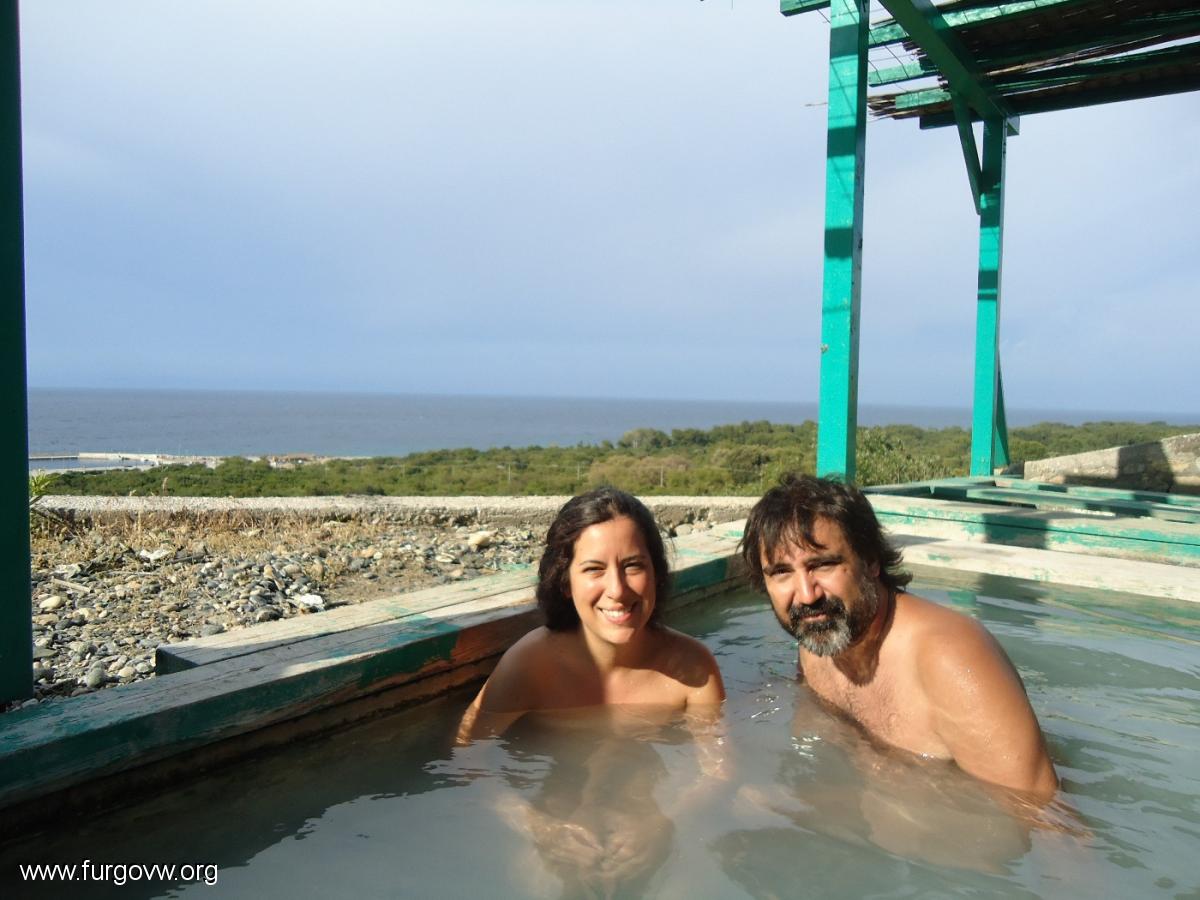
The forum site Furgovw (Spanish) has an extensive posting on this hot spring, with many photo's. In this forum entry, the author adds more info but not with enough detail. Apparently the best place for a soak is behind the main bathing building .... 
If only I were not sick the day before ... 
The info found: the irrigation ditch would date back 3,000 years, rises to 15m above surroundings in some places and in this dry climate encourages a moist micro climate.

In the Spanish language Waste.ideal.es site there's a full article on the irrigation ditch itself. It is 3 km long and is of high natural significance for the province of Granada. Because of the carbonated nature of the carried water, the irrigation canal has grown in height and length naturally.

The balneario hotel itself gets just 3,5 stars from tripadvisor but based on only 3 reviewers. Booking.com gives it a 7,5 based on 6 reviews. Not much word on soaking experiences or even the use of the swimming pools.

The following gives a good overview of the swimming pool itself:


A good youtube of the surroundings of Alicun:


Dolmens
We get in the car and continue our descent into the gorge. We'll return to the motorway, this time via the village of Gorafe. This a picturesque route. Near Gorafe, about 5 km from the balneario, one can find dolmen from Megalithic times.

From here the road winds itself back up the opposite side of the gorge. At the top more dolmen are to be seen and we are also blessed enough to see vultures soaring under and above us.

For more info on Gorafe check this page. 

Friday, May 2, 2014

Magical


Trapped
Reykjanes peninsula, the southwestern promontory, is just hanging on to Iceland rather than tumbling in the North Atlantic. Through the blizzard I can see the lighthouse of Reykjanesviti which equally warns ships for land and visitors for the surrounding geothermal fields. And the end of terra firma.


The geothermal fields are noted as Gunnuhver:
'The mud pools and steam vents on the southwest part of Reykjanes close to Reykjanes lighthouse are collectively named Gunnuhver after a female ghost that was laid there. She had caused great disturbance until a priest set a trap for her and she fell into the spring. This happend about 400 years ago'.


Visible
A number of look outs have been built which afford an overview of the steaming cauldrons. As well as Iceland's largest geothermal mud pool.
On the far side of the boiling pits, partially obscured by the blizzard, are a number of futuristic buildings apparently belonging to the Reykjanes power station.

Driving around the geothermal field to the geothermal power plant itself, we're a bit surprised that the Power Plant Earth exhibition, run in the geothermal power station is closed. Closed for the winter.

Somewhere I had seen some photo's of soaking possibilities nearby but whether it's the poor visibility, the snow covered land or simply being at the wrong place, soaking is not so obvious. 
After studying the landscape, I notice that a cement covered culvert is not covered by snow and yes the culvert is transporting hot water away into the blizzard. Knowing that the coast is nearby, we continue to follow the culvert.

Warning: no swimming

Royal
Three hundred meters on, we come to the end of the culvert where the hot water bursts from a pipe to the ever cold North Atlantic ocean. Elements are at work, the blizzard, steam from the water, crashing waves, well maybe it's not such a nice soak. Warning signs abound as well. Maybe when the tide is out?

 
 Where to soak?
Well, first to the left, there a couple of small petri-dish size rock pools. However they are either too small, too hot or too cold. Well, that's a no-go.

To the right though the situation is unclear. Clambering over rocks through the mist, we come to a large and deep pool. Testing reveals that closer to the inlet the water is too hot, however, seawater from crashing waves is coming over the rocks. 

Temperature is not bad. 

Well here goes. 

Strip quickly (very quickly!) and lower oneself carefully into pool. First the welcome heat, however after 30 cm of depth or so, the water gets cooler. A few kicks and the waters start to mix, the hotter water cooling, the cold water doing the opposite.

It may be a cold, blizzardy day, but this is a bath fit for a king.

Life on Mars?
Despite the great soaking opportunities, the origin of these steaming waters is less clear. 
The company-speak by the Power Plant Earth website:
'Power plant earth is an exhibition located in Reykjanesvirkjun, a geothermal power plant owned by HS. Orka hf. The power plant is not far from the edge of Reykjanes, the Reykjanes lighthouse and Bridge between two Continents.
The location is in one of the most beautiful lava fields in Iceland and its natural surroundings make it an extraordinary place to visit; Gunnuhver (one of the largest hot springs in Iceland), the continental rift, rows of craters, Mount Sýrfell and Rauðhólar Hills (landscape like on Mars) are among the many magical sites to see'.
The facts by Wikipedia which adds more background:
'The Reykjanes Power Station is a geothermal power station located in Reykjanes at the southwestern tip of Iceland. As of 2012, the plant generates 100 MWe from two 50 MWe turbines, using steam and brine from a reservoir at 290 to 320°C, which is extracted from 12 wells that are 2700 m deep. This is the first time that geothermal steam of such high temperature has been used for electrical generation'.
Then the truth? Saving Iceland has an extensive report on Iceland's geothermal exploitation and it notes that for the Reykjanes  power station:
'Further extraction in the already exploited area would simply be unsustainable and decrease the area’s capacity. Geologist Sigmundur Einarsson actually believes that the field is already over-exploited. His claim is based on studies from 2009, by the very same NEA, which state that the area’s long-term sustainable production capacity is hardly more than 25 MW'. 
It also details the parents company efforts to obscure direct Canadian ownership, which contravene Icelandic laws.

Other info on this soak is not readily available, so maybe this find will remain obscure?

Tuesday, April 22, 2014

Takers?

Damn
Having had a blast (literally) in Iceland this March, let's look at what may or might not be making waves on the European natural hot spring topical trends.

Oddly when featuring Iceland, there's a lot to do about etiquette. Here's a funny entry by Averagedinks on a walk to Reykjaladur:
'Our plan now was to find a part in the river where we could go for a little skinny dip, we had the whole valley to ourselves and when else would you get a chance to do something like this. We walked and walked testing points along the way for the optimal temperature, as it turns out Mother Nature can not regulate her streams as well as we can our baths, the river was either luke warm or boiling hot. After a few soakers and a mud covered shoe we found a spot that was accessible, it was sooooo hot, I sat down and the water was almost bearable at times but the rocks on the stream floor were a little much for my manly parts. I jumped out and started running down the stream looking for another spot to bathe. I didn’t make it far before the ground turned to quick-mud and swallowed my leg, it scared the shit out of me. Once it registered that I was not in any harm, I could hear Deana laughing asking me to stay still so she could take a picture.

Ryan testing out the water temperature before Deana gets in. Quote of the day: “Hot Dog” – G. Coxford
I cleaned my naked self off and went to grab a towel when I heard Deana say that we were not alone, 4 guys were coming around the corner, Damn! Our private part/valley wasn’t so private anymore, I put my shorts on'.
And thus ends what could have been their slice of heaven if only they would have been more comfortable with themselves and less worried about others ...

Here are another two recent experiences on much the same theme.

Maya Seaman has a nice blog entry (December 3, 2013) on American experiences of Swedish sauna's. It gives good insights into how relaxed Europe is, how uptight the US is and how to adapt:
'What I do know is that after four weeks of being naked in a Swedish co-ed sauna (excluding the American ogle-fest that was week three) I learned that it is possible to like my body, and for men to appreciate it without sexualizing it—two statements I never thought I’d hear myself say—which is really the saddest part of the story'.
An entertaining entry on a visit to a true Turkish bath by pegsonthline (November 23, 2013) in which the author is flabbergasted by what is the right way to experience a hamam and what will come next:
'I sat on the stone stool, filled the plastic bucket and threw it over my head for the last time. I wrapped myself in the fluffy towel and plodded back to the changing area
I don’t think I’ve ever been this clean.
I was scrubbed, washed and massaged all over'.
And before we head over to the country entries, just take a note that Fodors published (January 7, 2014) a list of Europe's best hot spring spa's

France
Very few real natural soaks left here, so it's surprising when a European natural hot spring photo pops up on instagram. This is from Rennes les Bains by leucatois:
Greece
On rappler.com an entry from AFP's Sophie Makris, which supposedly was somewhere on AFP's own site in French on April 8. It's a very interesting article on the perils of business operations and hot springs in Greece:
"We have an exceptional product but it is poorly used," sighs Markos Danas, secretary general of the union of Greek spa towns.
He notes that across the country less than a dozen sites offer acceptable tourism infrastructure.
"Hot springs are mostly run by local communities, and this has limited the scope of development," he adds.
...
For years much of the clientele were Greek pensioners on state-funded curative tours.
However, in the wake of the economic crisis gripping the country for the past five years, demand has fallen dramatically.
The union of spa towns reports a 50-percent drop in paying customers since 2009.
The spa towns are now hoping an EU directive that authorises reimbursing citizens taking hot baths in other member states will revive interest.
Greece's state privatisation agency last year also offered four hot springs in central Greece, including Thermopylae, for sale to private developers.
But there were no takers ...'.
LA Swimming crossing the borders, to the Pozar hot springs of Loutra, Greek Macedonia. Great photo's.

Earlier this month Emily visits the hot springs on the island of Kos:
'Welcome to Therma Beach! These hot spring were discovered by the Italian archeologist Laourentsi in 1934. The hot water runs straight down to the ocean, where a pool is carved out for soaking.
When we arrived, there was just one Russian couple getting ready to leave.
Rob and I soaked in the water for over an hour as cool waves splashed over the rocky barrier. We had the pool to ourselves the whole time. The hot spring contains potassium, sodium, magnesium, sulfur and chlorine that are "ideal for rheumatism, arthritis" and many other ailments. The smell isn't as sulfur-y as the hot springs I'm used to in California'.
Greece is still a great country to find dreamlike hot springs, take this one from the Spanish website of furgovw from the island of Samothrace:

'Y en Termopilas también está esta maravilla'.
Italy
In Italy they are developing environmental friendly geothermal energy (think geoenergy, January 29). And here we were thinking that geoenergy can only be eco-friendly. The article fails to mention why it's environmental friendly, low impact?

Meanwhile Maremme Tuscany wishes us a Happy 2014. Thank you. Then it let's us in on a secret:
'A lot of love for the Maremma was given to Saturnia and her magnificent hot springs. The Lonely Planet listed it as one of the top 20 hot springs in Europe. Not bad for a tiny, obscure town in Southern Tuscany.
Saturnia is practically in my backyard, so it’s only fitting that I share my secret for experiencing Saturnia’s hot spring like a local'.
Head over to the website and it will reveal the secret ...


Spain
Termatalia is an international trade fair promoting the spa industry between Europe and Latin America. the upcoming meeting will take place this October in Termas de Rio Honda in Argentina. Heavy sponsorship comes though from Galizia and especially the city of Ourense (see the Eurosoak entry on ourense and it's hot springs), which has a fair claim to being one of the worlds capitals of hot springs. One of the web pages has a lot more info on the hot springs of Ourense.

A good French blog entry on the hot springs of Zujar / Granada complete with photo's:
'Eté comme hiver, il fait bon se prélasser dans des bains d'eau chaude sulfureuse à ciel ouvert dont la température moyenne avoisine les 40°C.
Cette source située en  montagne est un petit endroit privilégié.
Aucune structure n'est construite pour s'y baigner ou y accéder.
Les petits bassins formés naturellement par le débit de l'eau sont composés d'argile et de petits graviers.
Sur le Jabalcon (ancien volcan), il est possible de randonner, de voler en parapente, de se baigner dans le lac Negratin et de s'offrir une petite trempette insolite en eau chaude'.
Meanwhile nearby (Santa Fe / Granada, I presume) more exposure:


Thursday, March 27, 2014

Icelandic notes

Appeal
Much of Iceland's image abroad is defined by it's geothermal and volcanic character. So it's no surprise that the country's tourism image relies heavily on it's appeal to witness and enjoy natural hot springs.
Such is this appeal, that there are very few countries in the world which can measure themselves in the same league. Possibly New Zealand, Japan or Costa Rica.

Recently I was in the opportunity to spend a week in Iceland (more entries to follow) and had the opportunity to put the experience of Icelandic soaking into a bigger picture.

Feeding the machine
Iceland actually encourages using wild natural springs as prime spots for a quintessential Icelandic experience. 
For instance the public-private partnership Inspired by Iceland tourism campaign has a video (below) which contains a few sections celebrating Iceland's geothermal origin's. This includes one where the soaking enthusiasts enjoy the open air soak al fresco! Official sanctioned skinny dipping! That's something you'll hardly see elsewhere on our planet ... Note that not everyone in Iceland is happy with this.


Another iconic image of Iceland is conjured up by the near-dreamlike atmosphere surrounding the Blue Lagoon hot spring. 
Originally an overflow pool of a geothermal power project, locals started using the pool as an easily accesible hot spring and free as well. However after a period of local use, in 1999 the company operating the place then decided to give it a make over and charge  for the  privilege (source). Out with the locals in with the tourists. At 35€ a head one can imagine that most locals and even many a more adventurous tourist would seek soaking solace elsewhere. 

Nowadays it seems that a visit to Iceland is incomplete without a visit to the Blue Lagoon; such that Blue Lagoon has become the most popular tourist attraction in the country. If only for the photo-op, a selfie on instagram? So much is their appeal that National Geographic have given it the accolade Wonders of the World!

'蓝湖上泡温泉.水温四十度,天空飘着雪emoji️emoji️emoji️emoji #iceland #bluelagoon #hotspring'
From the instagram page of  kelly_chen224

And the lures of Blue Lagoon made perfect by a well-oiled PR machine are persuading more and more tourists to seek more lust for soaking opportunities in Iceland, especially the wilder the better.

And why not? There are supposed to be 700-800 hot springs (source, [1])!

Adding to the heightened lures are the increased awareness through internet of available soaks, the improvement in access (both in road conditions and vehicles themselves) and the use of GPS, one can easily understand that the sought-after wild Icelandic soaks are seeing ever increasing soaker traffic.

Questions could be raised about the increasingly seeking out of (wild) hot springs. 
With many of these more remoter springs being unmanaged, are they not open to user abuse such that successor soakers are left in the lurch? 
And if so, what needs to be done to enhance self-regulation? Or should public / private control be the answer?

Witness
In my pre-travel reading fun on Iceland, I was drawn to this short article on Total Iceland. It states:
'These days, in line with huge and growing numbers of tourists to Iceland, the natural order of things is beginning to break down. Sadly, even our tremendously lovely natural hot springs widely found are no exception.
Turns out, according to a recent study, that amount of contamination in three popular thermal springs in the country is quite high. Perhaps you should stop reading if a hot spring in Iceland is on your agenda. Seems the Landmannalaugar hot springs, Lysuholl hot spring and Hveravellir hot springs are not only crowded by tourists. Considerable faecal contamination was found in all three places and especially where water flow was low'.
Further research lead to the possible source of this information. In the highly informative scientific article the authors [2] amongst others state:
'In this study, we conducted a microbiological analysis on three popular but different natural pools in Iceland, located at Lýsuhóll, Hveravellir and Landmannalaugar. Total bacterial counts were performed ...
...
The results indicate higher fecal contamination in the geothermal pools where the geothermal water flow was low and bathing guest count was high during the day.
...
Our findings suggest that the quality of bathing water depends on the interaction of guest count, pool size, flow rate and the hygiene of pool guests. The hygiene part is important because guests carry dirt on their skin and swimwear to the water (e.g., residues from urine and feces, skin particles, etc.). It is therefore important that bathers wash thoroughly before entering the pools'.
Hmmm, so it seems that visitors may be part of the problem.

And thus, excessive PR promoting hot spring use, may well be enhancing unhygienic situations. 

The article also notes that soaking on a busy summer day at the Hveravellir hot spring may well be at the limits of what could be described as hygienic as there is a mismatch between number of visitors and flow rates of the hot springs themselves.

I took the opportunity to contact one of the authors. Ms. Þórólfsdóttir emphasized that any kind of regulation is difficult, as we are talking about nature. However it must be stressed that the amounts found all are within official limits, be they Icelandic, European or from the U.S.A.

Keeping it so, the only solution are soakers themselves: maintaining personal hygiene and thorough showering beforehand.

However current fashion amongst tourists and general public seems to be in contradiction to this: witness the wearing of swim / beach wear all day.

Bathers disrobing pre-Klambragil hot stream: already dressed (sic) for soaking success?

Custom
Icelanders themselves though, have at least at public baths adopted heavy washing as an antidote. 

During my Icelandic sojourn I both visited the Laugardalslaug and Sundhöll Reykjavíkur swimming pools in Reykjavik. Though both have hot pools besides swim bassins I am not sure whether or not these are actually natural. The Icelandic Times (issue 14, 2012) notes on Laugardalslaug:
'The water in Reykjavik’s swimming pools is of the highest quality. It comes from drill holes in three different areas, in and near Reykjavik. The quality of the water is inspected four times a day by the pool staff and four times a year by independent health and safety inspectors. The clean natural geothermal water and regular inspection ensures the highest water quality possible'.
Or partially, this source refers to water being natural, but heated at Laugardalslaug. I did notice that the main swimming bassins at both pools did have chlorine.

Anyway my point. 
It's especially the pre- and post-swim showering in Iceland that differs from what is common elsewhere. Whether it's just a custom still in a time-warp or whether it's consciously meant to use social / peer pressure to enforce hygiene, gang-style showering naked is the way to go in Iceland's swimming pools. It's even mentioned (see link to the picture below) that there are supervisors required to enforce the policy, but it does seem that one can get away with the naked part somehow. Note that the showering sections are gender divided so no problems there.

 
Source: 
'[The illustration above is from the hardback version of my Little Book of the Icelanders and is by Megan Herbert.]'

Another point in favour of Reykjaviks swimming pools, is that swim and water management in general is done efficiently; liked the use of small centrifuges so that swim wear can be taken back home dry!

So is this custom showering the way to go? It certainly helps keeping swim waters less polluted thus cutting back on the need for chlorine.

Angst
Despite this, tourists beg to differ.

There's many a danger to be had when visiting Iceland as a tourist, however for most the fact that washing naked in gender segregated facilities is the source of anticipated angst. Is that the price to pay for our lack of personal hygiene? But as tourists, we want everything exactly as back home. 

For many it's a step too far. Instead of embracing differing cultures and experiences, many a visitor to f.i. Blue Lagoon lament the experience, just because of the shower angst.

Read this previous posting on this blog which describes the showering part as 
'traumatic'!
But there's much more. 

For instance, this blog entry on theworldisabook. It mentions in the article itself 'gross' and being '[not] overly traumatized' while comments in response expand the issue to for instance: 
'[the experience being] beyond intimidating'.
Or adventurouskate:
'Just the fact that you have to get naked is enough to scare me away!
...
Damn it! I didn’t know that you have to shower naked before going into any of the thermal pools in Iceland! Now I’ll think twice before going! That’s such a bummer :( 
...
... still trying to get over the naked bit!!'
Or ummmnowwhat:
'Becca and I had such angst about this entire process, I can't even begin to tell you how stressed we were going in'.
This list can go on and on, though it must be stated that there are also reactions to the contrary.

Even Lonely Planet [3] joins the throes of angst-drivers:
'Three warnings: the Blue Lagoon requires the same thorough naked prepool showering that applies in all Icelandic swimming pools, ... '.
Witnessing this, why then the showering requirement? The answer from Blue Lagoon:
'We kindly request that guests wash all parts of the body thoroughly, without a bathing suit. We do so in order to maintain the highest standards of hygiene and cleanliness in the lagoon'.
Even though the Blue Lagoon itself notes:
'Regular sampling shows that “common” bacteria do not thrive in this ecosystem, thus additional cleansers such as chlorine are not needed. 
This actually means that Blue Lagoon is a natural ecosystem and we do not need to use any cleansers to keep it clean. The ecosystem maintains itself and is an environment where foreign bacteria can’t live'.
Hmmm, is this the benefit of doubt? Or common sense?

I'm still surprised at soakers who deny the fact that they may well be the source of contamination.

The  Total Iceland of January 2012 laments the disappearing of more natural bathing due to the influx of tourists and their need for prudishness.
'Anyone visiting Iceland ten years ago could have enjoyed many Icelandic steam baths and geothermally heated pools and lakes without difficulty in their birthday suit. Not any more.
It seems the age old custom of bathing and enjoying a swim in anything other than your bare skin has in just ten years given way to horrible looking Speedo´s and various forms of designer clothing.
You can no longer bathe naked anywhere without difficulty; loud screams from Japanese tourists and constant pointing and whispering among people from the United States. And some fancy places as the very expensive Blue Lagoon or Fontana steam baths in Laugarvatn explicitly forbid any kind of nudity.
This is a shame indeed and entirely the fault of the growing number of foreign tourists making demands about civility'.
It's in common with other stories I have heard on f.i. Seljavallalaug where skinny dippers are becoming aware that their peace is to be disturbed by tourists. Source:
'Although it’s tempting to think you’ll have it all to yourself, keep your swimsuit close to the edge if you decide to skinny dip: we were surprised first by a honeymooning couple, and next by an Italian tour bus'.
'The pool is called Seljavallalaug and was never maintained. A small sign in Icelandic posted on the side of the building tells when it was built, who the first person was the swim there, and to please clean up after yourself and no dogs. Even when it wasn't full of black ash, it would often have algae growing on the edges. On the day we visited, algae was indeed in full bloom on the remaining wall, but the water was hot and inviting, and I stripped down and plunged in. I had expected the water to be very shallow, but it was actually fairly generous. Standing up in the deepest part, the water came to my waist. A gentle slope of ash under the water made a decent beach and lean against. When it was stirred up, the visibility dropped to almost zero, and it was a similar experience to the Blue Lagoon, being able to vanish just an inch below the surface.
Michal joined me in the pool only a minute after, and Katka eventually overcame shyness in favor of a luxurious soak, and soon we were all marveling at our incredible luck to be in such a place. Katka pointed out that we would remember this for the rest of our lives, and I was very glad she said that because she was right'.
To Icelanders the whole part comes naturally. Guide to Iceland:
'If you’ve been to Iceland or read any of the other blogs on this website you may have seen that one of the things you need to do to fit in with the nation is to get naked in the showers before you go to a swimming pool. And if you go to a hot pool/river/pond somewhere in the middle of the countryside with no-one else around – it makes perfect sense just to wear your Adam’s clothes (or Eve’s). I remember when I was growing up and I’d go with my family to pick berries in the autumn and if it was a sunny day and no-one around my mum would take her top off to get some tan whilst picking berries. And as a teenager going on summer cabin trips there are always going to be some people that strip all their clothes and run naked in the snow or into a freezing cold lake before warming up in a jacuzzi
So, bottomline is: Nudity is normal and very acceptable in Iceland'.
So there.

Pointers
So what can wild soakers do in Iceland? 

At more visited places, if authorities could possibly install showers and pray that 1. visitors take a shower first and 
2. that they take the full monty routine ... 

Less visited places might have a bucket at hand: visitors can scoop water out of the source itself and shower d.i.y. pre-soak. 

What can you do? 
  • Take note of the above.  
  • Add pre-showering as a routine to soaking where possible.  
  • Maybe not wear swimming clothes all day, after-all even changing al-fresco, nobody has ever died due to shame ... 
  • Or simply make use of the right to skinny dip ...

Expanding on the above, should what is being experienced in Iceland be extrapolated to other countries? Certainly f.i. Japan has created it's own answers towards bathing hygiene in hot springs, see the many cleansing rules regarding onsen use. 
In the U.S. public hot springs are often self-governed through volunteer groups. here there's really little control / social enforcement, after all it's the land of the free. But aren't then the US soaks subject to the same possible hygiene effects?

But what about Europe? Is there such a lack of wild soaks that hygiene is the least of the concerns?

Well, it's certainly a subject which requires more thinking.

Notes:
[1] Hróarsson B., Jónsson S.S. (1991)  Hot Springs in Iceland. Mál og menning; Reykjavík, Iceland: 1991. in Icelandic.
[2] Thorolfsdottir, B.O.T. & V.T. Marteinsson (2013) Microbiological Analysis in Three Diverse Natural Geothermal Bathing Pools in Iceland. International Journal of Environmental Research & Public Health: Mar 2013; 10(3): 1085–1099. Published online 
[3] Presser, B., C. Bain & F. Parnell (2013) Lonely Planet Iceland Lonely Planet, Melbourne, Australia.

Saturday, September 14, 2013

Cultural connection


Perfect Isolation
The Pomakohoria area of Xanthi region, (Thrace / Greece) lies close to the Bulgarian border. This area is best described as:
'Among the mountain villages stand out [in Xanthi region] the “Pomakohoria”, a cluster of approximately 40 villages north of Xanthi, renowned for their cultural and architectural uniqueness'.
Odd is that the most authoritative source of info in English on this area is no other than Lonely Planet Greece [1]:
'These 25-or-so villages host a unique population of Bulgarian-speaking muslims, the Pomaks [or Pomach], who spill across the borders and whose ethnic identity is a subject of some uncertainty (even to themselves)'.
Besides the physical isolation, typical of most mountainous areas, Pomokohoria was off limits in the post-second world war set-up. However with the thawing of relations between what was once West and East, this area opened up to the outside world.


This relative isolation has resulted in the villages and their inhabitants themselves (Pomaks) becoming a prime attraction: a way to see the muslim world without leaving Greece proper.

Luckily for the avid soaking enthusiasts there are also hot springs to visit in Pomokohoria. Located at what might be the end of the winding and hilly road originating from Xanthi town are the villages of three villages of Thermes: Ano (High), Meso (Middle) and (Lower) Thermes. All apparently host a hot spring or two, so I learnt. Also note that the wikipedia link mentioned to Thermes has a couple of photo's of the springs taken during winter ...

Nosing around
When trying to reach the Thermes, one needs to leave Xanthi city northwards, go up the valley to Smythine, cross the mountains to Echinos and cross the mountains once more to pass all three Thermes villages to arrive at Thermes itself! Or so I believe.
Thermes though is not a village but rather a number of buildings which have sprung up around a number of hot spring sources. The buildings are a school, a government office, a church, a mosque, two restaurants and something that may pass as a hotel and the bathing facilities themselves.

The modern soak pool

Opposite the hotel on a bluff above the river stand two buildings each containing a large enclosed pool. An entrance fee is required but nosing around today is also possible; it’s a slow day.

If one then walks down to the river (back north) midway down is another pool building with an outside pool. The inner pool is in a slowly crumbling once modern building, while next to this is a large (6 x 6m) outdoor pool, open to heaven and with a small opening in the otherwise very closed aluminium fence. 
A gentleman can be observed soaking here. 
We don’t know what the custom is here, are we allowed to join? Can genders mingle?

The outer open air pool with a couple of inner pools behind. The latter not so nice

So to overthink this quandrum, we wander even further down the road.

I remember that my eye caught a dome like structure on the drive in, but fail to re-see this close to the river. We wander down a side path to observe the fast flowing river and there, not more than a meter from the fast flowing river is the entrance to the elusive dome. 

The path leading to the dome soak. 
Note on the left the build up of minerals and the river to the right.

An elderly couple just pop out, presumably just having bathed. 

Next to the dome is a wall of mineral build-up which is slowly expanding from the off–flow of many of Thermes springs.

Soakability
We regather our things and enter the dome. Inside is a pool with some hooks and a crooked wooden bench. 


The once modern door can be locked but a large brick remains to somehow assist the locking process. We undress and despite Lonely Planets call 
('don't forget that since Pomakohoria is a conservative area the baths are no place for debauchery, shouting or gleeful nudity'),
undress every stitch and slip in the quite hot pool, choosing the gleeful option!

Maybe the brick was meant as a possible way to keep the door blocked but not locked so as to enable the air flow to continue because soon we are hot, very hot. Steam everywhere.

I read somewhere that temperatures of these hots springs are from 40 to 53. The soak lasts 20 minutes, during which we admire the old structure (originally constructed in 1928) and listen to the gushing sounds of the river. 
It’s a pity that one can not immerse one self in the crippling cold stream; it’s not our state of dress which is holding us back, rather the swiftness of the river which would probably take us with itself.

We redress, return to the modern world and walk up the hill for a cold drink.

What does this learn us? One would believe nature is bliss, but so is bathing in a historic building. And simple. 

Bulgarian connection
When originally built it was clear that the emphasis was on heat and body, while having a large enough pool to enable a couple of friends / family to enjoy. The river might have had another stream bed so jumping in might well have been possible then. 
It’s only since the arrival of modernity that somehow this frowned on. 

Further info is also scarce.

A website dedicated to Thermes by Nikolaos Kokkas has a nice write up. What do we learn? 
'The Healing Baths are in a small settlement where hot waters are everywhere springing.
...
Personal showers were added to the private baths in 1998. There are toilets also.
...
At the taverns of the area you can eat delicious cooked hot lamp or soutzoukakia (meatballs) along with other roasted meat, while you will find warm hospitality at the hostels.
...
Near the old hamam (bath) of the Thermes community, there is an older hamam that was reconstructed by the Bulgarians in 1941 but was open only till 1928 [!?]'.
Maro Kouri has a nice photo of the dome, completely white-washed (on the outside).

Interestingly, the local use of the baths / hamam stands in stark contrast to the fate of traditional hamams in general. In the blog mediterraneanespalimpst it argues the following:
'Today hammams are supported largely, and in some cases entirely, by external and internal tourism. In fact, Cichocki [2] argues convincingly that the advent of tourism saved Istanbul’s few remaining hammams in the 20th century. She interviewed the management and staff of the Cemeberlitas hammam, who claimed that without tourists their entire operation would fold and all baths in Istanbul would be closed today. Of course, to the western tourist the hammam has become the quintessential “eastern” or “oriental” experience, something viewed as authentic and necessary when visiting Istanbul and Turkey, despite the fact that very few Turks have ever set foot in one (as Cichocki notes). She also mentions the “internal” tourism of some Istanbullers today—those who use the hammam as a means to connect with their own cultural legacy, heritage and history'.
Traditional minarets adorn the countryside

Flourishing? 
Sounding similar, the hot spring of Thermies (or Thermia) is in fact quite a distance away. Located actually in Drama region it can be accessed from the town of Paranesti by heading up along the Nestos river and then heading for the Forest of Fraktos. With little local population living nearby this soak has been able to maintain a low profile and seems (hopefully for ever) to be void of many the modern day wellness hoopla. 

This website has a picture which adds not too much more knowledge and after translation we learn this:
'The sources come from the depths of the mountains are concentrated in smaller sources and there with tires arrive in specially built "pools" two to three people with restricted plates. Water is the basis of samples that have been drinking and has a temperature of 50-60 degrees Celsius.Some of the sources are so hot of course that does not withstand your body. With proper search of course but also asking residents there you will find one that suits you'.
Greece's official tourism website adds:
'The thermal spas of Thermia are located 73 km away from Drama on the road lnking Drama to Paranesti and Fraktos Forest. The thermal spring is located 25 km to the north of the town of Paranesti, at an altitude of 620 m, where an old stone-built spa provides evidence of human presence throughout many centuries. Nowadays, natural baths are used and the development of the region is under consideration'.
This website has more bad news for natural soaking enthusiasts and conservationists:
'The Municipality Paranestiou is currently drafting studies on the re-certification of sources according to the new legislation, in order to exploit the natural resources in the creation of a center thermalism'
On the other side of Xanthi city, near the airport and coast is the hot spring of  Nea Kassani.

Furtheraway, close to the Turkish border are the hot springs of Traianoupoli. Here is just one of the few links to the not yet modernized soaking facilities.
'Trianoupoli [baths] flourished during the Byzantine ages, but at the end of this period, the region became completly depopulated'. (source)
Niche
With this blog published, it draws close a four-chaptered feature of Greek Macedonia and Thrace hot springs (of which there are reputed to be in excess of 140 soaks [3]!); hopefully an area which despite current-day economic harshness will continue to maintain it's historic and natural hot springs without caving-in to short term cash gains. 

The future I believe of any hot spring is to seek a niche rather than cater to the masses.

Notes:
[1]: Miller, K., A. Averbuck, A. Schulte-Peevers, R. Waters, M. Stamatios Clark, V. Kyriakopoulos, D. Hannigan, K. Armstrong, C. Deliso (2012) Lonely Planet Greece. Lonely Planet, Melbourne, Australia
[2]: Cichocki, N. (2005) “Continuity and Change in Turkish Bathing Culture in Istanbul: The Life Story of the Çemberlitas Hamam.” Turkish Studies 6.1: 93-112. 
[3]: Anon. (2012) Thermal springs and Thermalism from Ancient times until Today in Greece. Comenius Project Italy-Spain-Austria-Portugal-Greece 2010-2012 <!--[if gte mso 9]>