Showing posts with label soaking. Show all posts

Monday, July 22, 2024

Paralyzed


In the past there has been the odd reference to the hot springs of Jafre, (Catalunya, northeastern Spain) on this blog. It's / it was always unclear whether or not it's still open.
thus, passing through the neigbourhood, a small detour was called for.

Jafre is a small sleepy village in the Baix Empordà area of northeastern Catalunya. Looks may decieve, but it seems it's claim to fame are very few.

Technically, the reference of this hot spring to this village is incorrect, as the source is located just over the border with neighbouring village Garrigoles, but a large forest and hilly area inbetween ensures the source is much closer to Jafre village. And more accissible from Jafre.

Looking into some history of the source, it is in fact not a natural source, but a by-product of oil explorating activities. 
The Catalan Wikipedia page dedicated to Pou del petroli (=Oil well):
'The oil well or Bassa de Jafre is a thermal water well in the term of Garrigoles, although the easiest access is through Jafre and this is where one of its names comes from. The origin of the well is the drilling of an oil exploration that in 1962 reached a depth of 2000 m but instead of oil it found sulphurous waters that flowed at about 60 degrees. Even though it was covered, the water pressure caused the well to spring up forming a pool of hot water that the people of the area used as thermal baths. 
In 2003 the water was declared as mineral medicinal and of public utility, and in 2005 a spa and hotel complex was built around it that intended to exploit the spring and channeled the water, but in 2008 the works were paralyzed by the crisis with most of the buildings already built and after a decade they were still waiting to be resumed. 
A local dedicated website, published 2005 and translated:
'Although it belongs to the neighboring municipality of Garrigoles, the hot water well or "oil well" is one of the most well-known and visited places and has spread the town's name around the country. This well was opened in the mid-sixties by the Italian company SIPSA, which was looking for oil on the Can Quintana estate. When they reached a depth of nearly 1000 meters they found hot and sulphurous water, although they proceeded to plug the outlet, the pressure repeatedly crumbled the plug. Very soon the place began to be frequented by people from all over the country and by many foreigners in summer, attracted by the properties of a water that benefits those with bone diseases, such as osteoarthritis or decalcification. This popular "spa" is simply the hole where the base of the surveying machine sat. It is 2x3 meters, and is used as a small swimming pool. The reputation of the waters prompted the Generalitat to build a new well, a short distance from the previous one, but within the district of Jafre, with a significant flow of water (100 m³ per hour) that had a temperature of 50º C. After an attempt to use the facilities for the cultivation of algae for medicinal purposes, the company that owns the place plans to build a spa with complementary facilities'.
kpacn (2017):
#relax #keepcalm #gd #friends #aiguestermals #jafre #birreo #risas #lempordà
A more recent posting (2017; same as date of photo above) on wikiloc refers to a number of relevant issues. Translated:
'Despite being in the area of ​​Garrigoles, some call it Jafre pond, but for the people of Prodalia, who knew its origin, it has always been the Petrol Well.
It all started when in 1962 a Catalan company of oil prospectors called SIPSA began drilling up to 2,000 meters deep.
...
The hole where the machine sat was plugged, but the pressure stubbornly popped the plug, so it became a sort of makeshift public spa of hot water with medicinal properties. A Jacuzzi avant la lettre. The water, like now, came out at a temperature of almost 60 degrees and the vapors surrounded the place giving it a fairy tale halo. It soon began to be visited by people from all over the country and by many foreigners, attracted by the properties of the water, which benefited those with bone diseases, such as osteoarthritis or decalcification, although it had to be careful not to spend too much time in the water so as not to lose your senses.
...
But an urban planning project to build a thermal center ended with the Pou del Petroli, remaining in oblivion.
But the pool springs up again. A recent leak [we're talking about 2017] in the catchment well that channels the water to the future thermal complex, no one knows whether it was accidental or premeditated, has led to a rebirth of the Jafre pond in a new location. A resident of the area has taken advantage of the hot water that runs along the side of a road to reproduce the old pond in a curious and meritorious exercise of poor architecture. The City Council has already warned that the days of this new pool are numbered, because it poses a health problem and does not have any authorization'.
Recent comments on the above are even more up to date:
almalilalibre (14 Nov. 2023)
Marcolic. Author. On behalf of the Jafre association that is fighting for this space to be public one day. (Right now it is private property) We ask you to delete this route. Right now we are in the middle of a conflict. And there are more and more problems with tourists who come from all over. And until this is resolved we do not want any more problems with the police.
Albett thai (28 Mar. 2024)
It is not advisable to go there, the police are constantly passing by and issuing fines, whether you are parked with a van or entering the hot springs, which are private'.
Ara.cat notes (from 30 Mar. 2017) virtually the same.

Could this be the source of (new found) worry:

AQUESTES SON LES TERMES DE JAFRE 47º
Also from this translation from 2017, it seems that the waters were to head elsewhere (to the above?):
'In 1991, the well was sealed with concrete, in compliance with the regulations that require aquifers that are not legally used to be closed. But the thermal water gushed out again and so did the public.
In 2000, the promoter Prestige Hotels of Josep Moyano, owner of several hotels in Roses and Barcelona, ​​showed interest in building a luxury spa in association with the Asian hotel group Six Senses. He bought land there, planned to invest 30 million euros and open it in 2007 as a European reference center for high-end tourism, with a hundred direct jobs, which was like saying half village of Jafre.
The real estate project was cut by the Urban Planning Commission of Girona. The construction started nevertheless. Today it is a ghost town of half-built buildings, degraded, without doors or windows. The developer entered bankruptcy with a debt of 48 million euros. The abandoned complex would be acquired at auction in 2013 for 9.5 million euros. It is now 44% owned by Banc Popular, 38% by Banco de Sabadell and 18% by the Institut Català de Finances. Together they didn't know what to do with it.
The spontaneous spring of thermal water returns has been covered since last August by the municipal services, to avoid public health problems. Another more practical way to avoid them would have been to enable a minimal access structure, as they have done in the outdoor thermal baths in the small municipality of Dorres, in Northern Cerdany (France), with parking for the cars, changing rooms, pavement, railings, for a price of €5 per entry'.
And our experience? 
Well we headed out to the fields, lots of birdlife btw. A walk through the forest and found the original source (below). Dry. Very much so. Nothing else.


Thursday, March 21, 2024

Prox

Iceland , wat ben je coool ⛄️✨🫶🐋
An Icelandic special. Not too rambling I believe.

We start off with TheWorldPursuit which lists 30 hot springs in Iceland (Feb. 4). Instead of Blue Lagoon they say. 
Highly trendy, especially as the Blue Lagoon needed to be evacuated mid-March due to the most recent eruption very nearby. Q&A by Icelandreview (Mar. 18):
'Q: Is the Blue Lagoon in Iceland open after the eruption?
A: No, the Blue Lagoon is currently closed after the volcanic eruption that began at Sundhnúkagígar on March 16. Due to its close proximity to the eruption site, the Blue Lagoon had to evacuate its guests and temporarily close down all facilities. It will remain closed through Tuesday, March 19.
This is the fourth eruption since December 2023 and is, in time of writing, still active'.
More specific alternatives.
National Geographic has a travel article (Feb. 1) on some of the lesser known soaks of Iceland, albeit just Hvammsvík.
'I’m at Hvammsvík. Opened in 2023, it’s the newest addition to Iceland’s impressive collection of hot springs, all of which make use of the country’s abundant geothermal waters'.
Heed the post-script:
'This story was created with support from Hvammsvík, PLAY Airlines and Grandi by Center Hotels'. 
Reykjadalur Hot Spring Thermal River
#iceland🇮🇸 #iceland #islandia #исландия #island #islandlife #hotsprings #thermal #горячиеисточники #relax #goodday #кайф #travel #travelgram #travelphotography #traveltheworld #travelblogger #travelling #traveling #traveler #lovetravel #travelgirl #river #mountains #góry #горы #nature #podróże
The Reykjavik Grapevine on tour. They head out and report (Mar. 13) on the Forest Lagoon, Akureyri:
'Forest Lagoon, or Skógarböð, opened its doors in May 2022 and has since welcomed more than 200,000 visitors. Natural baths aren’t a new concept in Iceland, in fact, there’s one in almost every corner of the country. But, until Sigríður María Hammer and her husband Finnur Aðalbjörnsson turned their land into a thriving business, providing a haven for both locals and tourists to relax in the region, there wasn’t one in this part of the North.
...
“When they were drilling the tunnel, they found hot water within the mountain that wasn’t supposed to be there. It was quite a surprise,” Sigríður explains.
The discovery of the hot water caused considerable delay for the construction work of the tunnel. “The construction workers were actually working just in speedos, because it was 50 degrees inside,” says Sigríður. “Ever since the tunnel was finished, this water has basically been going into the ocean. Nobody was doing anything with it. What a waste.”
The 50-degree water, rich with oxygen and minerals, wasn’t suitable for heating houses. Finnur, who’s a contractor and has worked on many infrastructure projects in the area, first thought of the idea of building a nature bath. However, the problem was that the hot water vein lay approximately three kilometres from what is now the Forest Lagoon. The project sounded ambitious but very costly.
...
I change into my swimsuit in the shower area, which is equipped with both open public showers and individual shower cabins for those who aren’t used to the Icelandic bathing customs of showering naked. A good shower is essential, highlights Sigríður — the water in Forest Lagoon is free from any chemicals, including chlorine. The only thing Forest Lagoon adds to the water is cold water, exchanging it a few times a day to stay free from bacteria'.
The inevitable, subject wise.
Icelandwithaview on naked showering before bathing in Iceland's mostly hot spring sourced swimming pools (Dec. 8, 2023). Quite something, that you can make an extensive article on something that's actually a non-item.
'Once you overcome the initial shock of having to shower at the pools in Iceland naked, it’s actually quite liberating.
Don’t let it scare you; not only is it an amazing experience, but you also gain a better understanding of the local culture.
I’m not a member of any Iceland naturist community, I swear, but I do think it’s pretty cool!

Thank god we've still got the pictures that soaking in nature in Iceland still exists, phew! 

When all of Reykjavík has covid, you go on an isolating winter road trip to the west fjords

Sunday, October 16, 2022

Strike off


On my wish-to-visit list of natural hot springs in Europe had been the Bagni di Craveggia.
A rather remote Italian hot spring, though not too difficult to reach, if only using the Switzerland route.
Run down and ruined it seemed. But partially renovated, for touristic curiosity; it's not a drive-in soak. Most shared photo material from here shows twin tubs (as above!), just beyond the ruins on the river bank. Best view to be had.
But where are the soakers?

Fact check:
1. It's not a hot spring, only 27-28°C; that's warmish in winter, luke warm in summer.
2. The ruins are not really ruins anymore.

Without much thought to all the info available on the Bagni de Craveggia, we set out on an early September afternoon, the sun already dipping beyond the mountains of the Onsernone valley.


Heading to the end of the road through the valley is a feat in itself. 
From the south Swiss town of Locarno one heads first north, then west up Onsernone valley, the road becoming alarmingly narrower as we pass through many smaller villages. Forty-five minutes after leaving Locarno we are in the small village of Spruga, end of the public road and where the bus returns. There's a small parking area, a good map and a number of trails diverging out beyond, below and above Spruga.

The easiest way to continue to the Bagni di Craveggia is to keep following the road, which is now pleasantly off-limits to motorized traffic. 
Half an hour later, you can take a bridge to cross the Isorno river:


From here it's quite straightforward: cross the bridge, walk up the other bank and from here a path drops into the back of the Bagni buildings: 


But you can also stay on the road. Then one ends on the river bank directly opposite the Bagni. No bridge here. To get to the baths, one needs to ford the rather swift flowing river.

Standing on the edge of Isorno river and looking back you see the two tubs and a number of buildings steps wise above here:

khan.kublai from the opposite river bank:
Sentieri della liberazione
Highlights
You can wander around the former buildings, renovation has made these ruins safe. 
The lowest level (where the bathtubs stand before) is the only interesting level. There's:
* a changing room (1); basically a corner with a door in front, 
* some older (unusable) tubs (following),


* a tap from where one can drink water, 
* a kneipp outdoor tub (following),


* some plaquettes describing the past set up and 
* a huge tub which holds the water from the source inside. Don't quite understand the reason of its existence.

Our curiosity quelled, we test the waters. 
The outside tub could contain thermal waters, but the low in and out flows suggest that the temperature is probably nowhere near the 27-28°C. A full body plunge confirms that these waters are hardly any warmer than the ambient temperature alas!
The inner tank though is closer to what one would expect. Besides the struggle to get in, the temperature is doable, though even at the stated temperature (above) it can't be really qualified as thermal at all.

Peace
I didn't come across many recent experiences, most findings though are published on walking trail sites. Such as this from Outdooractive:
'The hot spring Bagni di Craveggia can be reached from Spruga (Switzerland) walking on a blocked paved road for about 40 minutes and from Craveggia (Italy) through a mountain trail. This trail, along the “acqua e pace” itinerary, is difficult and requires hiking equipment: hiking boots, trekking poles, etc. The access is free and it takes about 4 hours to reach the hot springs. Visitors are requested to respect nature and security regulations.
The two new pools are always open from April until November. The road from Spruga is not cleaned during the winter'.
Tripadvisor reviewers note 4.5 stars from just 8 (German speaking) reviews. 
Google reviewers (125) give it 4.3 stars; again many German speakers, but in general a better choice of reviewers. Most though seemed disappointed the waters were not hot (enough).

There is an experience from before the renovations (travelettes, Nov. 29, 2011), nothing revealing.

A bit more background info. 
Starting off with the expansive Bagni di Craveggia Wikipedia entry, from which there's already quite a lot to share. 
A synopsis: back in the Middle ages, there was the first mention of the thermal baths, which then belonged to the federal area of Switzerland. Early 19th century saw the area ceded to Italy and in 1819 a six story hotel was built. Access remained poor until 1930, when the road over the last km's was built by the Swiss; access from Italy remained extremely poor. 
In the fifties of last century an avalanche obliterated most of the buildings. Only recently (2015) were the ruins renovated into what can be currently be seen.

The aforementioned peace probably refers to a WWII skirmish when towards the end of the war partizans retreated here over the river (to Switzerland) and were fired on by fascists, despite being on netral terrain.

My Switzerland has an article with a short briefing on the history:
'The bath house was built from 1818 to 1823, followed in 1881 by the hotel. The foundation walls are still visible today. Yet the Craveggia baths did not attract many visitors because of their remote location and perhaps also because the spring yields just 12 litres of thermal water per minute. In 1951 the baths were engulfed by an avalanche from the northern, Swiss side of the border and almost completely destroyed'.

Another then. Trippick:
'The Bagni di Craveggia hotel was opened in 1823 and was moderately successful before being destroyed in a fire in 1881. The hotel was rebuilt but this time was destroyed by an avalanche in 1951 and then allowed to fall into ruin until a couple of years ago the Bagni were finally restored.
The recent restoration is a clever amalgam of the old ruined stone building alongside sensitive modern touches such as two outdoor tubs hewn out of solid stone, wooden decking, glass and simple Kneipp therapy warm and cold baths. All the modern features are open to the elements and free to use. Next to the warm springs is a river which can be crossed by bridge lower down or forded in the summer.
At a height of nearly 1000 metres, the spring is south facing; it makes a pleasant picnic or sunbathing spot during the summer months'.

And with this, the list is one soak shorter. 

Wednesday, September 21, 2022

One stop


Mid-summer 2022, visiting the village of Sirmione (on Italy's Lago di Garda) is not your pleasant and relaxing stroll.
That's apparently a well-known; little did I know! Even a blistering Monday, late August sees a swell of visitors. Eager to consume whatever's touristy: suppose you might have missed something!
I'm not the only one with this issue. Magnificantworld has a recent (Jul. 13) guide with 12 tips for visiting Sirmione, most on how to avoid / deal with the crowds!

If fit to contend with this tsunami of visitors, certainly you'll need to visit Sirmione. It's possibly even easy to understand the attraction: located halfway up a peninsula jutting off the lake's southern shore, it's medieval core houses a castle, a few small winding streets (lined with ice-cream stores) and beyond: Roman ruins, beaches and vista's over the lake towards the mountains.

And then there is it's fame for it's thermal waters. Sunstylefiles (May 22):
'Terme di Sirmione is one of the most important spa centres in Europe. Precious sulphurous water, containing sodium chloride, bromine and iodine, flowing naturally from the depths of Lake Garda, aid in the cure of pathologies of the respiratory system, the treatment of rheumatic complaints and motor rehabilitation. The spa water feeds the “Virgilio” and “Catullo” spa complex and a new well-being spa centre, Aquaria.
Aquaria, awarded as Europe’s Best Thermal Resort in 2018, is a one-stop wellness oasis where one can spend the day being pampered by massages and relaxing in the magnificent thermal waters overlooking Lake Garda'.
Aquaria thus. The Terme di Sirmione website clarifies:
'The offer of Terme di Sirmione is spread over four areas, health, wellness, hospitality and branded products, through different structures: 
Terme Virgilio a health center for prevention, treatment and rehabilitation
Aquaria Thermal SPA, the thermal day SPA with over 14,000 square meters of lakefront wellness.
Four hotels, the five-star Grand Hotel Terme, the four-star Hotel Sirmione and Promessi Sposi and Hotel Acquaviva del Garda and the three-star Hotel Fonte Boiola. All hotels have an internal SPA, three of them are thermal'.
Though this other world mentioned piques my interest, it might to have to wait for another time / another dimension (older, more sedate?) / another life maybe.
Suffice to say, I'm not here for the tacky houses (though the gelateria's are tempting), not for the overrun ruins. Nor the vista's.
Yes, I'm here, because somewhere a free soak is to be had!

Shrunk
Or so I am made to believe. There's this photo from a 2017 posting:

Natural thermal springs of Lake Garda, temperature up to 70degrees ! #veronacity #lakegarda #thermal #hotsprings #verona #italy #italia #travelgram #travel #winetour #beach #summer #wanderlust #vscocam #lugana #luganadisirmione

And a youtube venture by Sojourn:


So beyond the haven of commercialism there might lie a small chunk of freedom.

My hopes are not high. What with the (unexpected) crowds, the midday heat (craziness), but also the Lago di Garda is at all-time lows. Euronews (Aug. 18):
'Tourists flocking to Italy's largest lake ahead of the country's long summer weekend have found a vastly different landscape than in past years.
Lake Garda in northern Italy has shrunk to nearly its lowest level ever recorded, revealing swathes of underwater rocks and warming the water to temperatures seen in the Caribbean'.
Apparently water levels are a meter of more lower than usual.


Now -readers- comes a difficult section to comprehend, which helps to establish how the springs are faring. And where to find them.

The source of the following is none other than the Beeboatservice: which surprises with the following very informative and extensive info.
'The Boiola Spring
During [their] circumnavigation of the [Sirmione] peninsula we’ll be able to see bubbles surfacing from the depths of the lake who take the name of the Boiola Spring.
Everything started in 1889, when a venetian diver called Procopio, equipped with a diving suit and special pumps imported especially from England, dove in Lake Garda, and at a depth of 20 metres, near Catullo’s Grottos in Sirmione found the hot water spring, the Boiola. Nobody had been there before despite the fact that the spring was already known for 3 centuries.
After several attempts, Procopio managed to embed a long conduit in the rocky layer, where a gush of sulphuric water emerged 5 meters above the level of the lake. The endeavour was clamorous, but it was only the beginning of a long and delicate work of channelling over 300 metres of metal tubes.
Finally, the precious thermal water was conducted to Sirmione, and in 1900 the first thermal establishment was built. At the old Boiola spring, after the perforation of two more wells, two sources with thermal mineral water with the same chemical, physical, and therapeutical properties as the Boiola spring were added.
A conductor system brings the thermal mineral water to the Valerio Catullo establishment site in the town centre and in the thermal wings of hotels and at the Virgilio Establishment, inaugurated in 1987, a site at the feet of the peninsula'.
Try
So essentially are we looking for an overflow from near the pumping station? 
Seems like it. 
In all honesty Google maps has two potential locations, one named Terme naturali all’aperto (Outdoor hot spring; 1 review) and another named Sorgente Acqua Sulfurea Calda which has 17 reviews. If anything it still confirms that a soak is to be had. Quite helpful.
Though reviewer Sabrina notes:
'La source d’eau chaude était très sympa lors de ma première visite en août 2019 (petit endroit en accès libre) ! Malheureusement elle n’était pas « en fonctionnement » lors de ma seconde visite en mai 2022.
Anyroads, there's a pathway on the eastern side of the peninsula directly north of the village, which follows what some creative person might refer to as a beach.

Looking back towards Sirmione, a rocky 'beach'.

From here, head onwards past a restaurant (Il or Al Molo) and then you will come to what is the pumping station building.

Some pipes are laid out, originating from the low-on-water lake. 
There are also a couple of puddles. See also lead photo.

Looking back from the lake towards pump building.

Now, if a soak would be too had, would said soaker thus try to soak in the searing heat? Or is he/she/whichever one ids with on the lakes edge where the waters might be surging up? Investigation / investigation. 

We seek the surroundings and conclude:
1. the right location,
2. no soaking, possibly no soaking for a long long time.

Because probably the soak is from an overflow. Waters in premium, high season, max evaporation, etc. So probably no overflow currently. 
So no soak. Oh well, max points for trying, let's have more luck next time (confession: didn't happen)

A bit more info on the water itself. Again Beeboatservice:
'The Water of Sirmione
The water of Sirmione is of meteoric origin and, before gushing from the Boiola spring, follows a long path in over 20 years.
It is born in the basin of Mount Baldo, over 800 metres high, and falls down for more than 2100 metres below sea level, where it is enriched with minerals and raises its temperature to 69°C. Finally it pours into the Boiola spring, where a complex system of metal tubes channels it into two wells, Catullo and Virgilio, both on the eastern side of Sirmione.
The water of the hot springs of Sirmione is categorised as mineral and hyperthermal water, since arose bacteriologically pure, with a fixed residue more than 0,50g/l (precisely it is 2,542g/l) and emerges at a temperature of 69°C. The mineral waters are unique since they only exist and nature and are practically unreproducible.
Such attempts have, in fact, demonstrated that artificial mineral waters present different biological activity than the natural ones. Based on its chemical-physical characteristics, the water of Sirmione is categorised as bromine-iodine: it contains in fact a relevant amount of sulphur, in the form of hydrogen sulphide, sodium, bromine, and iodine. The trace elements present (lithium, potassium, iron, arsenic, cadmium, chromium, nickel, selenium, and zinc) all function as catalysts and thus activate chemical reactions.
Medical literature shows a peculiar attention for sulphuric and bromine-iodine waters, so we know their biological actions well. Generally, thermal waters determine both a local action and an action on the entire organism (tonic-sedative action on the endocrine system, antiallergenic, and the metabolism).
The water of Sirmione has revealed itself as healthy for the absorption of sulphur through the skin and the tropism for articular cartilages, the mucus of the respiratory tracts, the average ear and the vaginal mucus.
Furthermore it stimulates the parasympathetic nervous system, with an increase of the vasal permeability and a reduction of the systemic arterial pressure'.
Evidence of a free soaking past

Tuesday, October 5, 2021

Conundrum

A start to this post without knowing where it will end.

I like to think this blog is all about conserving the few wild, natural and free hot springs left in Europe. Sharing concerned info wider should result in increasing awareness which should result in more conservation.

For a variety of reasons, a couple of European hot springs have escaped the development conundrum of the last centuries and have remained freely accessible, mostly undisturbed and havens for soakers and soaking spirits who value community and nature. A pity yes, as soaking has overwhelmingly been viewed on as a commercial opportunity.

But the past few years have seen some these last havens coming even under more threat. And it's not from development.

A variety of reasons can be appropriated. 
More easily accessible info, lack of other avenues of entertainment (think Covid-19), increased escapism, erosion of societal control, overall growth of population and their associated economic wealth and increasing social polarisation (just to name a few) have all resulted in increased natural hot spring consumerism, more unbridled hedonism and increasingly an attitude of been here, done that, sod the rest.
Surprisingly, these reasons are not valid for many of the developed hot springs. 

The increased usage of natural soaks has resulted in a backlash from authorities. 

Respect
Some recent examples of this backlash:
This Tuscan hot spring is increasingly being turned into a uncontrolled hot spring theme park. Recent Tripadvisor reports:
'There are visible signs of dis-respect to this awesome site. Lots of garbage and cigarette butt everywhere. Crowded and no control of any sort. This is bad.
...
First of all I have to underline the fact that for free Thermal baths, the water is not so bad. And you also have free parking.
For all the rest: people and place I would say a big No NO. Is an open free space for everybody including animals that go inside the water. When I went, it was also full of drunk and strange people, I would not recommend this place for a solo visit or family with children'.
InToscane (Apr. 21) with how authorities respond. Translated:
'... or the first time , access to the Cascate del Mulino di Saturnia, one of the most beautiful free open-air spas in Italy, will be regulated to protect this incredible naturalistic area'.
Responsible attitude? Really? Glass? gabs_goe:
⛲
Definitely one of the best places we went to in Italy ✨
.
.
#hotpools#hotsprings#naturalspring#naturelove#italia#poolsofinstagram#saturnia#chill#chillzone#redwineandeverythingsfine#vinorosso#vacation#toskana#tuscany#hotstuff#freestuff#skinnydipping#bluewater#holidays

Bitter
Concerning a very popular hot spring in southern France, this has gained national notoriety. Franceblue (Jan. 17). Translated:
'“We have been dispossessed!” Dozens of inhabitants of [...], in the Pyrénées-Orientales, cry out their anger and bitterness, evoking their lost paradise.
Traffic problems on the small mountainous road blocking access to other communities, squatting leading to unsanitary situations are the most serious situations'.
As recent as last September, authorities were dealing with the evolving situation. L'Independent (9 Aug.) translated:
'This weekend, some holidaymakers must have been surprised when they went to retrieve their vehicles after tasting the pleasures of the warm waters of Prats-Balaguer. Indeed fines of 135 euros and impoundments followed one another on Friday and last Saturday. "We regularly carry out control patrols but this time it was a large-scale operation", explains Commander Le Bouic, in charge of the Prades gendarmerie company. "A known situation in Prats-Balaguer with an overcrowding which has arrived gradually", according to Dominique Fossat, sub-prefect of the district of Prades.
"The situation gradually worsened with in particular access to the hamlet regularly blocked for residents, public services and even firefighters.
...
"In the short term, I will advise visitors to park further away if there is no space and to favor soft modes of traffic. We will continue to be particularly severe with offenders, warns Dominique Fossat. In the medium term, the idea is to create dedicated parking spaces and to completely prohibit parking along the departmental road. In the longer term, the project would be a land acquisition by the community in order to permanently secure the premises ".

Clearly not all is well in this soaking paradise. 

When did it became normal for dogs to soak? blauontheroad:
I've been craving for this ever since I left Taiwan, where campsites near hotsprings where my second home.
Graciaaas Mon por el foton.
Sinners
Over to Spain. In Andalucia another hot spring is fenced off alltogether.

Tierrassinfronteras (Mar. 29 2021):
'News
Important! It seems that they have cut off access to this natural space because it is located on a private estate. We do not know how long this circumstance will last. We invite you to stay informed in the comments of this article, at the bottom of the page.
Problems
As we have said before, these thermal pools in the middle of nature are a spectacular and magical place, but not all that glitters is gold.
The main problem we have found is the dirt that dominates the area. Wraps, bottles, plastic cups, forgotten clothes and abandoned furniture are some of the objects that we will find much more frequently than expected .
Currently, by partially cutting off the entrances, the place is cleaner, although it is not as clean as we would like. From here we would like to appeal to all the people who visit this place, to conserve the environment and take the garbage, because it is a shame to find such a beautiful and magical place, so dirty'.
Antonio reacts to this (Sep. 1, 2021):
'It is a real shame as among all the pigs that went there and left all the garbage, and the hippies with their settlements, they have loaded the environment. In the end we pay righteous for sinners.
They say it is because they are private .. Yes, they have always been private, but they let bathers go, the problem is that it was already a dunghill and a point of sale for drugs, robberies and mobsters.
Hopefully they will remove the fences from there and allow the bathrooms to all the public, but controlling a little who enters and leaves, that it does not spoil everything again'.
Rust In Pieces 💀
Sense
Remember that if we want to continue enjoying these spaces, conserving it is everyone's mission.

And yes, note how I don't name the specific springs involved.
Followers of this blog will have seen that the references to each recently posted photo of hot spring fun have now become shushed.
We here believe much more in being a part of the solution, rather than part of the problem.

But even so, soaking in Europe is not the only nature based activity which seeks to limit nature being trampled on and destroyed. Wild Swimming (UK) for instance shut down it's map references. Guardian (Jun. 2, 2020):
'Overcrowding at swimming spots around the country has prompted the Outdoor Swimming Society (OSS) to take down its online crowd-sourced map – at wildswim.com – for the first time since its launch in 2006.
...
Rew (Founder OSS Kate Rew) has even suggested the site may not be reinstated: “Armed as many of us are now with better common sense and better abilities around open water, we may need to go back to bush telegraphs and maps – there is a joy in finding your own swim spot, too.”
Current OSS advice includes swimming local, avoiding popular areas, swimming early or late in the day, and – contrary to its usual promotion of #sharetheswimlove – thinking twice before sharing on social media, to discourage other visitors'.
Should we do the same? 
Well for one, we don't have exactly the same, I doubt whether the map supplied will serve as a guide to more soaking adventures? 
Cut the (quite popular) list? Again there's insufficient info there for potential soakers to access directly the hot spring. It's just a tool to assist potential soaking seekers. And an encouragement to look further.

So where does info sharing assist in conservation?
That's difficult to answer, people seem to derive their info online mostly by ignorantly asking the question: I live in x, where's the closest soak to me? 
However on this blog (other than the reports), you'll possibly see the name of the hot spring and possibly a hint of the direction. So you'll need to do the research yourself.
So should I not publish reports anymore? Hmm, I might have to think more about this.

Is there more than can be done?
* I personally prefer to foster purity. 
Concerning soaking culture, Japan sets the global example but there's no reason why we can't try to imitate. Dogs, shampoo, shoes, swimwear, etc.; all need to go. Thus creating an atmosphere of respect. And cleanliness. 
In Europe we have an extensive sauna culture which seems similar to Japanese onsen culture, so why can't this be replicated at our soaking sites?

* Make vehicle access less obvious. 
Drive-in hot springs should be a no-no. With ease of access for motor vehicles, come all kinds of camper vans, whose occupants often stay (too) long and end up littering the surroundings. Do we know that in NZ a campervan should legally be able to have water for 48 hours and have sufficient capacity to store refuse (water) for the same period. This to protect the direct environment.

* Getting local users managing the locations. 
They have all to win, nothing to lose. They know their way and they will create win-win situations for local communities and their natural surroundings.

* Crashing the European soaking culture.
Soaking is for all ages, the infirm, but surely the healthy as well. 
Often the European soaking culture is dictated by the ability to hand in a bill of treatment to the health insurer; thus this dictates the soaking industry. 
Where soaking is freely accessible the clientele is much more diverse and especially younger.
Quite a few older establishments (esp. in southern Europe) are also out of business, but in closing down so to has the access to the original sources disappeared. Investors are possibly waiting in the wings. 
Open these closed locations and link these up with a new (counter) soaking culture.

Any other suggestions?

The future may be bright, but it seems that the future need not all be positive.

Terme di Bullicame, a free soaking spot which only could be resurrected thanks to a protracted local fight. 
Recent photo by cristinatequila.

Wednesday, July 7, 2021

Cares

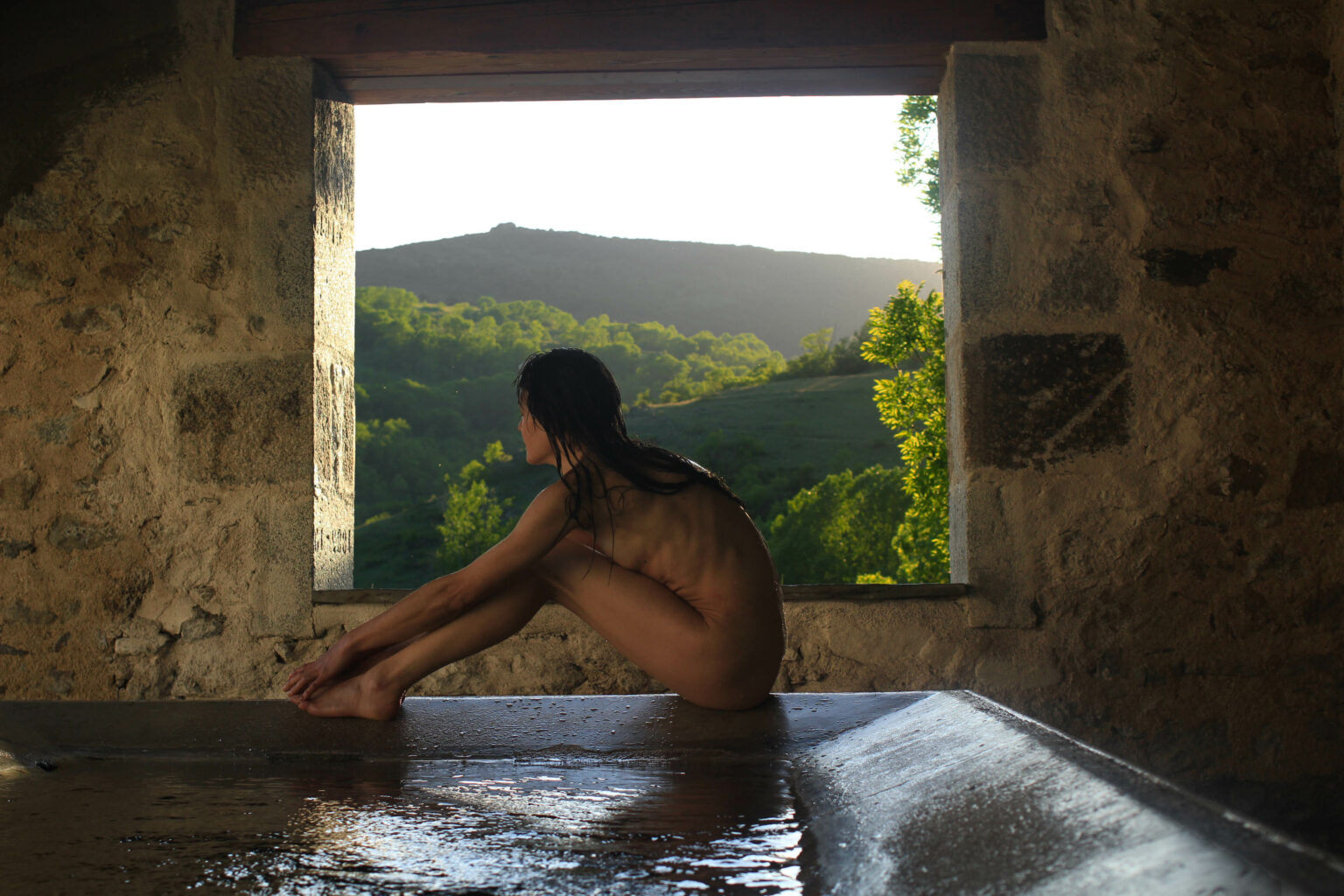
La lluvia limpia.
#galicia #galiciarural #ruralgalego #prexigueiro #ribeiro #ribadavia #ourense #ourensetermal #termas #hotsprings #warmwaterbron #wanderlust #theoutbound #folkgreen #thefolkpr0ject #oldtonecollective #solarcollective #stayandwander #mountainlovers #mountainscape #moodnation #riverside #river #naturephotography #nature #woodland #woodlandwalk #treephotography #treesofinstagram
My apologies. As I am looking at what to post, the list is getting ever longer, so it maybe a considerable read.

Let's start off with a Pan-European article. 
What are the most instagrammable hot springs? Travel and Leisure (Dec. 2020) refer to research by Park Dean Resorts who have compiled a list which sees 4 Euro soaks in their global top 10. 
Alas, only Saturnia (see paragraph below) is the sole natural soak and in a natural setting. 
Blue Lagoon (Iceland) stands at the no. 1 position with nearly twice as many hashtags as the no. 2, Szechenyi, Budapest (Hungary).
In the Top 10-25, another 4 European based baths make the cut, with Icelands Reykjaladur (photo below) the only other European natural hot spring in natural setting to make the list.

❤️
Sticking to Iceland and tops this or that:
  • Pickyourtrail (Jun. 25) has a Top 10 Hot springs in Iceland
  • Happyis (Jun. 9) has 5 Free Hot springs in Iceland:
'Icelandic bathing culture is a tradition that can be traced back centuries. It is definitely an experience not to be missed on any trip to Iceland. Experiencing a natural thermal pool amongst the majestic beauty of the Icelandic landscape is my top recommendation for anyone travelling to this island. So… I’ve pulled together a list of my favourite free hot springs in Iceland, because as the saying goes, the best things in life are free'.
  • Icelandtrippers (Jun. 10) has 10 Best Icelandic Hot springs. And a map.
  • Hekla.com has a recently compiled Top 10 Natural Hot springs in Iceland.
  • Icelandwithaview (Jun. 14) has 8 Reasons why to hike to Reykjadalur, none which endear itself I would think to potential hikers. In the fyi section:
'Yes, you need to get naked in the wilderness with people around. Get over it. In Iceland, nobody cares'.
[Werbung, da Markierungen] Take a bath in a Hot Pool ✔️
.
Gestern haben wir ein Bad in der heißen Quelle von Landbrotalaug genommen und ich muss sagen, nach ein paar Minuten war uns schon ziemlich heiß 🙈 die Quellen sind so winzig, dass nicht mehr als zwei Personen dort rein passen 😵 es gibt dort nur zwei Quellen! Glücklicherweise waren wir allein dort und das bei Abendlichtstimmung 😍
.
.
.
#hotsprings #hotpool #quelle #landbrotalaug #pool #island #iceland #blondgirl #snaefellsnes #travel #travelgoals #travelgoalzs #visiticeland #reisen #reiselust #reiseblog #prettylittleiiinspo #prettylittletrips #dreamyygoals #reykjavik #sunset #love
Reykjavik Grapevine (Jun. 4) checks out the newest addition of less natural hot spring facilities on Iceland: the Sky Lagoon. 
The report is not really worthwhile sharing: it was pre-opening. Cheapest entry pass is nearly €50, so expect or hope to expect luxury. 
ThinkGeoenergy (May 10) adds:
'Ideally located just minutes from Reykjavik’s vibrant city centre, the relaxing and restorative retreat brings a modern approach to traditional Icelandic bathing culture. Features of the geothermal lagoon include an ocean-side 75-metre, (246 ft), infinity edge showcasing expansive ocean and sky views, a sauna boasting Iceland’s largest window, and an overall design inspired by historic turf houses. The project was developed by Canadian attraction and experiences company Pursuit'.
Reviews for Sky Lagoon:
- on Tripadvisor nearly all 5 stars, 
- while Facebook jots down a 4.9 (from more than 50 reviewers) and 
- Google with more than 100 reviews rates the Sky Lagoon a 4.7.

Visir.is (May 22) looks at all these less natural resorts available currently in Iceland and their family friendliness. Apparently that means it's all about pricing:
'Of the places that were inspected, it is cheapest for the family in question to go to Laugarvatn Fontana where it would pay ISK 9,900 for the whole group. However, it would be most expensive to go to the newly opened Sky Lagoon in Kársnes, even though it is assumed that the youngest child will not be allowed to set foot in the lagoon due to the age restrictions'.
There are quite a few examples of geothermal power generation with hot soaking as a spin off. Think Blue Lagoon. ThinkGeoenergy reports (Jun. 17) though on the opposite: swimming pools generating power. 
Krauma geothermal bath has installed a heat exchanger which cools it's very hot waters and now generates sufficient power for it's own needs.

The Reykjavik Grapevine (Jun. 7) has another peculiarity. Apparently a farmer has a geysir is his garden:
'Last week on Tuesday, a farmer was (un)pleasantly surprised by a geyser in his yard, Vísir reports. An old borehole for hot water, that had not been useful for over thirty years, has turned into a geyser and has since erupted several times per hour at a height of approximately thirty meters'.
Sacrifice
Soaking in Europe has always been part of its bathing culture. Following are more on Europe's bathing culture in general.

Sauna. Nude (May 23) has a post on the practice of sauna aufguss:
'The essence of the procedure is that several people go into a dry sauna (90-100 ° C), in which there are hot stones in the middle. The attendant (aufguss-master) pours water with essential oils (mint, orange, eucalyptus and others) on these stones in small portions, as a result of which the steam rises to the ceiling of the sauna.
He uses a towel to disperse the steam, first over the entire area of ​​the ceiling, and then with sharp movements of the towel from top to bottom directs the hot steam, which collects under the ceiling of the sauna, to everyone in the sauna, or to several people at once. Then he again pours some water over the stones, and the procedure is repeated several times'.
The article refers to the pronoun he, as the authors experience is that the Aufguss Meister is nearly always male. My own experience though differs, there doesn't seem to be a specific gender role as such. It's more about the technique of swirling of the towel as well as the ability to cater to and to bond with the sauna guests and make them feel as relaxed as possible. 

Mostlyamelie (Jun. 14) experiences a hammam in Istanbul.
'I read so many Turkish naked hammam horror stories online from other travel bloggers that my curiosity got sufficiently piqued: I just had to volunteer myself on the naked altar of the body scrub sacrifice for the greater good of this blog (I know, tough…) – a rather painful and awkward experience by many if not all accounts, and see what this Turkish hammam nude experience was all about.
...
Unlike some of the horrifying tales I have read online, I feel serene, relaxed, cleansed and my skin feels amazing. I would go to a naked Turkish bath every damn day if I could! It’s such a beautiful ritual and tradition and I urge you to try one if you visit Turkey'.
Odd though with remarks are dated to 2016. And that it was not a 100% naked experience (no, I don't know how much % bikini briefs counts as). 

The author does undergo a German sauna experience (Mar. 16; though again comments are from 5 years ago?):
'Whereas I came here to experience what a nude spa Germany was all about, at the end of the day, these were all very trivial points in the grander scheme of things. I had the most relaxing day ever and, if anything, being naked simply contributed to making me feel really awesome about myself and super relaxed. Not what I expected!'
Maitravelsite (Jun. 28) also on sauna's, but from Finland:
'Few traditions are as rooted to the Finnish way of life as the sauna experience. So much, in fact, that most hotels have them (even if they are North of the Arctic Circle, where I also experienced one) and even families tend to have one in their homes, when they can.
If not, will often visit the closest one for a good dose of extreme heat and humidity.
As a visitor this may seem a bit odd, but when you remember that the average temperature of the country is around 0ºC things begin to make some sense- Finnish people don’t really have too many opportunities to experience heat and humidity, or wear few clothes'.
« While Russia still harbours a patriarchal culture with strict beauty standards for women and a squeamishness towards nudity, the banya is often a space of emancipation, where the body is not sexualised but connected to corporality and spirit. »⠀
Very interesting and beautiful article on the cultural significance of the Russian bathhouse or banya.⠀
Link in bio.⠀⠀
Words by @annartemieva
📸 by @sashakulak⠀⠀⠀⠀⠀⠀⠀
#semiotics #semiology #sémiotique #sémiologie #семиотика #семиология #linguistics #linguistique #humanities #scienceshumaines #лингвистика #photography #photographie #фотография #баня #banya #russia #russie #россия
Back to Nude (Mar. 26). An interview with the author of this blog and the love of the banya.
'8. Have the baths changed your own attitude towards your body and nakedness - and how?
The bathhouse [banya] taught me to appreciate the body, be more restrained and respect it, not hiding it.
It was easy for me to undress, but now it is free.
The interview is in response to an article in the Calvert Journal (Feb. 26) by the Nudeblog author Anna:
'Anna Artemieva started @nudeblog — a dedicated blog sharing the best of banya culture, aesthetics, and expertise — in 2017. She had been inspired by a trip to Finland to explore local sauna traditions and ceremonies, a journey that made her reflect on the importance of the bathhouse in Russia. Over the years, she has educated her readers and contributed to a growing banya renaissance, as more and more young people become interested in bathhouses as a part of contemporary Russian life. Together with photographer Sasha Kulak, she has also explored the way that banya culture shapes how people look at the naked body — and especially the female body). While Russia still harbours a patriarchal culture with strict beauty standards for women and a squeamishness towards nudity, the banya is often a space of emancipation, where the body is not sexualised but connected to corporality and spirit.
...
The banya takes away the taboo of corporality. It exposes us to the body simply as it is, without projecting our own thoughts, ideas, and prejudices upon it. The banya has taught me to appreciate my body, to openly respect it and treat it with care. I have always felt free being naked, but I have learned to appreciate the special beauty of the moment thanks to the banya. Nudity is not about obscenity, but about purity, soul, and spirituality — and you can find all of those things in the banya itself'.
A very interesting article with good photography.

A different take on German sauna culture. 
Mostly these articles are by surprised / curious bloggers who are suprised / content with what they experience.
Meanderingnaturist (Jul. 2021) has an updated article referring to the differences in German spa's and their respective clientèle (and how they act naked), though the places visited are basically all in or around Berlin. Times of visits, places and aura determined very much who were also visiting, nothing new there I suppose. Conclusion:
'What did the study prove? Well… naked humans are simply human, but naked! Profound… I know! 😐
Surprise
pinktinkerbell76 in the south of France:
Finde de relax amb la millor de les companyies 💦☀️🏕
Seeing it's been quite some time since more in-depth and short notes have been sent your way, there's rather a lot to share.

For instance this article I stumbled on. 
Eldario.es (May 17) reports on a Roman bath house find on the Spanish coast near Cabo de Trafalgar. Dating back for possibly 2000 years it has been buried for centuries under sands and had only recently reluctantly revealed itself. A dig ensued. From the article and translated:
'... have found that it is a sophisticated rural thermal complex, which had a hot air circuit fed by an oven that emanated through chambers in the floor and in the walls.
His hypothesis is that these hot springs would serve to provide a hygiene and leisure service to the workers of the traps, salting factories and aquaculture in the area, jobs that surely impregnated smell and dirt to those who used it'. 
Archaeology (Jun. 2020) also reports the finding of a Roman bath; this time in the town of Baden, Switzerland:
“We thought we might find the bath here, but it was still a huge surprise when we saw that it was in such good condition,” said archaeologist Andrea Schaer of Bern University'.
A website dedicated to lavoirs. What were lavoirs? Their website:
A lavoir is a public basin for washing clothes. The washhouse is supplied with water either by a source or a stream, generally covered where the washerwomen washed the laundry. Some were equipped with fireplaces to produce the ash needed for bleaching. In stones, bricks, or more modestly in wood or cob, they deserve to be preserved.
I hope you understand that we are still talking about the past, there are precious few which see any public use nowadays.
The website jots down each and every lavoir in France (current database numbers 19,670!), clearly a lot of dedication involved.
So why share this? 
Entrance number 66800 is a lavoir in Llo (Pyrénées-Occidental). Situated at the back of the thermal baths it's noted to have a temperature of 33C. Which means that nowadays it could double up as a warm soak. Or as place to photograph a model:


More historical baths. The Lamp Baths of St Petersburg have reopened (topspb, Apr. 22):
'After a long renovation, the Lamp Baths are opening in St. Petersburg. This is one of the iconic objects of old St. Petersburg, which has been under restoration since 2014. To the credit of the owners, they have preserved not only the historical appearance of the building, but also its historical purpose'.
Rolling
Then more topical notes.
Starting off in Italy.
Tusciaweb (Jun. 7) reports on long term hot springs activist Giovanni Faperdue. Not only has he won his battle to ensure public access to the hot waters surrounding Viterbo (Lazio), but he is now accorded with taking a political position in the Lega Nord party, as head of their "dipartimento termalismo".

From here just slightly to the north. Traveladdicts has an article (May 10) on the Saturnia hot springs (Tuscany), that instagrammable soak. Heed this advice:
'Moderate your expectations
The springs are free, so it is helpful to think of them a bit like your public swimming pool. You’re likely to encounter kids splashing and playing, obnoxious tourists, people hogging the waterfall baths, and other inconsiderate behavior. Just roll with it'.
Down south, PRNewswire (Feb. 1) has an in-depth look at Naples geothermal pizzeria:
'In essence, Enzo Albertini reveals that what gives the geothermal pizza its signature qualities is that it is prepared and in tuffaceous chambers in which it leavens for 24 to 48 hours and is then baked in a tuffaceous oven. More specifically, this unique combination of history, geology, archaeology and cuisine can only be found in this marvel of a place - Naples Underground (Napoli Sotterranea)'.
Elsewhere. Vidviday (May 14) notes 
"5 reasons to visit thermal waters in Kosino". 
They will tell you everything you need to know. Kosino, btw is just over the border from Hungary, in Ukraine.

Looking for (potential) hot springs in Hungary? This Geomap assists with an in-depth overview of all boreholes.
Péterpictures knows a couple of unknown hot springs / boreholes north of Budapest, such as below:

Mothers day! ❤️ #mothersday #mother #mothersdaygift #naturalhotsprings #hotsprings #hotwater #thermalsprings #thermalbaths #hungary
Proininews (Jun. 7) reports on the annual opening of Krinides mud baths (Greek Macedonia). 
Travelpassionate (Oct. 2020) has an recent extensive 'how to' guide of these mud baths, while Greececonfidential (Nov. 2020; photo below) shares an experience as well as Midnight blue elephant (Sep. 2020) has likewise.


Beautiful hot springs even? Greekcitytimes (Mar. 28) names the nations most beautiful. But also therapeutic. I counted 8 contributions, which is just a small part of what's on offer in Greece.

And then to log off, a slightly older find (Oct. 2018). Tim-sara account of soaking at Thermopiles (Central Greece):

'The reason we went to Thermopiles in the first place was that it was marked with a little star on our map. You should absolutely go there if you love hot pools! Beautiful in winter with more than 40 degrees celsius.
At the main gateway UNHCR built a refugee camp, so at first you don’t really know what’s going on. That day the baths were reserved for women so we decided to park our van a few hundred meters down the river and enjoyed three days right by the hot sulfur pools!'