Showing posts with label thermal spring. Show all posts

Sunday, December 16, 2018

Correct


The second part of Sascha's report on Băile Herculane.

In the previous part we looked at the general overview of the village and it's springs and with some detail at Băile Venera.

Picking up from here, Sascha continues:
'Ceausescu Hot Springs
Just in front of the Băile Venera springs another hot spring is coming out of the wall. Soaking Romanians told me that the water comes from another hot spring that fed in the past a hotel that belonged to Nicolae Ceausescu. 
On the picture [above] you can see the ruins of the hotel with the two smaller roofs. 
I tried to check the hotel, but the entrance was closed. Even if it is easy to enter on the hotel ground, I was not in the mood for Urbexing and preferred to stay in the pool at the river. 
No idea if this hot spring has an official name, therefore I suggest temporarily to call the spring Ceausescu Hot Springs.
The water was 48°C hot but mixes up to quickly with the cold water from the river. The bottom was quite muddy. 
The more comfortable soak was clearly on the other side of the river at Băile Venera'.
Well, we might have to use the correct name. travelguideromania:
'Opposite it is a circular building with a conical roof accommodates the Neptune Fountain II (Stomach Spring). Its water is good for diabetes. We continue upstream on the banks of Cerna to arrive at Baia Neptun (also known as Austrian Empire Baths). It is one of the most imposing buildings from Herculane Baths having its own bridge over the Cerna river'.
Pumped

After possibly naming a no name hot spring, the next on offer is actually named no name by Sascha:
'No name hot spring in Băile Herculane
Continue the walk on the right side of the river (where Băile Venere  is located) and you will come to an unpopular hot spring of 38°C. 
I didn't see people bathing here, maybe because the entrance on the street was closed, maybe because of the noise of the water pumping machines right behind [the soak]'.

Massed

We now move towards Hotel Roman (Facebook), so-called because:
'In the monumental structure of the hotel [Roman] building, the old Romans Baths are incorporated. Inside, there is still an ancient bas-relief depicting the demigod Hercules. To see the remains of Roman baths you have to enter the hotel. Unfortunately this is not mentioned anywhere on the outside'.
Sascha:
'Hot springs close to Hotel Roman
The next hot spring is a bit out of the town, but still at a walking distance.
Cross the town on the left side of the river and head to Hotel Roman. It is one of the old hotels of the 80s that are still open (at the moment it is a 2 star hotel) and needs urgently a renovation. At the hotel, it gives the impression that the road ends, but it continues under a kind of tunnel and goes straight to the national park.
Around 100 m after the hotel you will find the hot springs. When you walk you will see them immediately, but probably not when driving in a car.
The water varies from 40°C to 42°C. Two concrete pools are on top, that create two waterfalls that feed the lower pools with another stream. Therefore, the lower pools have more or less the same temperature than the concrete pools. It is advisable to soak early in the morning or late in the evening when the masses are back in their hotels for dinner. It is probably the most natural hot spring in the area, and it is always great to find a hot spring that gives possibility to refresh in a cold river.
Very closeby starts a hike to two caves that are special because they are heated by natural hot gas. Do not expect sauna temperatures, it is more a humid subtropical climate in the cave'.
Barepockets describes a visit to the soaks of Roman hotel:
'Two outdoor hot-water pools await climbers in front of Hotel Roman, right on the banks of the Cerna River. These are not as smelly or crowded, but freaking hot! Luckily, there’s a solution. People improvised a small dam on the river where thermal water mixes with the river’s. And if you feel like swimming, Hotel Roman has an indoor hot-spring swimming pool'.

More on Hotel Roman itself.
Tripadvisor gives it just 2.5 stars based on 18 reviews. Examples:
'Dirt and communism are oozing from every corner and crevasse, and there are lots of crevasses....The basement with the Roman baths is a gem, like the entire falling apart town'.
Agoda reviews are similar. 

Wednesday, July 31, 2013

Suffered modifications


Die Hard
Traditions die hard. And Europe's love to it's thermal bathing traditions are no exception. 

In spite of the world moving on, many of Europe''s hot springs remain stuck into enclaves of pre-WW II practices of being enticed by the waters. Appealing to citizens with time on their hands, a hot spring resort in Europe seeks to entertain soakers by offering a plethora of water based activities overlaid with medical thoughtfulness. And the thermal establishment will determine what you will get. And did you know that the waters are natural? Because they are, even though we have built, rebuilt and redecorated everything such, that naturalness is not something we connect with thermal bathing ...

Steeped in traditions such as Calvinism and Catholicism, actual enjoying while soaking in Europe seems to be an afterthought. Appealing to the new generations, which are a slightly more hedonistic and in for new experiences, is totally dismissed.

Caldes de Montbui, located just outside of Catalunya's capital of Barcelona, (north-east Spain) seems to be world's away from that magnet of everything hip, happy and hopeful, Barcelona itself. Spend a day in Barcelona you will be touched by its' diversity, its' youth, its' connection to the past and its' positivism. 
Built with cement, Barcelona combines a vibrancy which is evoked in it's football, architecture, avant-garde art, sports and cuisine to name a few. 
It manages to combine a non-descript natural setting into a home for the lotus eater. Just take a look at its' beaches, late afternoon, where everyone (with exception of the traditional tourist, still caught up in a spiritual fervour to stand in line at one of the paid attractions) can be them-self: an individual.

But Caldes is none of this.

Inside
Located only 30 km's from La Rambla, there's precious little evidence to link it to that metropole. Even the bus ride out to Caldes takes near to an hour, adding to the air of distance. 

The town of Caldes de Montbui is essentially a small village which caters to many professionals of the outer Barcelona suburbs. 
With the exception that it is steeped in history and is still seeking to run this same gambit. 
Gone are the Romans which set up store in Caldes to take advantage of the thermal waters. 
But where will the new tourists come from? The search continues ...

The use of the thermae of Caldes de Montbui dates back long ago, even to before the Romans arrived. But at least the Romans put in an effort to construct something lasting. Even today these can still be evidenced (they are the best kept Roman thermae on the Iberian peninsula), but a fence around the ruins precludes further exploration. 
Behind the fence one can witness a large (but empty) pool, an arched roof and off to the side further rooms (?). This was the hottest part of the thermae (caldarium) and excavation has revealed that what remains was just a small part of what once existed.

 
The main square of Caldes de Montbui: straight ahead are the renovated ruins of the Roman thermae, adjacent to the left is the museum. Right the Boquetas spa hotel.

Inspired by their remains (and supposedly some hefty sums of subsidy), a small museum has popped up next door, aptly named Museu Thermalia. Inside are located the local tourism office, a number of local products for sale as well as a two story exhibition on Caldes' thermal past and a floor devoted to Picasso insider and sculptor Manolo Hugué who lived in Caldes de Montbui for 17 years, where he also died.

The exhibition on the thermal past includes a number of scenes set to re-create of what is believed to be the living past. Below are a number of plates from the exhibit which give a better overview of what the place would have looked like and show the womens (?) sudatorium (vaulted steam room, top left; did they have separate bathing facilities?), individual baths (top right), the gymnasium (bottom left) and the apodyterium (entrance) supposedly in use (bottom right).

Contemplating afterwards, to me, the museum is quite interesting. 
But I've seen this before in Spain at the Termas de Bande: museum and all, but no other visitors besides myself? Is it just a chicken and egg situation? Or not?

Gossip
Directly opposite the museum and the adjacent Roman thermae is the Font del Lleó (Lion fountain). This spring gushes forth very hot (74º C) water. Built in 1581 and renovated later in 1822 (source) the current set up dates from 1927.

 
The lion gushing forth.

Behind the museum lie some medieval walls as well as some left-overs of what look like watermills, dating back to the 1500's. The subsidy programme has afforded to construct a walkway along the banks of the small Boquetas stream, culminating in a washing place, otherwise known in Catalan as safareig (which literally translates into English as laundry room).


Safareig or their equivalent in Spanish, lavadero publico (see above), are phonomena found in and around the Pyrénées and the rest of Spain. Water streams are diverted into tubs with big washing stones adjacent. 
Though a safareig could also refer to larger water reservoirs.

In Caldes, the Safareig de la Portalera, one of the two remaining reservoirs (the other the Safareig de la Canaleta), is a long pool, approximately 10 meters by 2,5 meters wide. All around this is a ledge made to assist in the washing process. 
Typical of the nineteenth century (source), the safareig was restored just a few years ago (source) a feature which got highlighted on national television. Sourced from the aforementioned Font del Lleó, it means that the temperature of this bassin is still quite high. This source also mentions that the waters are refreshed daily.

Somewhere in the past this safareig was heavily used, but not anymore. 

A different kind of use can by found from the Catalan Way blog. It describes a visit to Caldes de Montbui. During the visit there is also an art performance in the Safareig de la Portalera itself. On it's past use, the blogger mentions the following:
'This performance took place in a Safareig - a communal wash house that uses the natural hot water and has a large central stone tub where women used to come to wash their laundry and talk. There is a Catala phrase 'fer un safareig' which means to gossip - a word that in English has some negative associations but which I think also describes a vital and caring way of passing on news about your friends aquaintances and family. Womens communications - so many words that are pejorative - nagging, bitching, gossiping....
This town now also has a large community of people from Mali and some of these women have begun to use the Safareig as a meeting place and for washing clothes again. There are three Safareigs in Caldes and one of them seemed derelict and sad although as part of the project it was being used as a grafitti house where you could write your desires on the walls.
At the end of the performances people were invited to have a hot bath in the tub - I dangled in my feet and legs but wasn't tempted to plunge in when it started to fill up with hot steamy bodies'. 
Safareig de la Portalera

Well, there were no steamy bodies other than the steamy body of water. An elder man did emerge from a garden nearby to collect a can full of water. But no evidence of anyone doing their washing here. The pristine surroundings would suggest that a plunge is not entirely a common practice.

There are quite a few video's available on the subject of Caldes' safareigs, such as this one: 

Time to retire
We wandered back to the village square past the Termes Victoria. It's website adds to our growing knowledge on Caldes:
'Water comes out at a temperature of 74ºC, the highest in the Iberian Peninsula, but the most important thing in the mineral medicinal water is the minerals it has. In our case, the waters contain sodium chloride and fluorides. These kinds of waters are best for stress therapies, fracture recovery, rheumatism, degenerative osteoarthritis or arthritis'.
On history of the Termes:
'The origins of the Hotel Termes Victòria go back to the 17th century, although no one knows exactly when it was built. Initially, it took up several medieval buildings and even part of the old walls. Throughout the years it has suffered many different architectural modifications, but it preserves original elements such as the vault of the baths, from the 18th century.
Despite its modern facilities, the hotel is still run familiarly, since the 1850s, by the family Anglí-Palaudarias.
The Hotel Termes Victoria has maintained a selected and loyal group of guests. From King Alfonso XII to painters and writers in search of peace and tranquility for their inspiration. It has also been an ideal place for the meeting of teams such as Ladislao Kubala’s FC Barcelona. He loved thermal treatments'.
What we don't gleam from the above is that in it's heyday there were no less than 8 facilities available for thermal treatments in Caldes de Montbui. Now however, this has dwindled to three: the above and two other places both part of the Boquetas group. Which in fact comprises just those two.

The Vila de Caldes hotel seems quite a flash place and the prime part of the Broquetas group. Located away from the old town square visitors, the hotel web site fails to provide much other info, than that a room price and some vague references to thermal treatments. Hotel booking site booking.com gives this it a  7.1, in comparison to Victoria's 7.7. Both on the negatives as well as on the positives there is little between the two. Do note Victoria's guest Vincent's negative:
'Guests very old felt more like a retirement home than hotel'
I doubt the other thermal venues would be any better. Bathing in thermal waters is apparently something of earlier generations ... Europe-wide!?

Tripadvisor also puts Victoria ahead of the other two, 4 stars. But do note this visitor, msr38 comments:
'Another negative is that the average age does not fall below 80 years, which makes the services offered by the hotel are only aimed at this sector of the population'.
Tripadvisor does note a huge difference, giving Vila de Caldes just two stars ....

Geriatric
If only we had known the following on forehand, we might have never tried out the Broquetas hotel spa. Tripadvisor hands out 3 stars, there being a mention or two of geriatric clientèle / staff .... Booking.com comes to an mediocre average of 7.3.

View of the town square looking onto the Boquetas spa hotel.

Balneoario de Boquetas looks a little less smart than the Victoria and we saunter inside. The receptionist is busy on the phone and decides then and there that we must be soakers and points out that we must go around the back of her office.

Behind her office is another desk, that of the bathing receptionist, who also manages some English. She explains that in spite of some of the bathing possibilities on offer being over the 20€, the going tariff today is two treatments for 16€.  Even that is quite steep, but who knows there are also personal touches making it well worth the hand-out. Our number one choice is of course a thermal bath (they have no pool?), number two is less clear. After a lot of consideration by us and the bathing hostess, we all settle on the high pressure water massage.
Everything is added up (use of bath robes are free, but we need to pay for slippers) we are then directed to return to hotel receptionist to settle the outstanding amount. She is still busy on the phone and after I hand her a note of 50€ I neatly receive 50€ in return but in notes of smaller denomination. Bathing receptionist lady sighs and settles the payment herself.

The formalities out of the way, we are directed to two small changing facilities, down a hall, down another hall and there we are. The main hall is apparently Catalan modernist and looks very nice, but also dated. But who knows when something is dated and when it returns in vogue?
Anyway, after changing in the barely enough space for 1 person changing rooms, we are directed to a door on the side of the long hall. Behind the door lies an L-shaped pool, approximately 4 by 4m. We are allowed the privacy of our private bath, bathing lady turns on a switch which will mean that we will have 20 minutes of jets and fountains in which to soak. Instructions are to report back in the hall afterwards.


Not quite the Roman sized bathing pool: what you see is what you get.

After the 20 minute soak we report back in the hallway and we are afforded entrance to the water massage room. The 5m long room has a chair on the door side, a contraption resembling a fixed fire hose and on the far side are two aluminium brackets, a meter high. An explanation follows: the volunteer is put up against the wall and bathing lady fires water thereby simulating a massage experience. At set intervals one is told to turn, so in the end one is blasted from all sides.
'Naked or not?'
Up to ourselves, which is both a relief and a concern. The answer lies in the lead photo ...

Anyway in the end it is quite relaxing having a high pressure massage, something different at least. I note that this kind of therapy is quite common in some less up to date centers of wellness. Think Eastern Europe.

Modernist
The hotel web site adds some info on the past:
'The activity of Broquetas Spa began in 1729 when its founder, Salvador Broquetas, built the first bath house where the current spa is located, giving it his name.
The first still-standing reconstruction is from 1770, when the initial spa was enlarged after acquiring the Can Vincenç hostel. 
...
Initially the spa was a building with three floors that towards the end of two centuries of existence it had once again been enlarged in order to include even a private park for our clients.
The predominantly modernist style harmoniously melds with the more heterogeneous areas that resulted in successive transformations'. 
The web site Balnecat adds:
'In 1729 Salvador Broquetas built the first bathhouse in the current spa called Spa Broquetas since then. The modernist building has some areas of great architectural value and is part of the overall architectural monument protected in Caldes de Montbui.
Inside, there are many elements that betray the influence modernist (scales, the Hall gallery bathrooms and balconies), with a spectacular mix of stained glass, lamps and marquetry. Sculptures, tapestries, paintings, and especially one of the largest collections of owls known, the most generous of Spain, are other interesting elements that can be found'
In total the fun has lasted an hour, it's time to find out where the changing rooms were, dress, admire the owls (?) and get ourselves a lunch.

And lunches in Caldes de Montbui turn out to be surprisingly easy and tasty. Back to return to Barcelona!

Epilogue
All-in-all, Caldes is a nice break and quite interesting in itself. Don't however come here with a thermal treat in mind. You might just be disappointed. It seems that the bathing facilities are yet to catch up with the 21st century, both in ambiance and in service. 

Having bathed in hot springs on 3 continents, I still fail to see why thermal baths are required to be small cubby holes and I have some questions on the pureness of the water, it certainly wasn't filled why we were waiting ... 

Probably for too long, thermal retreats have been able to make ends meet by focussing on an ageing clientèle. Not so any more. From many of the remarks in the reviews I noticed that the reviewers were young and were out of sync with what was on offer.

Getting to Caldes de Montbui is not too much of a trouble, the Sagalés bus company drives there half hourly from Barcelona's Fabra i Puig bus station, the journey taking up to an hour.

On youtube I found an overview of the sources and safareigs:


Inside the thermae 

Sunday, May 12, 2013

Conception

 The snow-capped mountains of Kaimaktsalan on an early May Sunday

God
Natural soaking in Europe tends to be a fringe activity: the closer to the fringe of what calls itself Europe, the better the chances of a real natural soak. 
And with real I mean not some over-medicalised, over-wellnessed place but a place where water gushes from the earth and where you can bathe in un-adultered H2O preferably in it's natural habitat.

Greek Macedonia is one of those European fringes and thankfully the geothermal god(s) (Poseidon? Amongst others he's the god of earthquakes ... Or Tethys, mother of springs?) are favouring the mountains of this gorgeous place of the world. 

Blessed with a fair doses of sun and welcoming natives there are still a few soaks to be had in natural and little enhanced bathing sites.

Forthcoming
And hot springs hardly come less spectacular than those of Loutra Pozar (sometimes known as Loutráki; note that a hot spring with the same name is located in Korinthia). Loutra Pozar is located in Edessa (Pella region, Greek Macedonia). 

Where the local stream enters from it's hiding place behind the high mountain cliffs of Kaimaktsalan there are a number of springs set alongside the swift flowing river.

The river itself is quite spectacular. Precautionally a number of man made waterfalls have been created each dropping about 5 meters at a time. This to let the river drop speed before it gushes onto the plains.

Under and aside of at least two of these falls, hot springs come forth. 

Stuff of what dreams are made of ...
The lowest of these two pools is surrounded by a restaurant complete with changing facilities where visitors must pay the 2€ entrance fee for use of the facilities and the better soaking pool. 
Inside the building are more bathing facilities (see below); but why come Trans Europe to soak in a chamber cell?

There is still nothing better than soaking in warm water with the river crushing down just meters away.

The next waterfall upstream has a non-enhanced more natural but smaller pool. Above this cataract and beyond the waterfall, a half size Olympic pool has been constructed with a packed terrace; this being Easter Sunday. Many a visitor seems to be more interested in soaking up the looks of potentials suitors ... Well sort of at least. Not my cup of tea.

Poolside: packed

Away from the hedonism, on the opposite bank is a small pool which after a little inspection proves to be a hot spring. No soakers taking an interest though ....
You think it's a hot spring?
Beyond all this though are the added wonders of near limitless tracks and trails heading up, in all directions along the valleys and up the still snow covered mountains (see above).

 
Great falls
After a mild walk we return to the smaller more natural pool and join others in the delight of soaking next to the gushing river. The noise of other visitors is drowned out by the crashing falls. This pool even has it's own massage jets, naturally powered!

Just big enough

If any comment would be required, it would be that there is an absence of pure natural outdoor soaking, as natural as possible of course ...

In general the soaking site is well laid out and neatly organised. There´s quite a lot of parking space. Near the first parking space is a small market where local produce is sold.
Mental
The best site for more info would be that of the organisation running this nice show but somehow their English is a bit scratchy. Example:
'A visitor takes care of personal physical and mental hygiene in the entrance of the outdoor pool Pozar, leaving the gurgling warm water to act with beneficial properties. Receives the therapeutic properties of spa water in the hot Pozar'.
The organisation is actually a local municipal set up, apparently:
'Since 1990 the spa has been under the administration of the communal enterprise "Loutra Loutrakiou Pellas" which nowadays is an immiscible [= 'Not forming a homogeneous mixture when added together'] municipal enterprise'.
This hotel web-site has the following information to add:
'The temperature of the thermal water baths in Pozar, at the 6 main hot springs is 37 degrees Celsius. One can enjoy the water in one of the specially formed private swimming pools (privet spa), internal steam spas or at one of the also internal 40 bathtubs. The adventurous ones [?] can make use of the large outdoor pool with hot, running, spa water during both winter and summer.
For the even more daring ones, the countless waterfalls with running healing waters along the riverside and the 5 natural lakes where the hot water steams from the ground create the perfect setting for relaxation through a natural hydromassage'.
Note the many ways to sell a hot spring to the public. Locally Alex is a hot selling topic:
'Immerse yourself into natural therapeutic waters as Alexander the Great did over 2.500 years ago. The Loutrá complex has adopted a modern luxurious spa profile offering invigorating therapies for your body and soul.
The Pózar Thermal Baths boast two modern hydrotherapy centres: the one comprises 48 private thermal baths, 2 indoor pools and 2 private hamams, whereas the other, founded in 2005, boasts 6 modern beautifully decorated private thermal bathing pools with artificial waterfalls.
Visit also the outdoor facilities of Pózar Baths: let the sparkling waters of the waterfalls flow through your body, or go for underwater swimming in the big outdoor thermal pool. No matter how cold the weather is, the water temperature remains steadily at 37°C!'
More info:
'Recommended for rheumatic, dermatological, gynecological, and respiratory and circulatory system conditions, the hot springs of Pózar are beneficiary for everybody’s health and well-being not just while bathing in them, but also when drinking their water. Still, that’s just half as natural and healthy as you can go'.
Tripadvisor rates this a five star attraction, based on 9 reviews ... That's not bad ...

There's also quite a few youtube vdo's out there, here's an example.

Note this visitor report:
'Nevertheless, most of the visitors drive up here to enjoy the warm water and majestic surroundings and it is common knowledge that hundreds of local children were conceived in this romantic setting'.
What else?
Besides the already mentioned hiking trails, a quick day visit to Loutra Pozar may be combined with a visit to the spectacularly located town of Edessa. Perched on a slab of mountain high above the eastern plains Edessa is wellknown for it´s waterfalls; the local river dissects the town and drops off the plateau on the edge of town.

 
Edessa drop off

Elsewhere in the same region are the hot springs of Loutrohori. More info on these:
'Further south and some 20 kilometers from Edessa lays the village of Loutrohori, which is also adorned with hot springs of water rich in minerals such as sulfur. Their healing qualities are recommended for skin diseases, rheumatisms or arthritis'.
p.s. Artemis is actually the protector of hot springs ... (source)

Saturday, October 13, 2012

More modern


Fortunate fame
Forming the border between north Portugal and Galicia, Spain, the Rio Miño (Minho) flows through a depression which sees many hot springs. Deeper in Galicia, the city of Ourense, on the upper banks of the Miño, seems a magnet for Spain’s hot springs with 8 hot springs surrounding the city. Furthermore there are possibly hot springs Os Baños.

The Portuguese side have fared less fortunate in the possible soaking section. However the two towns of Monção and Melgaço are known throughout Portugal for their hot spring fame.

Commercial
Monção is a former rampart town, set on a cliff just south of the river. Through the centuries it served to exist in turning away the northern invaders, hoping to maintain it’s allegiance to Lisbon. The town is now a commercial center in the surprisingly green rolling hills, jam-packed with vineyards producing the light white wine which is the famed Vinho Verde. Eastwards of the village however a thermal center has existed for some time.

On my visit it seemed to be a more public facility, but still entrance requires a doctors' visit. This rules a recreational visit for 2 over-expensive. Despite this though we could observe other visitors (patients?) visiting the facilities. 
For a moment we are hoping that towards the Rio Minho is a more public and inexpensive facility. But no, the kids jumping in this pool are jumping in a normal swim pool, not fed from any spring. Surrounding the facilities is an extensive park with café, playground and fitness park. Lots of visitors here.


The termas themselves, are run by the Spanish wellness company Tesal which claim that they are possibly the most modern spa of Portugal. Opposite the soak is the hotel, called Bienestar. Tripadvisor gives it a meagre 3 stars, while booking.com offers 7.4.

There is a youtube intro film of the hot spring facilities themselves. 

 One of Melgaço's springs

Swinging
Twenty km upstream of Monção is the smaller town of Melgaço, set at the foot of the mountains of Serra de Peneda. Just outside the town, actually part of the village of Peso, is a fin-de-siecle park complete with buildings forming the thermal station. As is customary in other Portugese soaking sites, there is a huge building with the the opportunity to sample the waters by consuming a plastic cup fill. 

 
Opulent constructions for a plastic cup of pure water.

Seeking the soaking building it becomes apparent that these are being rebuilt / refurbished and as such closed. The action was in full swing, so expect these to open up, in the near future. Termas de Portugal suggest 2013. And then these will be the most modern soaking facilities of Portugal (?).

Entrance to the buvette.
 
More info is available from the Portuguese wikipedia website for the Melgaço, facts which include that the development of the site started from 1884. This website adds that the termas are situated on a 2 ha park which includes a campsite. 

 
The main soaking building (under reconstruction)

Jornal de Noticas mentions in an article (18/05/2012) writes the following:
´In this first phase was invested one million euros in landscaping and in the recovery of sources, plus the installation of a mini-golf and rehabilitation of a small stream.The remaining investment, over 3.7 million, is reserved for the contest that the management of the Northern Regional Operational Programme - "ON2" - opened in April, with 80% of this money will be supported by EU funds."It involves the recovery and expansion of the resort, now in ruins, but keeping its architectural as well as the construction of a Museum Thermal," explained the mayor of Melgaço, Rui Solheiro, Lusa.The complex is owned by Unicer group, which also operates the capturing and bottling that water, but that has delivered management space, with an approximate area of ​​59,600 meters square, to the municipality.All these works are the responsibility of the municipal company formed by the local authority and private, that after the investments will be in managing the Thermal Park Melgaço for 25 years´.


Tuesday, August 14, 2012

Aquistas


Waters
Portugal boasts it's fair share of thermal hot springs. Though wikipedia seems to be oblivious to this, Termas de Portugal counts 38 termas (Portuguese for hot spring) as it's members, a figure the excellent (but Portuguese language only) Águas Termais attributes as those hot springs for which commercial concessionaires exist.

The former adds a number of now dried up geothermal springs, as well as partial geothermal and quite a list of commercial mineral water bottlers. For one thing has become apparent on my visit to the Portuguese termas, and that is the fact that the Portuguese like their waters ...

(Do note though that confusingly the area around Furnas on the Azores island of Saõ Miguel counts no less than 22 hot springs, none of which were counted in the above mentioned ....).

Certified
Portugal and hot springs go back a long way and it seems that like many of the other European cultures the Portuguese prefer the medical benefits of thermal waters. Sod the socializing.

Thus it has seen fit to transform their natural springs to scenes of medical dedication. Such that if you would even remotely dare to take a soak, a doctor will have to certify whether or not that need be the case. Naturally forking out 50€ or so, just to be told that "yes, you can take a soak" seems to fend off the touristy type, in need of a one-off soak, the hippy or the novice.
What remains are a geriatric generation who do need to heed the doctors advice, who stand to benefit most from the waters and whom have the freetime to say use the advice taken to stay for a week or two of great soaking ...

Even the art of sampling the waters with a couple of sips will sometimes require a signature from yourself absolving the termas of any liability in case you just might keel over or die. Or less.

Aquistas of Chaves
Any road, one of the 38 concessions mentioned in the first paragraph lies in the town of Chaves, Vila Real district, glued to the northern border with Spain. Serving the wider mountain region, Chaves (pronounced as chaaves, as in chives) has seen quite some historical turnovers leaving it with a long Roman bridge and a number of forts and towers which in some time had managed to either keep conquerers at bay or dissuade would-be liberators from freeing the town.
Naturally, it lies along the banks of stealthly slow flowing Rio Tamagas and boasts of it's bathing waters. Well, this blog will see if the boasting is fair!

Chaves by night

The wider region of Chaves though, to it's credit, does mention in the local tourist brochure, an upswing in aquistas (persons who undergo medical treatment by bathing in thermal baths). The upswing is thought to be due to the increased awareness to health and well-being. Unfortunately the brochure (produced by the Alto Tamega e Barroso tourism office) is undated and also unsubstantiates this trend.
Specifically it adds for the termas of Chaves:
'The medicinal properties of the thermal Spa of Chaves were discovered by the Romans, and soon became an ex-libris of the city. They are the most accredited spas in Portugal, having the hottest thermal waters of Europe. All year round they are visited by thousands of people finding treatment for rhuematism, nutrition diseases (obesity[!], gout and diabetes), disorders of the liver, intestines and hypertension'.
Operator Termas de Chaves supposedly (poor translation?) adds on it's Portugese language website that the waters are unique for the Iberian peninsula and facilities are geared to receive 15,000 'patients'.

Then the charges:
  • just 35€ for the doc, 
  • but then 30€ signage fee and 
  • another 20€ for nutionist.
That´s just €85. Oh, and then if taking a soak, add the mere €5,50 to that figure.

Sourced
Other excellent info from the Wikipedia Chaves entry:
'The hot springs (Portuguese: Caldas) were known since the Roman period, when the town was Aquae Flaviae; the Waters of Flavius were an important social gathering point, but fell into disuse as the town was slowly abandoned by attacks.
...
The waters of the spring, that are captured in three springs within Chaves, have mean temperatures of 73 °C (163 °F) (the hottest bicarbonate waters in Europe). The modern spa industry in Chaves use these waters for numerous treatments, including stomach, liver, intestinal, and kidney ailments, through oral ingestion. Many small guesthouses in the old part of the town are dependent on the influx of these visitors. The thermal spas are located between the castle and the river, in front of a large area of grass-covered park with playgrounds and tennis courts'.
There is actually an archeological dig in the center of Chaves not too far away from the hot spring, in line with the bridge which should contain remains of some original roman spa, but as there was a high fence around it, can't verify this ...

Flickr member frproart has a number of photo's before the fence was constructed.

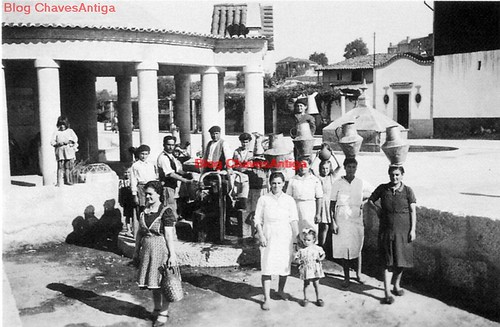
The spring in the old days, possibly before WWII. Source

Sampling the soaking source
So I skipped the soaking part, but decided to nose around. Besides the intense medicalisation of soaking process here, another aspect of Portuguese hot spring culture is the ability to sample the waters by drinking. Thermal springs of the official kind cater to the vox populi: free glasses of water.

 
Fill her up please. Inside the Termas de Chaves buvette

In a building alongside the spa there is a nurse like figure doling out plastic cups of water straight from a tap, we hope that's connected to the hot spring. The water is not hot and has little taste. To fully appreciate the flavour of this plastic cup of water, there a number of chairs and benches, mostly occupied by the elder part of the globes population. There's not much I can say about the water though I do like this tradition, a buvette [refreshment stall] along the soaking facilities.

Outside the buvette is supposedly one of the aforementioned three sources. Steam rises up with a faint smell of sulphur; the only actual hint that something geothermal was apparent.

 The source


So you may have guessed, I didn't soak at all.

And from the lack of sources, neither have many other netizens ...