Showing posts with label bagni. Show all posts

Sunday, October 16, 2022

Strike off


On my wish-to-visit list of natural hot springs in Europe had been the Bagni di Craveggia.
A rather remote Italian hot spring, though not too difficult to reach, if only using the Switzerland route.
Run down and ruined it seemed. But partially renovated, for touristic curiosity; it's not a drive-in soak. Most shared photo material from here shows twin tubs (as above!), just beyond the ruins on the river bank. Best view to be had.
But where are the soakers?

Fact check:
1. It's not a hot spring, only 27-28°C; that's warmish in winter, luke warm in summer.
2. The ruins are not really ruins anymore.

Without much thought to all the info available on the Bagni de Craveggia, we set out on an early September afternoon, the sun already dipping beyond the mountains of the Onsernone valley.


Heading to the end of the road through the valley is a feat in itself. 
From the south Swiss town of Locarno one heads first north, then west up Onsernone valley, the road becoming alarmingly narrower as we pass through many smaller villages. Forty-five minutes after leaving Locarno we are in the small village of Spruga, end of the public road and where the bus returns. There's a small parking area, a good map and a number of trails diverging out beyond, below and above Spruga.

The easiest way to continue to the Bagni di Craveggia is to keep following the road, which is now pleasantly off-limits to motorized traffic. 
Half an hour later, you can take a bridge to cross the Isorno river:


From here it's quite straightforward: cross the bridge, walk up the other bank and from here a path drops into the back of the Bagni buildings: 


But you can also stay on the road. Then one ends on the river bank directly opposite the Bagni. No bridge here. To get to the baths, one needs to ford the rather swift flowing river.

Standing on the edge of Isorno river and looking back you see the two tubs and a number of buildings steps wise above here:

khan.kublai from the opposite river bank:
Sentieri della liberazione
Highlights
You can wander around the former buildings, renovation has made these ruins safe. 
The lowest level (where the bathtubs stand before) is the only interesting level. There's:
* a changing room (1); basically a corner with a door in front, 
* some older (unusable) tubs (following),


* a tap from where one can drink water, 
* a kneipp outdoor tub (following),


* some plaquettes describing the past set up and 
* a huge tub which holds the water from the source inside. Don't quite understand the reason of its existence.

Our curiosity quelled, we test the waters. 
The outside tub could contain thermal waters, but the low in and out flows suggest that the temperature is probably nowhere near the 27-28°C. A full body plunge confirms that these waters are hardly any warmer than the ambient temperature alas!
The inner tank though is closer to what one would expect. Besides the struggle to get in, the temperature is doable, though even at the stated temperature (above) it can't be really qualified as thermal at all.

Peace
I didn't come across many recent experiences, most findings though are published on walking trail sites. Such as this from Outdooractive:
'The hot spring Bagni di Craveggia can be reached from Spruga (Switzerland) walking on a blocked paved road for about 40 minutes and from Craveggia (Italy) through a mountain trail. This trail, along the “acqua e pace” itinerary, is difficult and requires hiking equipment: hiking boots, trekking poles, etc. The access is free and it takes about 4 hours to reach the hot springs. Visitors are requested to respect nature and security regulations.
The two new pools are always open from April until November. The road from Spruga is not cleaned during the winter'.
Tripadvisor reviewers note 4.5 stars from just 8 (German speaking) reviews. 
Google reviewers (125) give it 4.3 stars; again many German speakers, but in general a better choice of reviewers. Most though seemed disappointed the waters were not hot (enough).

There is an experience from before the renovations (travelettes, Nov. 29, 2011), nothing revealing.

A bit more background info. 
Starting off with the expansive Bagni di Craveggia Wikipedia entry, from which there's already quite a lot to share. 
A synopsis: back in the Middle ages, there was the first mention of the thermal baths, which then belonged to the federal area of Switzerland. Early 19th century saw the area ceded to Italy and in 1819 a six story hotel was built. Access remained poor until 1930, when the road over the last km's was built by the Swiss; access from Italy remained extremely poor. 
In the fifties of last century an avalanche obliterated most of the buildings. Only recently (2015) were the ruins renovated into what can be currently be seen.

The aforementioned peace probably refers to a WWII skirmish when towards the end of the war partizans retreated here over the river (to Switzerland) and were fired on by fascists, despite being on netral terrain.

My Switzerland has an article with a short briefing on the history:
'The bath house was built from 1818 to 1823, followed in 1881 by the hotel. The foundation walls are still visible today. Yet the Craveggia baths did not attract many visitors because of their remote location and perhaps also because the spring yields just 12 litres of thermal water per minute. In 1951 the baths were engulfed by an avalanche from the northern, Swiss side of the border and almost completely destroyed'.

Another then. Trippick:
'The Bagni di Craveggia hotel was opened in 1823 and was moderately successful before being destroyed in a fire in 1881. The hotel was rebuilt but this time was destroyed by an avalanche in 1951 and then allowed to fall into ruin until a couple of years ago the Bagni were finally restored.
The recent restoration is a clever amalgam of the old ruined stone building alongside sensitive modern touches such as two outdoor tubs hewn out of solid stone, wooden decking, glass and simple Kneipp therapy warm and cold baths. All the modern features are open to the elements and free to use. Next to the warm springs is a river which can be crossed by bridge lower down or forded in the summer.
At a height of nearly 1000 metres, the spring is south facing; it makes a pleasant picnic or sunbathing spot during the summer months'.

And with this, the list is one soak shorter. 

Sunday, October 29, 2017

Heated nymphs


Despite the relative nearness to one of the earth's most active volcanoes, the Etna, the rest of the island of Sicilia (Sicily) has not much geothermal activity. 
So it's slightly surprising to find out that near the ancient grounds of Segesta on the western part of the island, a few hot springs are to be found.

Ancient? Segesta is the name given to a Greek settlement about 20 km inland from the north coast. Not to be outdone by others within the Greek community, Segesta contained a temple complex as well as a mountain top located amphitheater, both having been able to withstand the ever changing world.
In the brief websites I skimmed through, there's little evidence concerning the reason why the site is inland which seems a bit strange. Other than coincidence. 


Initially I also had trouble finding a possible link between ancient Segesta and the nearby hot springs, possibly the link (read existence) is from later than that period?
Wikipedia comes to the rescue and has a page on Segestan thermal baths: 
'The first Greeks living in western Sicily related the phenomenon of the formation of hot waters to a mythological event, according to which the heat of the river waters had been emitted thanks to a fluvial god’s will, Crimiso, to let heat the nymph Egesta, escaped from Troy, get worm as she was unconscious on the river bank, and that later became his wife.[1] They had a son, Acestes, who founded Segesta and gave her mother’s name to it.[2] 
The historian Diodorus Siculus tells about Heracles’ trip: while he was going to Erice he met the Egestee nymphs who, in order to help him to recover from fatigue, made Egestan (or Segestan)[3] hot water springs appear on the surface'.
Not happy
Terme Segestane is the name of the commercial entity, complete with website.
It doesn't look too special: a large 25m pool, a smaller pool and some inside baths. 
Pool temperatures range from 37-39°C, though it notes that the 3 sources emit waters of 44-46°C. 
It didn't look too busy on both occasions we passed the terme.  
A visit is priced at €9 entrance, it seems pretty hefty for what you get.

Reviews from Tripadvisor average a 3.5 stars rating, based on 198 reviews, 90% in Italian, no. 231 of activities in the Tràpani province. 
Many Tripadvisor reviewers are kind enough, though there's this recent one: 
'The place is kind of old and bad maintained, feels like to be in public sauna in North Korea. The staff is not kind at all, they do not smile and have an arrogant expression on their face, maybe they are not happy of working there'.
Not too far away (about 1 km, but with complete different access) is the thermal establishment of Gorga.  
Tripadvisor reviewers rate this even lower: 3 stars (15 reviews). 
From pictures it does look more weary than Terme Segestane. Sourced waters are deemed hotter (51°C).

Wikipedia's entry notes the following:
'Near the Segestan baths there are two thermal plants:
  1. Terme Gorga ([town of] Alcamo):[5] in contrada Gorga, at about one kilometre from Alcamo Diramazione railway station; the thermal waters near this plant, are concentrated in a natural basin among clay material and are alkaline-sulphuric; they have a temperature of about 49°C and with a water flow of 80 litres a second. The plant is located inside an old mill restored about 50 year ago.[6] 
  2. Terme Segestane (Castellammare del Golfo):[7] this plant is located in contrada Ponte Bagni where the mineral waters gush out at the temperature of about 47°C and with a water flow of about 110 litre a second. The treatments provided here are mud baths, grottoes, massages, hydromassages, aerosol inhalations and irrigationns.[6]'
Boons
Terme Segesta Libere / Terme naturali di Segesta is the name given to the natural source located on the west side of a small river (Fiume Caldo). It's located directly opposite the high banks on which Terme Segestane is settled. The former also lets natural waters overflow into said river.

Italia by Natalia website has good and complete info on getting here, following them it's impossible to miss. More introduction:
'About 42km east of [city of] Trapani and about 8 km south of [town of] Castellammare del Golfo, almost at the foot of known and described in every guide archaeological sites of Segesta, from the ground takes hot spring baths. As usually happens in such places next to hot spring was created hotel with SPA which use a boon of nature, but for the average traveler with limited resources the most important information is that just behind the hotel, in the bushes surrounding a small ravine with high, travertine rocks in ivory and pink, flows a small river. To that river, flows down water from hot spring, but firstflows through partially artificially formed little puddle, where locals and a few initiate tourists with delight joy dip in the hot water with temp. +47°C'.
Using her near-perfect directions, finding the terme is a breeze. Parking is a bit makeshift, there's a larger lot at the bottom of the road, while you can also park earlier on a higher terrain bordering an olive orchard. To cross the stream you can hop across a couple of boulders or (as was the case on our second visit) two wooden pallets managed to bridge the waters.

We visited on weekdays, once earlier on Tuesday, once at sunset on a Friday. On the first visit there was only one car, though more visitors dribbled in while we were there. On the Friday, many a visitor was just packing up.

After crossing the stream, it's then a 150m walk to a large sun-soaked pool underneath a cliff. 
Waters here are very hot, well over 40°C
While there, the increasing gaggle of men were soaking and discussing passionately, I'd presume politics but it could just as well be what's on offer at the local baker. 


The surroundings of this pool and the site itself are cleanish; there does seem to be some effort to keep clean.

As said, this pool sits below a cliff from which the waters emanate. The cliffs are roughly 15-20m high and make this an outer worldly place. It's just the soakers and the gushing stream.

Follow this stream upwards, the small canyon narrows. On the far side are smaller pools coming from the Terme are equally enticing, each with piping hot water and the possibility to cool down in the adjacent stream.


Soaking is excellent in whatever of the pools. 
Au-natural bathing is probably less customary (esp. if you only check out instagram photo's), probably more so in the bigger pool, though I can imagine it's a great place for a night time skinny dip.

As is habitual, there's not much English info beyond already offered above. A better source of info in Italian is the gogoterme website.

Montenari et. al. (2015) note that the sources temperatures are 45-50°C, though this could also apply to both official hot springs, i.e. Gorga and Segestane.

Besides the ancient ruins of Segesta, the town of Castallammare del Golfo is worth a visit as well as the nature reserve of Zingaro. Note that this reserve is (as are the Segesta ruins) well and truly on the tourist trail: you'll not the only one. 


Notes:
Montanari, D., C. Albanese, R. Catalano, A. Contino, M. Fedi, G. Gola, M. Iorio, M. La Manna, S. Monteleone, E. Trumpy, V. Valenti & A. Manzella  (2015). Contour map of the top of the regional geothermal reservoir of Sicily (Italy). Journal of Maps. 10.1080/17445647.2014.935503.

Monday, May 18, 2015

Going public

Journalist and publicist Giovanni Faperdue is a true Viterbian: with being a citizen of the town of Viterbo (Lazio, Italy) comes the love for its surrounding naturally occurring hot springs. With a keen interest in local history, he takes special interest in the Termi del Bullicame. 
This translates into Giovanni taking up the presidency of the Associazione Il Bullicame: a group of interestees in the public cause of the Bullicame hot spring source as well in the conservation of other local springs. High among their priorities is keeping the hot springs public and free for all to use. 

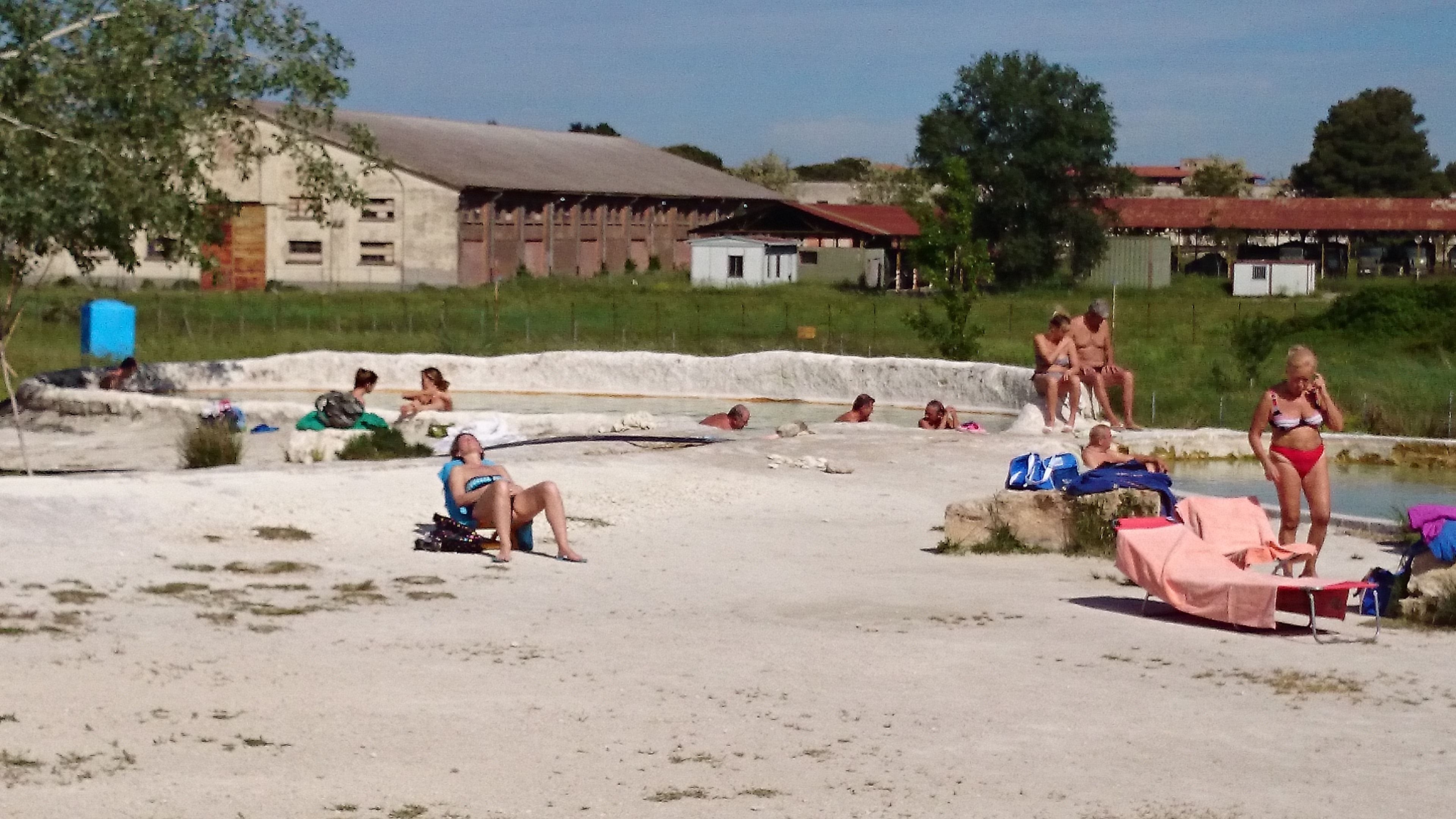
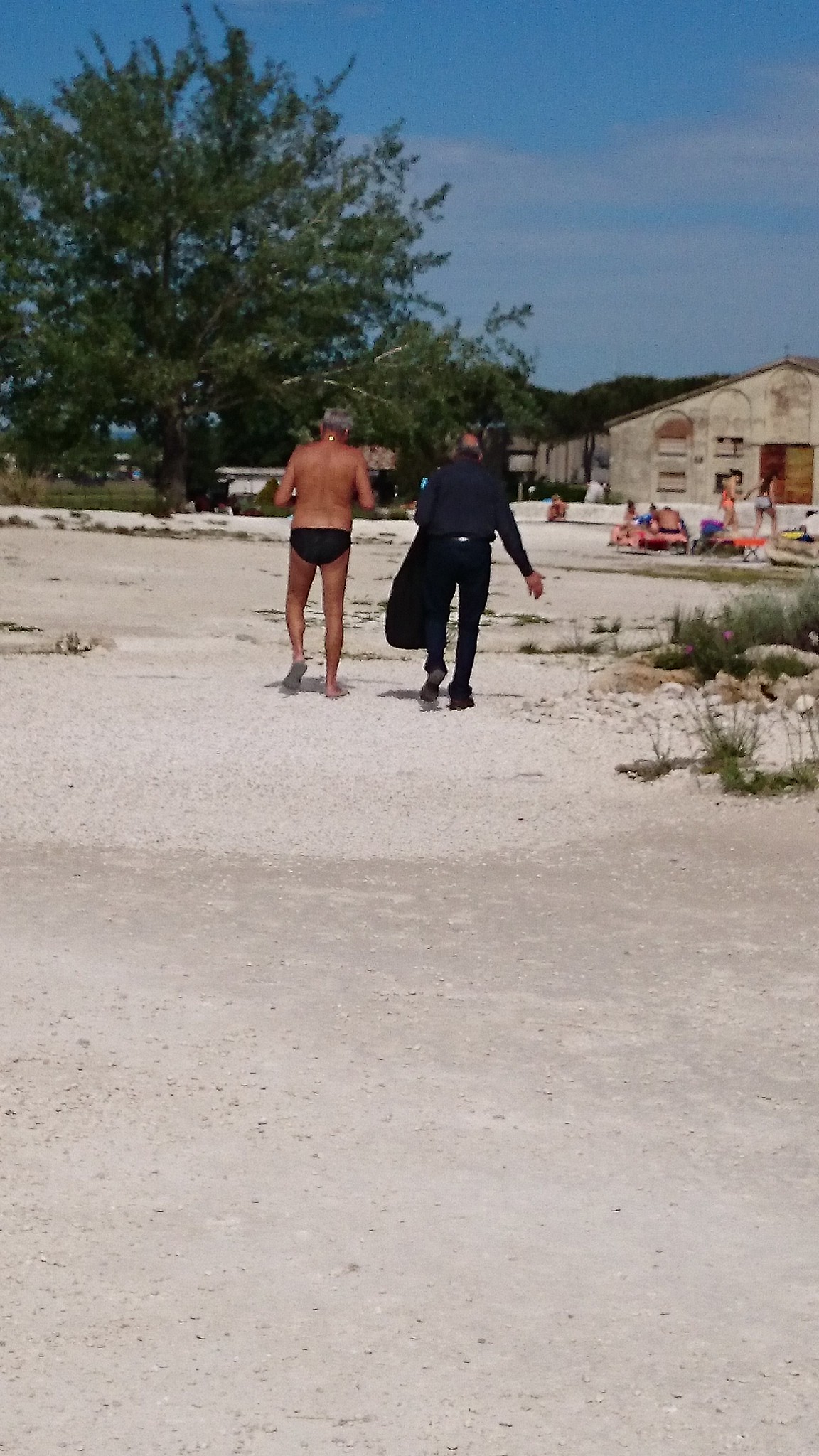
I met Giovanni on a sunny Friday mid-morning earlier this May at the site of the Bullicame hot springs. Dressed in black, he contrasts greatly with the swim wearing soakers and sun-worshipers who have descended on Bullicame to use the springs and surroundings as Viterbo’s public beach. 

“Welcome to Il Bullicame. The hot springs of Il Bullicame have been used for a long time. Il Bullicame was referred to in Dante’s Inferno”. 
How did the association come into existence? 
"Well people have been coming to Bullicame for a long time. From the times of Etruscans and Romans. Some time back we became concerned with the state in which the terme was. Especially when we noticed that the hot spring was in full swing but the waters flowing to Bullicame were lower than before. We looked into this and concluded that the commercial operation called Terme dei Papi was extracting more water than it would be legally permitted. Together with the local government we have been trying to get the Terme dei Papi to be held to its restricted amount.
Besides this we raised awareness about the situation in which the springs were to be found. Consequently the government has found funds to enclose the surroundings of Il Bullicame so as to improve the management and upkeep of the site, as well as re-designing the pool areas. Now volunteers from the association keep the terrain clean, keep order and with some facilitation by the local council keep the small and large pools clean. As per our associations statute I have been voted president for a term of five years. We have 600 members, unfortunately though many are not paying their membership fees otherwise we would be able to expand our activities. Now we are mostly dependent on cooperation with authorities.
 The Piscine Carletti pools and car park
The association also have the management of the hot springs by the name of Piscine Carletti, another local hot spring no more than 1 km away. Here the local government has problems keeping the site clean. The overflowing trash bins are only cleaned once a week.
Another further two sites have been earmarked for future projects mostly in the sense of conserving the surroundings, so as to ensure that these sites which are now on private land will enter the public arena. Do you have time?” 
Taking care of soaking business.

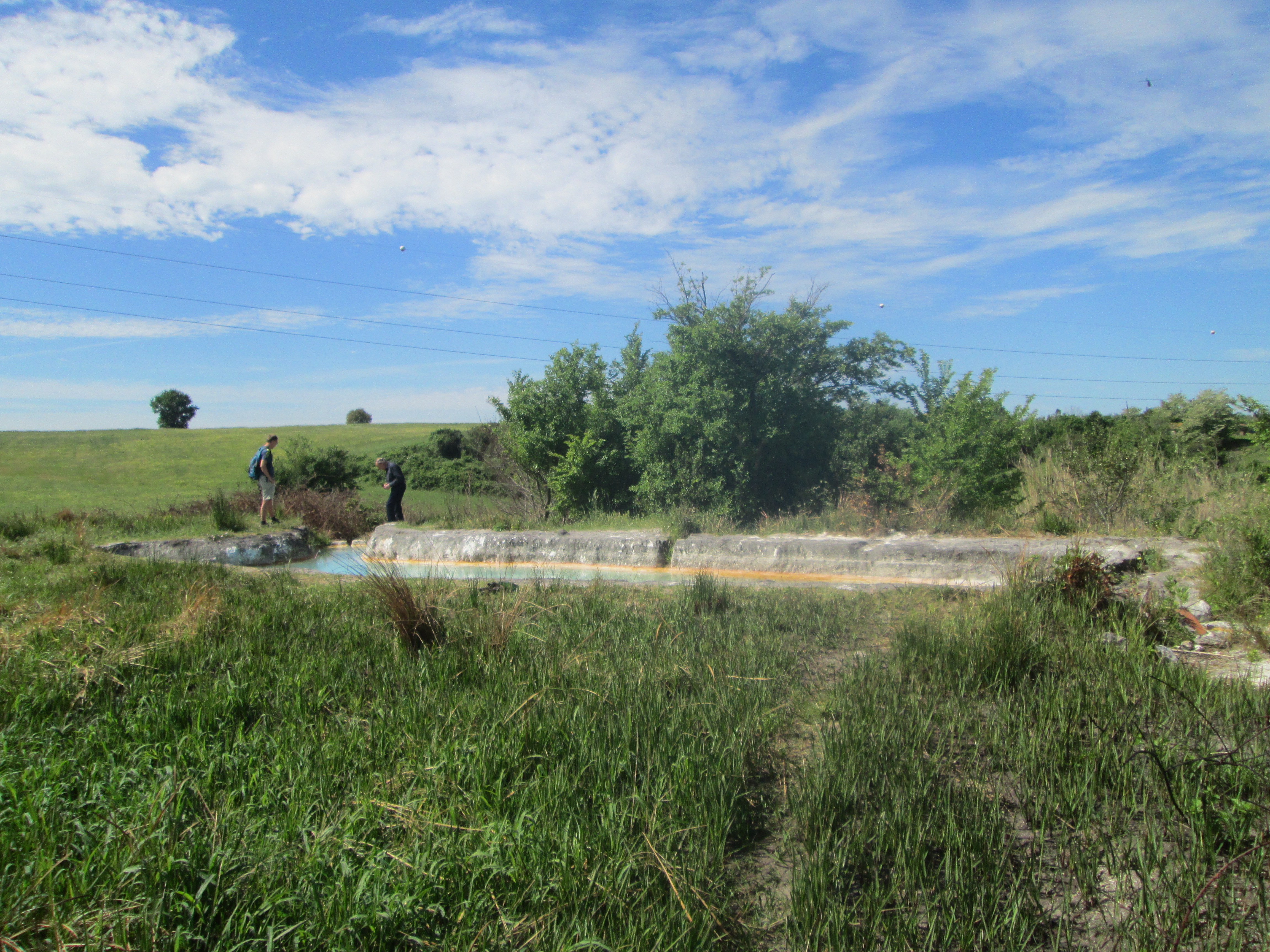
We do, but when Associazione Il Bullicame president visits the hot springs he always has to address a number of issues. These heard / resolved, we speed away. Ten minutes later we park the car along a winding country road. There is a small path which we follow for 25 meters to a scrub-lined hillock. On top is a 5 by 2 meter whitewashed pool which emanates the telltale signs of sulfur. Here the Romans were known to bath. But since, it has degraded somewhat and now this bath stands on private land with the only potential soakers some cattle and those in on the secret. The landowner has no interest in restoration nor in any visitors. We could see evidence of a soon to be resurrected barbed wire fence. Giovanni explains that this place is called Asinello. 
“The water here is the same source of that of Bullicame. Below Viterbo is a big underground lake of hot water, because at the site here, at Il Bulllicame, at the pools of Carletti, at Bagnaccio and San Sisto [roughly 20 km apart] the temperature is just below 60°C with the same mineral qualities. Here at Asinello the flow is probably just 3 liter / second and intermittent so the pool is not too hot”.
The Asinello pool.
 
Earlier evidence points to a cooling system which just hints that Asinello has seen better times. 
“As an association we want to keep the hot springs of Viterbo free. In for instance San Sisto they have been charging entrance fees even though they have no concession to do so. This is not right. The government does nothing against this. We should do more to ensure rules are adhered to and public access is guaranteed”. 
After a thorough exploration of this pool we return back to Bullicame where our roads part.

Giovanni, thank you for being so welcoming and able to discuss and clarify the affairs of Viterbo's hot springs, it was really appreciated. Having just spent a week in Viterbo I have had a great introduction into the significance of hot springs for Viterbo's touristic future. 
Let's hope that these remain open for all to enjoy.