Showing posts with label Lipari. Show all posts

Tuesday, July 3, 2012

Smells like mud


Laghetto di Fanghi with the volcano of Vulcano rising beyond

Topping it
Geothermal mud baths are just another universal way of soaking. In the mentioned link, a full overview is presented of most of our globe's geothermal mud baths, most it must be said in Europe. 

If a list would be drawn up with the most popular of the earth's mud baths, included would need to be Japan's Hoyo (Beppu), New Zealand's Rotorua, Calistoga (U.S.A.), St Lucia, Colombia's Volcan del Totuma, Dalyan in Turkey and the Laghetto di Fanghi on the island of Vulcano, Italy.

Named after the Roman god of fire, the island of Vulcano makes up one of the Aeolian islands, tucked in between Sicily's north coast and the mainland of Italy's peninsula.  Roughly sized 15 by 10 km, Vulcano consists of two active volcanoes which were especially active in the latter years of the 19th century, though the island has always been known for it's eruptions.

Happy
Getting here is already part of the adventure and once on the Aeolians one is transponded to another world; a much more peaceful and delicate one.

Vulcano itself is rather sleepy in the beginning of May, but I read that come summer the tourists are out in force and the peace is disturbed by those similar souls seeking solitude. 

Arriving by hydrofoil from my holiday base of Lipari (see the ENSS entry on San Calogero), it's just a 10 minute affair to cross the narrow strait that divides the two bigger Aeolian islands. Whereas Lipari is more bustling, Vulcano is strangely nearly deserted this time of the year.

Another aspect which strikes one when just arriving, is the smell of sulphur, which seems all-present. 

Before setting out to explore the island we take a coffee plus from the cafe adjoining the pier, what a choice of plusses! 


It's best to tackle a hike up the volcano of Vulcano first. Not that it's a really challenging climb but with no shade, a hike up to the crater is not intended as refreshing walk. 

Only an hour away, Vulcano's volcano crater edge.

Overall it's roughly 1 hour from the harbour to the fumaroles on the crater's edge. Up there, some French are busying themselves with measuring all kinds of data.
But most people are happy enough to take in the views of the northern Eolien islands of the nearby Lipari, Salina, Panarea and even the volcanic might of Stomboli.


The muds
After this mostly dusty action, we head back to the pier, as just beyond the pier northwards, is the famous mud bath of Vulcano. Between the harbour and the baths themselves is a small section of fumaroles through once a walk wound itself through; not anymore. Just beyond the slight rise lies the laghetto. The public road runs alongside and semicirculars the little lake. A pole fence ensures that those interested in joining the fun of those seen in the lakes themselves can neatly and orderly enter via the small kiosk which charges a fee of 2 €. 

There is even an official company running the baths, Geoterme Vulcano. Despite most visitors being foreigners, the website is solely in Italian and I need to rely on google for a correct translation.

Geoterme's information sheet:
  •  Due to radio-action (radon), no soaking for youngsters (the English translation mentions 15 years as the underlimit, in other languages this is lowered to 12 years!)
  • Don't soak midday
  • Don't remove the mud
Interesting facts about the mud bath history: the lake has existed for only 30 years, when a small pond was dug. Fumarole's met fluids and the lake has since been enhanced to it's current setting. With the unique combination of brackish waters, liquefied earth and mineralization from the fumaroles, the interaction results in mud with extremely high mineral content.
The mud is supposed to help with joint problems, skin diseases, respiratory diseases. Bathing is suggested to take place before the morning and evening meals, thus also avoiding the intense midday heat; but the soak should not last any longer than 20 minutes and a kür should last 6 days for full benefit, not counting on the two days prior to starting which are required for acclimatization purposes.
Geoterme's site also includes a video.


Soak it
After paying the entrance fee, to your left are just three changing rooms, a wee bit insufficient at meeting the demands for the few visitors that day; if in summer don't imagine you can use them at all! There's also a forlorn toilet, it's actually not clear what the 2 euro buys you other than a tax which falls to the government, lucky man him, Mr Goverment.
Anyway an extra euro buys you a cold shower, one takes a shower after the bath of course (though here´s a hint: it won´t help much). 


If some see a challenge in the lack of changing facilities (shy?), the advice on what to wear is even more daunting. With the facilities open to the views of the wandering public many choose for their flaunting best. Not correct.
Lonely Planet is clear on the subject: 
'Don’t wear your designer swimsuit (you’ll never get the smell out), and be sure to leave your gold chains behind (they will tarnish)'.
'A word of warning: always warn friends who plan to go there, wear an old swimsuit, one that can be thrown away afterwards, because it will never be the same again'.
Or 
'It’s best not to wear clothes or swimming attire that you want to keep as the smell may linger and the mud could stain'.
Wikitravel though makes it very confusing:
''Swimsuits are not optional here, and it's a good idea to use a suit that you won't be wearing in more conventional settings for a while (and that you can bag in some airtight container after use), as a sulfurous odor will continue to emanate from the suit for some time after you exit the baths'.
The funny part of all this is that, if anything, the bathing costume restricts the mud coming in, but equally restricts the mud getting out. If any advise is needy, is to wear as less as possibly can be achieved / accepted, it's not uncommon for women to wear only their bikini bottoms.

Author lathering up

Anyway, feeling fit for the fumarolisch fanghi, one can walk over the wood walkway towards the pond. The pond itself is never deep. At regular spots one can see (and feel) the heat spring up. On the far side there are even a number of tiny vents just out of the water. Tiny, but strikingly hot. The process is to smear oneself with the mud and then jump into the sea, just 5 m's away.

Surely with this kind of services available, Vulcano must rank as the best of all geothermal mud baths. But the geothermality does not stop here. Jumping in the cold may sea, one can swim a meter or twenty and delite in a jacuzzi like hot spring vent! Wow, surely this must be the best!

Braving the cold sea, note the lighter coloured waters further out
 are where the geothermal springs sprout.

A few rounds of alternating the mud and sea along with some real relaxation in the spring sun and the clock indicates it's time to catch the ferry back.

Souvenirs
Many people complain about the smell of sulphur. For instance, my Rough Guide Sicily states: 
'... one pool containing a thick yellow soup of foul-smelling sulphurous mud, ...
The smell is indescribable, ...'.
Further on it actually dissuades tourists from staying on Vulcano, due to the lack of good accommodation adding
 'even if the lingering smell doesn't put you off'.
Elsewhere it's noted
'Please be aware that the smell of sulphur, a direct characteristic of a trip Vulcano, may be overpowering at times, however this smell is absolutely safe for humans and absolutely non toxic'.
Wikitravel adds:
'Famous for its mud baths, the island literally smells like rotten eggs (sulfur)'.
Surprisingly, the fanghi (or in this case the terme) only rank 8th in tripadvisors overview of things to do on the Aeolians, so maybe it is just not for everyone?. 

Others like myself take a liking to it. 

Opinions differ on how to get rid of the smell, many of the above might just reason that the best way is not to get to the smell at all. Hmmm, not me, 2 months on, my shower towel still smells with a faint whiff of sulphur if I plant my face in it. Ahhhh ..... Vulcano mud baths!


What many do not understand is that the occurence of sulphur increases the health qualities of the water / mud.
The Soaking Life has dedicated a whole blog on the plusses of sulphur: 
'In hot springs, small quantities of sulfur can be absorbed transdermally or inhaled as a mineralized mist to provide relief from a number of conditions:
  • Arthritis – when absorbed transdermally, sulfur may alleviate the pain and swelling of osteoarthritis, rheumatoid arthritis and psoriatic arthritis
  • Skin conditions -  sulfur eases irritated itchy, reddened, irritated skin and may minimize the symptoms of psoriasis, dermatitis, dandruff, eczema and warts
  • Respiratory congestion – when inhaled as a mist, sulfur has a mucolytic effect, clearing mucus from the lungs and facilitating breathing
  • Liver disorders – sulfur may assist the liver in its detoxifying functions
  • Digestive disorders – sulfur-containing compounds may facilitate digestion and minimize the effects of acid reflux
  • Gynecological disorders – sulfurous water has been used to treat disorders of the female reproductive system
Sulfur-rich mud can be applied to the skin to relieve the symptoms of arthritis, rheumatism or psoriasis'.
The parting shot:
'If you have the opportunity to visit a sulfur spring, don’t hold your breath; inhaling sulfur vapors may help you breathe easily. Consult your health-care provider before taking sulfur supplements or adding balneotherapy to your personal treatment program'.
So there.

Wednesday, May 16, 2012

Ammollo Naturale?

 
 Looking west from Lipari towards Flilculdi and Aldicudi

A new beginning
When starting anew with a blog which might continue for years upcoming, it's difficult to find out where to start. I'm not a newby to hot springs in Europe, but should I rely on past and possibly outdated info or should I let the future dictate which way to go?

Well it's the latter. And thus it saw my family and I leave for south Italy last week, mostly due to the fact that cheap tickets were on offer, entirely by co-incidence to Lamezia Terme (how many hot springs bequeath their name to an airport?), a town in Calabria, which until then I had never heard of!

However there was no time initially to hang around. South Italy lies on a geological fault zone; to the north lies the notorious Vesuvius, southwards on Sicily the Etna, which itself lends it's name to a range of cookers! So for more geothermal fun, a choice had to be made.
But neither were on the cards, as inbetween in the deeps of the Tyrrhenian Sea (Mare Tirreno) lie the volcanic Aeolian Islands. 
 
Stromboli from sea, just beyond the clouds lies the lip of the crater 
of one of the worlds most active volcanoes.

Northern most of these, is Stromboli island: a conical volcano highly active and regarded as one of the earth's best places to see a volcano erupting. The other islands are also all volcanic, their activity more or less dormant with the exception of the island of Vulcano / Vulcanello.

Lipari
Vulcano island warrants a blog entrance of it´s own, so much volcanic activity takes place there. Very accessible too.
Even if the other islands volcanoes are less active there is enough other geothermal activity on each to entice the avid geo-amature. Every island has it's own tell-tale signs. For instance, the small Panarea island has a beach with a fumarole and further out to sea are a number of submerged fumaroles with geothermal characteristics.  

Panarea's north facing beach with it's own set of fumaroles.

The bigger Lipari, Eolie´s center most island, is also the most populous and the largest of the island group. Ideal as a base to visit the surrounding islands and enough interests on it's own to hold the visitor captive. NESOS has a collection of walks around Lipari, for instance.

The past has seen quite a few hot springs on the island, but nowadays these possibilities are limited to 2 or 3 (as there are indications of thermal activity in the Fossa del Fuardo [2]). Tranne et al. [3] sum the volcanic activities of Lipari as follows:
'Actually, the only evidence of volcanic activity is represented by fumaroles and hot springs: low-temperature fumaroles (80-90°C) are present both in the western (between Timpone Pataso and Timpone Ospedale [a]) and in the southern (Vallone Ponte) sectors of the island, whereas hot springs (57°C) are located in correspondence with Terme di San Calogero and Bagno Secco'.
One of these possible hot springs  is a no name affair with a very small flow located lower down the mountainside from the nameless fumarole, (depicted directly below) itself slightly downhill from the Cave Caolina ancient clay mine near the community of Castellaro ([a] above). 


Follow the washed out track downhill, one will eventually meet the western coastal path. This coastal path is a beautiful and goes through a rather quiet stretch of Lipari, continuing through brush and gorse. Views extend over the Tyrrhenian Sea towards Sicily (with the distinct possibility of spotting snow-covered slopes of the Etna) and westwards to the islands of Salina, Filicudi and Alicudi (see lead photo).

Heading south the closer one gets to the other hot spring of Lipari, the more civilisation returns: the track gets better and increasingly nature is being supplanted by olive groves and assorted orchards. The trail takes a sharp turn land inwards and up, then one is back in the living world, resembled by the rather large building with ample parking space.


Protectorate
The hot spring on Lipari island is known as San Calogero, possibly named after San Calogero of Agrigento, Sicily:
'The history of San Calogero dates back to the 4th - 5th Centuries.  The saint escaped the persecutions that were decimating the Christian churches of North Africa, whose followers took refuge in Sicily, in particular in Agrigento where he stayed for a long time. His talents for miracles soon made him the most beloved holy person in the territory of Agrigento'. (source)
Under the only place where there is shade an old vehicle stands. Oddly, on it's bonnet lie a arrangement of stones and possible trash. The car and paraphernalia belong to an old and slightly hunched gentleman, together with his toothless wife. 


Trying to establish which language he wants to address me in, he seems quite set back that my home country has it's own language, one he has never heard of before and rendering any kind of services he could provide null and void. 

But nonetheless hands and feet and some limited vocabulary do get me somewhere. But before I can try to ask questions he rattles of his introduction speech of the hot spring site, it's history, it's religious significance, therapeutic qualities, current uses, etc., all what is lost in translation unfortunately.

At the end of his speech by magic appears a book in his hand concerning hot springs of Lipari [4]. With enormous photographic quality, it would be a huge source of information. Priced at 20€ he was willing to part with it, not the dog-eared copy in my hand, but a copy in mint condition for half that price. Still at 10€ having a book about the few hot springs of Lipari in Italian seemed a bit too extravagant, so I skipped the opportunity, even though my old friend insisted that you could get in Lipari town, but only for the 20€. (Much to my astonishment, this later appeared to be true!)

But anyway, still not much wiser I peered over the fence as the gate was heavily locked. A pool was obvious (which was connected to times the Greeks roamed Lipari). Behind it a sauna cave.  Both are on the leftside of the following picture.


Besides these, there was the previously mentioned building. Imposing it seems out of place. Possibly it is. Deserted and devoid it stands as a monument for those failed developers. Money wasted. Public money too, as the carpark has a large two lane road connecting it to the circular Lipari main road. Bruno et al. (1999) suggest that the source had partially dried out due to the renovation works.

The source proper

I manage to make clear that I wouldn't mind looking more closely at the site. I get the permission but no key appears to unlock the gate; no, I get permission to climb around the fence! Behind and stream upwards of these structures is a pond with a trickle of water. The pond is warm but doesn't seem to have been cleared for quite some time so I reluctantly let this chance go by.

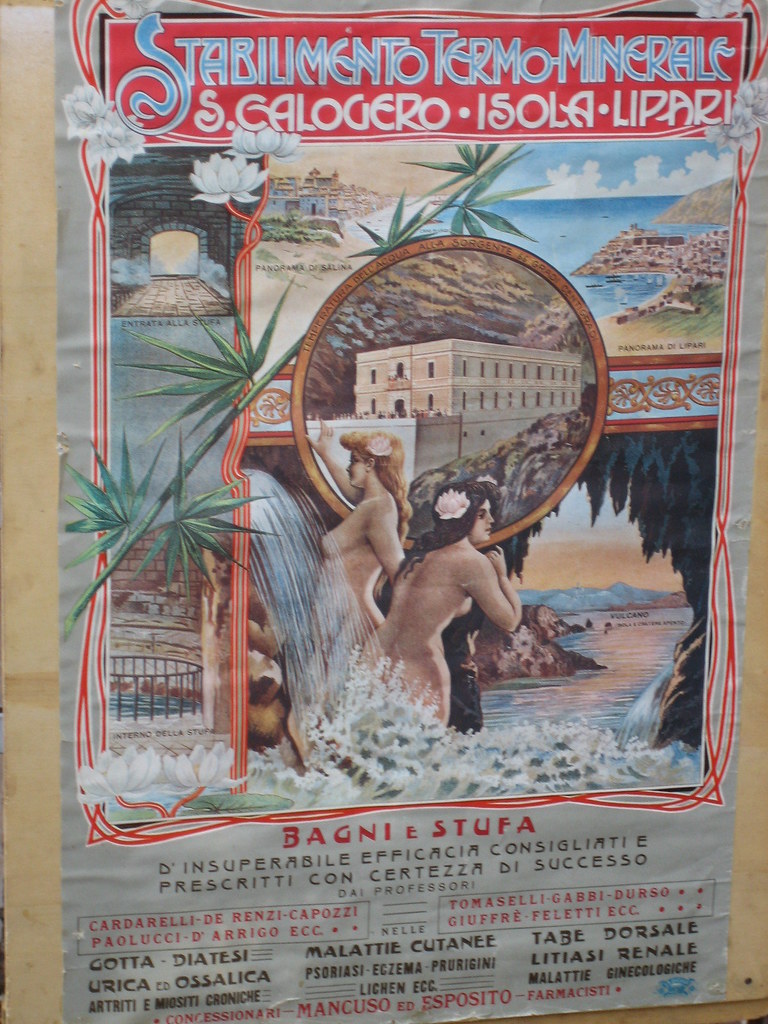
I return to my elderly guides and buy an authentic turn of the century poster off them for 5€, a possible bargain. Their interest wanes, besides there are new faces to tend too. I can sneak off.

Through the ages
As the remains indicate there is quite some history involved. This website dates the springs way back to times of the Mycenae (1500 BC). It adds that analysis of the water was first conducted in 1872 by Arrosto ....

In his 1991 publication, Luigi Bernabao Brea [1] reports that 
'The thermal springs of the island of Lipari, recorded by writers of the Greek and Roman periods, were so famous that one of the minor thermal establishments in Rome bore the name of Eolia'.
This source also briefly mentions the Arabs 'enjoying' the springs. 

Depictions are less common but none more the most common as the following:

'Here Houel depicted baths located by a hot spring. The baths consisted of two rooms, the rectangular dating from the Roman era, and the round one from a later date. Such baths were open free of charge to citizens and served medicinal purposes. The figures in the foreground were intended to give the composition a sense of life and to reinforce the documentary precision of the motif'.

This is a sketch by Jean-Pierre-Laurent Houel, dating back to his visit to Lipari between roughly 1776 and 1779. Note the connection made between the infirm and the springs. The domed structure still stands nowadays (?).

Located further away from San Calogero (in the Vallone Ponte) are these remains of Roman spa dating back to 300-400 BC. The placate refers to this site being drawn by Monsieur Houel and re-discovered in 1979. 
The spa was heated from nearby fumaroles

Nineteenth century
'traveller, sailor, scientist, artist, open-minded thinker and mentor, visionary, pacifist, traditionalist, conservationist, writer and lover'
the Archduke Luis Salvador, is mentioned as having dedicated the following text to the terme of San Calogero: 
'The Lipari Islands are home to many hot springs. The largest of these is San Calongero, on the west side of Lipari. It gushes forth 400 litres of water per hour in a little rocky valley filled with rough drops. Convinced of the curative powers of the water, the town built some nice baths at the spring. According to chemical analyses, the spring contains aluminium sulphate, potassium carbonate, sodium hydroxide, magnesium, calcium chloride, sodium, potassium and organic matter. The temperature inside the spring can reach 57°C. The water is especially effective at treating scabies, scaly herpes, rheumatoid arthritis and tertiary syphilis.”'
Included is a drawing of the thermal bath buildings of then. Added are the comments by his current day groupies:
'With respect to the Archduke’s drawing, relatively few changes can be seen in the building structure today. By contrast, in his portrayal, the landscape was completely barren. Today, however, the vegetation is very abundant and includes capers, Spanish broom, mastic shrubs and other diverse bushes and trees'.
Popularity may have waxed and waned over the years however the previously mentioned purchased poster may be proof of better times for soakers:


It mentions how the temps of the water are 66 degrees Celsius and the prescribed baths are a certain success. Note that the ladies do not appear in dire straits. But maybe they are just soaking godessess taking the opportunity to take an ammollo naturale! 

Culture and vulture?
Final desk research helped in delving up the aforementioned book. Unfortunately not available in print form on the internet, it's priced at around 20€ (also seen it being discounted to €16). I would like to add more on the book, but it's not there other than the usual such as very informative, author a long term local, etc.

But then I came across this link. According to the January 2008 link two French tourists were groped while visiting San Calogero two years before. The culprit, an ' insistent tour guide' goes by the same name as the author. Co-incidence?

In any case he denied any wrong-doing and I have failed to find any other info on the case.
On a positive note, this Italian website mentions
'Today spas are not working and are in a state of neglect that leaves the visitor with a mixture of pain and anger, it is expected the restoration of the baths for years, but it is not known if and when this wonderful facility will be fully usable by the community. The Terme di San Calogero are open only through the voluntary contribution of Mimmo Mammana, Liparota, a fan of the culture of his island, who, in a few minutes to visit, tell the story of humanity, through that of the baths.
He will speak of history and fiction, Roman soldiers dying for severe war injuries, miraculously healed, with thermal waters, the life of Saint Calogero, a native of Asia Minor, who came to Lipari, to scare away the devils nested in the area is overflowing with miraculous healing those sources, to comfort the suffering'.

On Facebook a link to a photo of Angelo (with some words of praise), though it is not his page. Btw, are we now talking about the same person? At least I didn't see him ...

Finally, places to stay are in access out of season on Lipari, which is a great place to have a holiday.Just Go.

Notes:
[1] L. Bernabò Brea & M. Cavalier (1991) La tholos termale di San Calogero nell'isola di Lipari. Studi Micenei ed Egeo-Anatolici pp. 1-78. Link
[2] Bruno P.P.G., V. Paoletti, M. Grimaldi & A. Rapolla (1999) Geophysical exploration for geothermal low enthalpy resources in Lipari Island, Italy. Journal of Volcanology and Geothermal Research,  Volume 98, Number 1, May 2000 , pp. 173-188(16). Elsevier Science, Amsterdam, the Netherlands.
[3] Tranne, C.A., N. Calanchi, F. Lucchi & P.L. Rossi () Geological Sketch Map of Lipari.
[4] Mammana, A (2006) Le sorgenti delle Isole Eolie. Ravagnese: Città del Sole Edizioni.