Tuesday, August 14, 2012

Aquistas


Waters
Portugal boasts it's fair share of thermal hot springs. Though wikipedia seems to be oblivious to this, Termas de Portugal counts 38 termas (Portuguese for hot spring) as it's members, a figure the excellent (but Portuguese language only) Águas Termais attributes as those hot springs for which commercial concessionaires exist.

The former adds a number of now dried up geothermal springs, as well as partial geothermal and quite a list of commercial mineral water bottlers. For one thing has become apparent on my visit to the Portuguese termas, and that is the fact that the Portuguese like their waters ...

(Do note though that confusingly the area around Furnas on the Azores island of Saõ Miguel counts no less than 22 hot springs, none of which were counted in the above mentioned ....).

Certified
Portugal and hot springs go back a long way and it seems that like many of the other European cultures the Portuguese prefer the medical benefits of thermal waters. Sod the socializing.

Thus it has seen fit to transform their natural springs to scenes of medical dedication. Such that if you would even remotely dare to take a soak, a doctor will have to certify whether or not that need be the case. Naturally forking out 50€ or so, just to be told that "yes, you can take a soak" seems to fend off the touristy type, in need of a one-off soak, the hippy or the novice.
What remains are a geriatric generation who do need to heed the doctors advice, who stand to benefit most from the waters and whom have the freetime to say use the advice taken to stay for a week or two of great soaking ...

Even the art of sampling the waters with a couple of sips will sometimes require a signature from yourself absolving the termas of any liability in case you just might keel over or die. Or less.

Aquistas of Chaves
Any road, one of the 38 concessions mentioned in the first paragraph lies in the town of Chaves, Vila Real district, glued to the northern border with Spain. Serving the wider mountain region, Chaves (pronounced as chaaves, as in chives) has seen quite some historical turnovers leaving it with a long Roman bridge and a number of forts and towers which in some time had managed to either keep conquerers at bay or dissuade would-be liberators from freeing the town.
Naturally, it lies along the banks of stealthly slow flowing Rio Tamagas and boasts of it's bathing waters. Well, this blog will see if the boasting is fair!

Chaves by night

The wider region of Chaves though, to it's credit, does mention in the local tourist brochure, an upswing in aquistas (persons who undergo medical treatment by bathing in thermal baths). The upswing is thought to be due to the increased awareness to health and well-being. Unfortunately the brochure (produced by the Alto Tamega e Barroso tourism office) is undated and also unsubstantiates this trend.
Specifically it adds for the termas of Chaves:
'The medicinal properties of the thermal Spa of Chaves were discovered by the Romans, and soon became an ex-libris of the city. They are the most accredited spas in Portugal, having the hottest thermal waters of Europe. All year round they are visited by thousands of people finding treatment for rhuematism, nutrition diseases (obesity[!], gout and diabetes), disorders of the liver, intestines and hypertension'.
Operator Termas de Chaves supposedly (poor translation?) adds on it's Portugese language website that the waters are unique for the Iberian peninsula and facilities are geared to receive 15,000 'patients'.

Then the charges:
  • just 35€ for the doc, 
  • but then 30€ signage fee and 
  • another 20€ for nutionist.
That´s just €85. Oh, and then if taking a soak, add the mere €5,50 to that figure.

Sourced
Other excellent info from the Wikipedia Chaves entry:
'The hot springs (Portuguese: Caldas) were known since the Roman period, when the town was Aquae Flaviae; the Waters of Flavius were an important social gathering point, but fell into disuse as the town was slowly abandoned by attacks.
...
The waters of the spring, that are captured in three springs within Chaves, have mean temperatures of 73 °C (163 °F) (the hottest bicarbonate waters in Europe). The modern spa industry in Chaves use these waters for numerous treatments, including stomach, liver, intestinal, and kidney ailments, through oral ingestion. Many small guesthouses in the old part of the town are dependent on the influx of these visitors. The thermal spas are located between the castle and the river, in front of a large area of grass-covered park with playgrounds and tennis courts'.
There is actually an archeological dig in the center of Chaves not too far away from the hot spring, in line with the bridge which should contain remains of some original roman spa, but as there was a high fence around it, can't verify this ...

Flickr member frproart has a number of photo's before the fence was constructed.

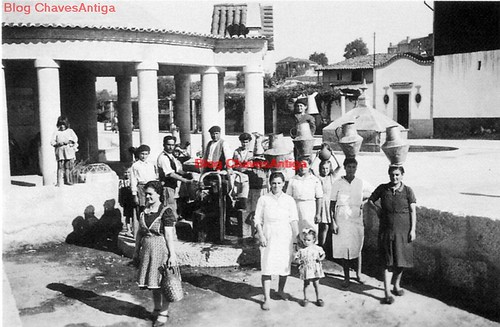
The spring in the old days, possibly before WWII. Source

Sampling the soaking source
So I skipped the soaking part, but decided to nose around. Besides the intense medicalisation of soaking process here, another aspect of Portuguese hot spring culture is the ability to sample the waters by drinking. Thermal springs of the official kind cater to the vox populi: free glasses of water.

 
Fill her up please. Inside the Termas de Chaves buvette

In a building alongside the spa there is a nurse like figure doling out plastic cups of water straight from a tap, we hope that's connected to the hot spring. The water is not hot and has little taste. To fully appreciate the flavour of this plastic cup of water, there a number of chairs and benches, mostly occupied by the elder part of the globes population. There's not much I can say about the water though I do like this tradition, a buvette [refreshment stall] along the soaking facilities.

Outside the buvette is supposedly one of the aforementioned three sources. Steam rises up with a faint smell of sulphur; the only actual hint that something geothermal was apparent.

 The source


So you may have guessed, I didn't soak at all.

And from the lack of sources, neither have many other netizens ...

Tuesday, July 3, 2012

Smells like mud


Laghetto di Fanghi with the volcano of Vulcano rising beyond

Topping it
Geothermal mud baths are just another universal way of soaking. In the mentioned link, a full overview is presented of most of our globe's geothermal mud baths, most it must be said in Europe. 

If a list would be drawn up with the most popular of the earth's mud baths, included would need to be Japan's Hoyo (Beppu), New Zealand's Rotorua, Calistoga (U.S.A.), St Lucia, Colombia's Volcan del Totuma, Dalyan in Turkey and the Laghetto di Fanghi on the island of Vulcano, Italy.

Named after the Roman god of fire, the island of Vulcano makes up one of the Aeolian islands, tucked in between Sicily's north coast and the mainland of Italy's peninsula.  Roughly sized 15 by 10 km, Vulcano consists of two active volcanoes which were especially active in the latter years of the 19th century, though the island has always been known for it's eruptions.

Happy
Getting here is already part of the adventure and once on the Aeolians one is transponded to another world; a much more peaceful and delicate one.

Vulcano itself is rather sleepy in the beginning of May, but I read that come summer the tourists are out in force and the peace is disturbed by those similar souls seeking solitude. 

Arriving by hydrofoil from my holiday base of Lipari (see the ENSS entry on San Calogero), it's just a 10 minute affair to cross the narrow strait that divides the two bigger Aeolian islands. Whereas Lipari is more bustling, Vulcano is strangely nearly deserted this time of the year.

Another aspect which strikes one when just arriving, is the smell of sulphur, which seems all-present. 

Before setting out to explore the island we take a coffee plus from the cafe adjoining the pier, what a choice of plusses! 


It's best to tackle a hike up the volcano of Vulcano first. Not that it's a really challenging climb but with no shade, a hike up to the crater is not intended as refreshing walk. 

Only an hour away, Vulcano's volcano crater edge.

Overall it's roughly 1 hour from the harbour to the fumaroles on the crater's edge. Up there, some French are busying themselves with measuring all kinds of data.
But most people are happy enough to take in the views of the northern Eolien islands of the nearby Lipari, Salina, Panarea and even the volcanic might of Stomboli.


The muds
After this mostly dusty action, we head back to the pier, as just beyond the pier northwards, is the famous mud bath of Vulcano. Between the harbour and the baths themselves is a small section of fumaroles through once a walk wound itself through; not anymore. Just beyond the slight rise lies the laghetto. The public road runs alongside and semicirculars the little lake. A pole fence ensures that those interested in joining the fun of those seen in the lakes themselves can neatly and orderly enter via the small kiosk which charges a fee of 2 €. 

There is even an official company running the baths, Geoterme Vulcano. Despite most visitors being foreigners, the website is solely in Italian and I need to rely on google for a correct translation.

Geoterme's information sheet:
  •  Due to radio-action (radon), no soaking for youngsters (the English translation mentions 15 years as the underlimit, in other languages this is lowered to 12 years!)
  • Don't soak midday
  • Don't remove the mud
Interesting facts about the mud bath history: the lake has existed for only 30 years, when a small pond was dug. Fumarole's met fluids and the lake has since been enhanced to it's current setting. With the unique combination of brackish waters, liquefied earth and mineralization from the fumaroles, the interaction results in mud with extremely high mineral content.
The mud is supposed to help with joint problems, skin diseases, respiratory diseases. Bathing is suggested to take place before the morning and evening meals, thus also avoiding the intense midday heat; but the soak should not last any longer than 20 minutes and a kür should last 6 days for full benefit, not counting on the two days prior to starting which are required for acclimatization purposes.
Geoterme's site also includes a video.


Soak it
After paying the entrance fee, to your left are just three changing rooms, a wee bit insufficient at meeting the demands for the few visitors that day; if in summer don't imagine you can use them at all! There's also a forlorn toilet, it's actually not clear what the 2 euro buys you other than a tax which falls to the government, lucky man him, Mr Goverment.
Anyway an extra euro buys you a cold shower, one takes a shower after the bath of course (though here´s a hint: it won´t help much). 


If some see a challenge in the lack of changing facilities (shy?), the advice on what to wear is even more daunting. With the facilities open to the views of the wandering public many choose for their flaunting best. Not correct.
Lonely Planet is clear on the subject: 
'Don’t wear your designer swimsuit (you’ll never get the smell out), and be sure to leave your gold chains behind (they will tarnish)'.
'A word of warning: always warn friends who plan to go there, wear an old swimsuit, one that can be thrown away afterwards, because it will never be the same again'.
Or 
'It’s best not to wear clothes or swimming attire that you want to keep as the smell may linger and the mud could stain'.
Wikitravel though makes it very confusing:
''Swimsuits are not optional here, and it's a good idea to use a suit that you won't be wearing in more conventional settings for a while (and that you can bag in some airtight container after use), as a sulfurous odor will continue to emanate from the suit for some time after you exit the baths'.
The funny part of all this is that, if anything, the bathing costume restricts the mud coming in, but equally restricts the mud getting out. If any advise is needy, is to wear as less as possibly can be achieved / accepted, it's not uncommon for women to wear only their bikini bottoms.

Author lathering up

Anyway, feeling fit for the fumarolisch fanghi, one can walk over the wood walkway towards the pond. The pond itself is never deep. At regular spots one can see (and feel) the heat spring up. On the far side there are even a number of tiny vents just out of the water. Tiny, but strikingly hot. The process is to smear oneself with the mud and then jump into the sea, just 5 m's away.

Surely with this kind of services available, Vulcano must rank as the best of all geothermal mud baths. But the geothermality does not stop here. Jumping in the cold may sea, one can swim a meter or twenty and delite in a jacuzzi like hot spring vent! Wow, surely this must be the best!

Braving the cold sea, note the lighter coloured waters further out
 are where the geothermal springs sprout.

A few rounds of alternating the mud and sea along with some real relaxation in the spring sun and the clock indicates it's time to catch the ferry back.

Souvenirs
Many people complain about the smell of sulphur. For instance, my Rough Guide Sicily states: 
'... one pool containing a thick yellow soup of foul-smelling sulphurous mud, ...
The smell is indescribable, ...'.
Further on it actually dissuades tourists from staying on Vulcano, due to the lack of good accommodation adding
 'even if the lingering smell doesn't put you off'.
Elsewhere it's noted
'Please be aware that the smell of sulphur, a direct characteristic of a trip Vulcano, may be overpowering at times, however this smell is absolutely safe for humans and absolutely non toxic'.
Wikitravel adds:
'Famous for its mud baths, the island literally smells like rotten eggs (sulfur)'.
Surprisingly, the fanghi (or in this case the terme) only rank 8th in tripadvisors overview of things to do on the Aeolians, so maybe it is just not for everyone?. 

Others like myself take a liking to it. 

Opinions differ on how to get rid of the smell, many of the above might just reason that the best way is not to get to the smell at all. Hmmm, not me, 2 months on, my shower towel still smells with a faint whiff of sulphur if I plant my face in it. Ahhhh ..... Vulcano mud baths!


What many do not understand is that the occurence of sulphur increases the health qualities of the water / mud.
The Soaking Life has dedicated a whole blog on the plusses of sulphur: 
'In hot springs, small quantities of sulfur can be absorbed transdermally or inhaled as a mineralized mist to provide relief from a number of conditions:
  • Arthritis – when absorbed transdermally, sulfur may alleviate the pain and swelling of osteoarthritis, rheumatoid arthritis and psoriatic arthritis
  • Skin conditions -  sulfur eases irritated itchy, reddened, irritated skin and may minimize the symptoms of psoriasis, dermatitis, dandruff, eczema and warts
  • Respiratory congestion – when inhaled as a mist, sulfur has a mucolytic effect, clearing mucus from the lungs and facilitating breathing
  • Liver disorders – sulfur may assist the liver in its detoxifying functions
  • Digestive disorders – sulfur-containing compounds may facilitate digestion and minimize the effects of acid reflux
  • Gynecological disorders – sulfurous water has been used to treat disorders of the female reproductive system
Sulfur-rich mud can be applied to the skin to relieve the symptoms of arthritis, rheumatism or psoriasis'.
The parting shot:
'If you have the opportunity to visit a sulfur spring, don’t hold your breath; inhaling sulfur vapors may help you breathe easily. Consult your health-care provider before taking sulfur supplements or adding balneotherapy to your personal treatment program'.
So there.