Showing posts with label fango. Show all posts

Saturday, November 6, 2021

Warned

Aguas sulfurosas saliendo de las rocas a 60 grados hacen que te puedas bañar en el río en cualquier época del año. Vaya un descubrimiento.Fotografía de @carlos290483
As the pandemic worries extend into a second European winter season, the past few months have not been very kind to the last remnants of our free and wild soaks. No need to remind you all, just look at the posts of the last couple of months.
However there is still more developments to share.

If you paid attention the last few weeks, most of the poor news came from France. Particularly the destruction of the Source Felix Croizat (b.t.w. here's a website with more historical background).  
Though there is also hope here. Apparently the local government that tore out the pools earlier this year, has now decided on an alternative plan which would see new construction of pools, but this time fenced, so at nighttime it can be locked. There is though doubt. The source itself sits within a no-construction / destruction natural zone with international status. 
In the meantime yet another makeshift pool has been composed by concerned locals. Keep on soaking.

In the overall discussion concerning this hot spring, I did come across this info on another free hot spring not too far away from above mentioned: Chateauneuf-les-Bains (Auvergne). 
Not really soakable, it does have a shallow basin in a public park. With temperature of 34-35°C. As can be expected, the majority of the two sources are syphoned off to the local thermal complex as well as to a bottling plant. This is where I delved the above info from.

Then to Austria. Europe's only natural and free and seasonal hot spring is likewise also under threat. Measures in the valley to protect flooding are rumoured to affect seasonal flows. A Change.org petition has been up and running hoping to ensure the seasonal hot spring will not go under as local authorities will see the light.

The soaking and wild swimming culture are very similar; though soaking has less opportunities whereas wild swimming is trending towards compulsive swimming rather than spiritual solace. 
But anyway. 
The Guardian reports (Aug. 26) on belated action concerning fertilizer run-off (a continent wide problem), but in this case Spain. And only after many fish in the Mar Menor (Murcia) wound up dead. Besides swimming the Mar Menor also offers excellent mud baths. However:
'Ecologists have warned for years that life in the lagoon is being suffocated by decades of nitrate-laden runoffs, mostly from agriculture, that trigger vast algae blooms – described as extreme eutrophication – that deplete the water of oxygen.
Wednesday’s ban on the use of inorganic nitrogen fertilisers within 1.5km of the lagoon was welcomed by ecologists, who have spent years calling for action. “We think it’s a good step but it comes very late,” said Sallent.
He called on the regional and central government to take urgent action, such as curbing the intensive agricultural practices of the area and creating wetlands around the lagoon that could act as “green filters”. Failure to do so risks incidents similar to that of the past week becoming more frequent.
“It’s unfortunate. This was a jewel, a singular site that at one point could have been a national park,” he said. “But instead, in the 1970s and 1980s, it bet on aggressive urban development and later intensive agriculture that was also very aggressive. They prioritised these economic sectors and they forgot the environment.”
It's odd that protecting the environment always ends up playing second fiddle to economic plundering. How long can we still use our natural waters?

Perceptions
Thus we come to the now-for-something-different section. And hopefully not too far away from the soaking culture.

Last year, Oslo's art an
d event center (SALT; complete with sauna) had an exhibition named Sweat. Translated:

'The artist behind the latest art installation at Salt is Mikkel Aaland (b. 1952), a San Francisco-based photographer, filmmaker and artist. In collaboration between Aaland and SALT, we have hung up more than a hundred different towels in the Arctic Pyramid.
Sauna enthusiasts from all over the world have contributed towels, personalized them with art, words and their actual sweat to our celebration of the world's well-being. Along with towels from countries such as Turkey, Japan, Italy, Australia, Russia and Mexico, Aaland's own towels with printed photographs from his world visit are also in search of the perfect sweat. Each towel represents a moment when someone leaves the stress of modern times behind and prioritizes health and well-being. Contrary to the contemporary perception of sweat, it has had magical connotations for traditional societies'.

I believe in the past (March 2018) I may have referred to Irish sweathouses. Very recently BBC has an article (Oct. 18) on these:

'Malone [Leitrim County Council Heritage Officer Sarah Malone] their aim was to identify and demystify these timeworn structures, which are scattered across Ireland and were used as a sort of extreme stone sauna from the early 1600s to the early 1900s. She said they had so far recorded more than 100 sweathouses in Leitrim alone – more than anywhere else in Ireland, and a staggering concentration given that this tiny Greater London-sized county is home to fewer than 35,000 people'.

Out of faith for quite some time (150+ years?) these were mainly built and maintained in areas with poor access to health facilities / know-how. They are believed to have come into existence organically and rely on raised atmospheric temperature to induce a sweat which assists in improving blood circulation and filtering out toxins (as the article states).

Lonely Planet also has an article (Sep. 9) on Europe's Best hot springs. Pretty much drawn up from all over Europe, there are just 1 or 2 free soaks to be had on the list; many though require splashing the cash.

Travel Tomorrow (Sep. 29, 2020) has 5 naturist-friendly thermal spas in Europe:
In many European countries, nudity inside spas is the rule and not the exception. Of course, you can wrap yourself in a towel or wear a robe when walking around, but you’re not allowed to wear any kind of swimming suite. So forget your swimwear and jump into one of these naturist thermal spas!

Note that what they don't mention is that these natural thermal spas are not so thermal; some of them  don't even have any access to natural waters!

Dulces termas☺
#trip #happy #amazing #nature #hotsprings #termas [] #spain #backpacker #mountains #lake #water #picoftheday #naked #beautiful #lovetotravel #aragon #goodvibes #therapy 
While we are heading down this lane, I might as well bring up an article (Jan. 13) by the excellent Nakedwanderings bloggers concerning etiquette at Europe's spa's:
'Many naturists take their first steps into social nudity at the nude beach. But in parts of western Europe, another phenomenon is quickly becoming the new number one place where people get naked with strangers for the first time. Or even with friends. Especially in countries like Germany, Belgium, and the Netherlands, the wellness or spa center has proven to be a great stepping stone for naturism.
Of course, these countries are not particularly known for having year-round great weather and perfect nude beach days are rather limited. Spa centers, on the other hand, are great to visit on a rainy day. With lots of indoor facilities to keep you warm. And even on sunny days, the outside pools are refreshing and the garden is excellent for working on your tan without sand crawling into places where it’s not supposed to be'.
It does need to be noted that the sauna culture works often contradictory to the general (beach) culture. For instance, all spa's in France are very much clothed de rigueur.
Another snippet from the article:
'Ever seen a very upset naked European? Try leaving the door of the sauna open after you exit. It takes a while to heat these things up, so warmth is very precious. If you hear someone yelling “this is not a church!”, it means that you didn’t close the door fast enough'.

Busted
The culture s
hock area. 

Germany's sauna culture once again dishes up a haunting experience. Wanderinggermany (Sep. 8):
The little board stated nonchalantly that I was entering a naked German sauna- no exceptions! It was nude or bust (no pun intended). As I glanced down at the sign and then timidly back up to the Saunahof, it was as if being naked in the sauna was absolutely no big deal to everyone wandering around inside. Apparently, for a sauna in Germany, it wasn’t. But for this little American girl….I wasn’t so sure!
Luckily, I’ve always been a bit hippy footloose and fancy-free. And when it comes to travel, I say, “Hey, when in Rome….well, Germany!”
So, off went the suit and into the German Sauna baths I went!!!

Despite the shreiks and shocks, a good and informative article. 

Giorno 5: bagni silvatici 🌿🛁
 []  #termenaturali #naturelovers #visittuscany #toscananelcuore

Wanderingcarol (Sep. 19) visits the thermal baths of Baden-Baden:

'If you visit Friedrichsbad, you’ll be shedding your aches, and also your clothes. Yes, the Friedrichsbad bath experience is completely without clothes. It doesn’t mean you shouldn’t do it.
...
Today the bath circuit at the Friedrichsbad spa is a 17-step wellness ritual of dry air bathing, steaming, soaking and being pummelled and scrubbed with a brush – all while being very very naked.
It’s a dream of a building. You’ll be sweating amidst richly-painted tiles and a Beaux Arts dome, but clothing is not an option.
And don’t expect to get dressed again for awhile – the complete bathing process takes more than three hours. It also includes views of the opposite sex you might not want to see.
Yes, in addition to being naked at the spa, you’ll have the pleasure of being in mixed company.
...
The lack of restrictive clothing means better circulation for you. And don’t worry, the atmosphere at the Friedrichsbad baths is anything but wild. It’s more like being in a temple dedicated to water.
After all, being nude is all part of the German spa experience, especially in the saunas where clothing is often forbidden. (I should know. I’ve been kicked out for wearing a bathing suit, and learned my lesson fast.)Avoid my mistakes and read my guide on German sauna culture, and while you’re at it, don’t miss these essential rules of sauna safety.
While there’s no escaping nudity at the Friedrichsbad Roman Irish bath, it does elevate a mineral bath into an adventure – maybe that’s why it’s the best-known Baden-Baden spa of all'.
Rachelsruminations looks (Aug.?) at the European soaking society; but that of the late 19th century:

'All over Europe in the 19th century, nobles and royals traveled to European hot springs to “take the waters.” Many of these thermal towns are still spa towns today, and they’ve united as part of the European Historic Thermal Towns Association, (EHTTA) one of the Council of Europe’s Cultural Routes'.
She visits a few German spa's and has more recently published 23 fun facts about Wiesbaden which include 10 about the hot springs of this city.

Revealations
We are now heading into south-eastern Europe.
Lonely Planet (Sep. 20) has put online an article on Budapest's thermal leisure sites:

'Following an unprecedented four-month closure to all of the city’s pools due to COVID-19, Budapest’s thermal baths are now reopen and back in business. Don’t get your towel in a twist deciding where to go, we’ve tried the lot—from the city’s 16th-century Turkish baths to Széchenyi Baths' "Sparty" nights (spa-party, geddit?!!)—and can now reveal all.
Here's the naked truth about Budapest’s thermal baths: Everything you wanted to know (but were too self-conscious to ask)'.
Though it covers many aspects, despite the titillating title and above potential, naturalistic soakers need to heed this:
'Nudity is not permitted in the public areas at any of the thermal baths'.
Ukraine. 10 best hot springs in Transcarpathia (Jun. 26), all very much developed and well visited though.

anastasia_guk15 at Chans - Lumsory (one of the highlighted soaks):
•Feel it and enjoy• ⛰
Kostenurka (Apr. 2) visits the Bulgarian hot springs of Rupite:
'But behind the fence there are thermal lakes in which people sit in the open air. Returning to the car, we moved along the right road to the next parking lot. There is a simple bathing house with swimming pools and recreation areas. Entrance fee is 3 levs (1.5 euros).
And since at the moment all the spas and pools are closed due to a lockdown, everyone is basking in the wild baths. Behind the lakes, there is an unofficial camping site and people in swimsuits and robes constantly come from there.
...
I very carefully dipped my hand into one of the pools - the temperature to the touch was much higher than +40. Like an incredibly hot bath. And people go and go, in bathrobes, in swimsuits from cars and from the camping. They sit down in the lakes, smear themselves with white clay ... Changing rooms and benches are installed near the lakes, everything for comfort even in a "wild" place'.
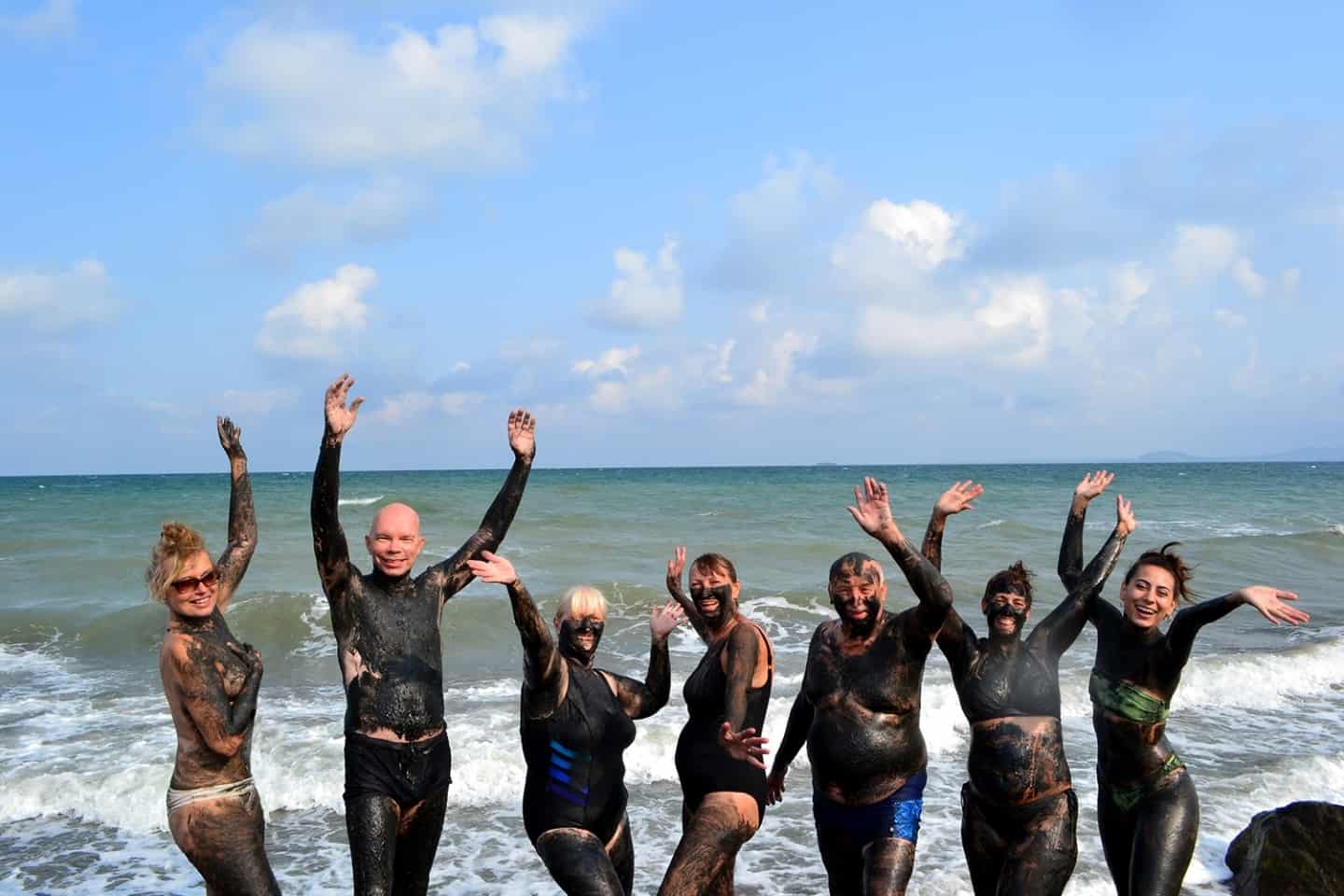
The excellent World Thermal Springs undertook a recent soaking sojourn to Bulgaria. My admiration to their whirlwind tour: sometimes up to 5 resorts are visited daily. All quite staid though. They also did visit Rupite (Oct. 9).

Getting muddy in Bulgaria. A Danish article (Vesterbroliv, Sep. 27) concerning a visit to Burgas and around. Google's translation is gibberish though. So just a photo then:


More mud to finish off with. Things to do in Kavala (Greek Macedonia)? Midnightblueelephant (Nov. 2020):

'To my utter surprise, the mud bathing [at Krinides] wasn’t done in a bathtub of sorts but in a huge pool of mud. Men and women are separated and there are various grid steps that you can access the pool with, which come in handy getting rid of the big chunks when you leave.
The mud itself feels weird in the best way possible. You float, you move in slow motion and it took me a moment to get over feeling a bit claustrophobic. After a while, I copied the other bathers, held on to a rope, and floated on my back.
THESE LADIES WERE AN ABSOLUTE HOOT. I ASKED FOR PERMISSION TO TAKE SOME PHOTOS, NOT THINKING IT WOULD BE GRANTED BUT THEY LOVED IT AND WOULDN’T STOP POSING'.

Wednesday, November 8, 2017

Vain

View northwards towards Lago di Venere from beyond Bugeber

The geothermal gem of the Italian Pantelleria is not at all located on it's coast where many of her hot springs are to be found, but inland in a former crater. 
And here, it's not necessarily the hot springs which are it's unique selling point. It's the setting, the hot springs just play a supporting roll. 

The near perfect circular inner cone is filled with milky waters and surrounded by greenery. Coming from the interior of the island, you'll see this setting with the backdrop of the Mediterranean behind it, a sight to see (above). 

Besides the setting, an added attraction of this site is the ability to offer visitors a near windless experience; Pantelleria is prone to winds such that the local economy has specialised in crops which stay low. Capers, creeping varieties of grapes and olives to name a few. Or using rock enclosures to make windless so-called Arabic Gardens. 
The distinct agriculture certainly adds to Pantelleria being a destination for foodies.

So on the many days with winds, the tourists flock to the lake to enjoy the sun and to swim. But they also lather themselves with mud and rinse this in the lake followed by a soak right on top of the many vents which are situated along the shore line. 

The lake is known as Lago di Venere (which translates as Lake of Venus) though also coined as Specchio di Venere (Mirror of Venus). Siciliamo (Jan. 4, 2011) explains: 
'Like so much of Sicily, Lago di Venere is the site of an ancient classical Greek legend  
...
The legend behind this place is that as the water was so strikingly blue and clear in its colour, it was used as the vanity mirror by the goddess of love, Venus.  She especially liked to compare the beauty of her reflection in the lake with that of her rival Psyche'. 
Sparkles
The crater in which the lake is situated is roughly 50-200m in depth while the circumference of the lake is somewhere around 1500m. The Lago is largely shallow, though the depth is noted to reach 12m. Despite the mountainous surroundings the lake itself is only just above sea level so seawater seepage is helping in adding to the salinity.
The shape of the lake could be circular, others would say oval, while a third train of thought prefers heart shaped. Suppose it's dependent on the level of the water.  

The shores are hardened mud, while just within the waterline mud depths can be considerable. Wading in to the water you might sink half a meter might into the mud.

Sunny days at the paradise 🌴#lagodivenere#pantelleria#hotwater#naturalspa#isoladipantelleria#magnificnature
#volcanwater#pantelleriaisolamagica#thankyounature#wellness#naturalwellness
 #thermalbaths#thermalpool#tripsfoodandlove#coupletime#coupletrip#coupleadventures
The hot springs are located at the least accessible (though still a short stroll from parking areas) southern part of the lake and lie at a shallow depth just within the shore line. 
Finding them is obvious.  
The springs (40-50°C) are surrounded by collections of smaller rocks which act as an windbreak and contain the waters creating a heated pool. See the photo above.

Mor
e background can be found on this Italian website (with characteristics such as chemical composition etc.) of all Pantescan hot spring sites, a great find.


In contrast to other Pantescan attractions there's quite some info on Lago di Venere and it's hot springs. Viverepantelleria:
'Bugeber's Lake (or, Specchio di Venere – Venus' Mirror) is one of the jewels of the island. Its water sparkles like a light blue and green gemstone amidst a typical lush vegetation of endemic plants. Its waters occupy the crater of an extinguished volcano.
The residues of this volcanic activity heat the waters of what is now the most known and visited of the thermal springs of the island. The water of the lake is rich with soda, it is perfect for a healthy peeling of the skin. The temperature is very high and in some places bubbles may be seen on the surface. Mud to spread on the skin is found in these hottest places when the tide withdraws'.
Magoguide (2016):
'The Lake of Venus is a saline endoreic lake. That means it’s a lake where the water doesn’t flow out through an outlet but simply evaporates leaving behind all sorts of chemical deposits. Although it is fed to some extent through rainfall, this lake is primarily filled by a series of hot springs (as high as 132F or 56C) located on the South side. Because the underlying structure of the lake is pouris and very near sea level, sea water also seeps in and contributes to its salinity'.
Translated from gogotherme:
'The presence of thermophilous algae, which is resistant to high thermal water spring temperatures, is essential for the formation of the precious black-green-colored mud which, due to its intense concentration of sulfur, is spread on the skin by tourists for aesthetic purposes ( natural scrub)'.
Schweinerei
Lakeside slash soakside is quite a vibrant place even though either visitors are occupied with the more mundane activities such as lumbering in the springs or mud drying on the shore.
Tripadvisor surprisingly concludes that it's both no. 1 (rated 4.5 stars from 764 reviews, >90% Italian) and no. 2 (4.5 stars from 274 reviews, >90% Italian) of things to do on Pantelleria, not recognizing that the slight differentiations in name actually concern the same site.  

Some first hand experiences. From a year ago from girlastray:
'The Lago di Venere (“Lake of Venus”) is probably the most stunning of the all natural wonders to be found here, with its salty hot waters shining a surprising shade of blue when the sun rises over it. Here, you can not only bath but also cover your skin with soft black mud, famous for its healing effect on eczematic skin. If you are a traveler with a nasty case of atopic eczema as myself, you will be happy to spend hours and days here! I felt like the world´s happiest pig rolling in this magical black mud just to see my skin get softer and smoother even after the first bath. Really, I can´t even think of enough praise words to describe the benefits of the mud although at first, it might feel strange to spread it all over yourself, taking into account the sulphuric smell rising from the springs! Sulphur contained in water, however, is just as fit to cure skin diseases as the mud itself. Thermal springs are also known for being a good cure to rheumatism'.
Note the rocks along the shore: between lie the thermal springs with soakers in action.

The Daily Telegraph (11 Feb. 2016):
'But if that doesn’t sound too appealing, think again, as the Specchio di Venere (“Mirror of Venus”) – a heart-shaped lake in a volcanic crater, fed by rainwater and hot springs, and of a colour that modulates from emerald to aquamarine to turquoise to deep blue – is both luxuriously self-indulgent and gratifyingly therapeutic. Slather on the mineral-rich mud, rinse off with a swim to the centre, and emerge, regenerated, with skin like velvet. Bring some water with you, and be aware that there’s no shade. Early mornings and evenings are the most atmospheric times (and the locals recommend a nocturnal dip under the full moon)'.
 Siciliamo (continued):
'People bathe in the lake and sometimes exfoliate themselves with the thermal mud as a beauty treatment while others swear by the healing powers of the lake.  My experience amazingly corresponded with this.  A week earlier I had a minor motor scooter accident on another Sicilian island, Ustica, off the coast of Palermo.  While I was largely unhurt, the accident left deep gashes and cuts to my leg.  I immersed myself in Lake Venus the day I arrived in Pantelleria and covered my skin with the volcanic mud that is to be found on one side of the shore.  After an hour or so, I stood up to walk further into the lake in order to wash off the mud.  When I returned to shore I noticed the scars and the deep cuts on my leg had almost healed.  Where there had once been a deep scar and crusty surface before, now there was a small mark that resembled an old wound that had almost healed.  It was almost as if my accident had occurred three months earlier and my scar had all but healed. I don't know what are the chemical properties that make up the thermal mud found in Lago Specchio di Venere, but I am sure that if a company had the rights to bottle and sell the mud, they would be sitting on the rights to "The Fountain of Youth".  I know I would buy a lifetime's supply - and maybe more!  In fact, I am sure there must be a natural cosmetic beauty company doing this now.  I will research and report back to the Blog.  Stay tuned future immortals'.
Magoguide (continued):
'This lake is hugely popular with locals and tourists alike. It’s the only place on the island with a soft, white, sandy beach. On a windy or cool day when it’s impractical to go to the shore areas for bathing, the beaches on the lake can get packed. And it’s not unusual to see folks slathering on the mud from the lake which is thought to have therapeutic value. Madonna did it.
Dedicated
As it's a very special place, we ended up coming here more often. As said, there's little wind, warmer waters, soaking and it's an easy circular walk around the Lago. Enough to occupy yourself for a couple of hours.


A typical visit would entail a swim followed up by slathering on mud, letting this dry, rinse and soak. The amounts of mud seem unlimited. The shore line provides ample sunbath space (maybe too much = there's no shade) though concerning the soaking possibilities these require a bit more planning. 
The hot springs are not deep, so for a good soak one lies down which means space is at a premium. However note that the springs are very localised, so you'll have a cool head, a burnt back, frigid thighs, while you toes have turned red.
The Lago di Venere forms part of Riserva Naturale Orientata which is part of the province of Trapani Nature Reserve:
'The Mirror of Venus is frequented by a lot of water fowls such as Ducks, Limicolous, different species of Herons and Flamingos. Sometimes you can also find Great crested grebe, Cranes, Storks and Spoonbill, recognizable by their peculiar peak. The Blue tit is an endemic species of the island. You can see it near the Montagna Grande'.
It also explains the lack of development and thus the more or less pristine nature of the lake itself. Let's hope that tourism is regulated such as to not threaten nature itself. 
On a side note, on the occasions we were here, there were hardly any birds to be seen.


Magoguide (continued) notes that there's more to the surroundings:
'In recent years there have been archeology excavations near the lake, unearthing a temple along the Northeast shore of the lake possibly built as early as the 9th century BC by the Phoenicians (Morgan thinks to the Phoenician goddess Astarte) and later taken over by the Romans and dedicated to Venus. Pretty cool'.
As said the area lends itself as a good base for walking. A stroll around the lake is little effort while extending this with walking a trail over the crater lip requires more effort, but deems better rewards.
Heading towards the coast one can pick up on trails surrounding Punta Spadillo, whereby one can for instance visit the Museo Vulcanologico, a museum dedicated to the geological past of the island as well as the role it played during WW II (on the front line).  
Tripadvisor puts a visit to the museum as no. 18 of 27 of things to do on Pantelleria awarding it 4.5 stars based on 27 reviews, none of which are English. We found it an interesting break.

Head inland there's a beautiful track heading up to the village of Bugeber from where one can continue inland into the mountainous and forested interior of Pantelleria with more challenging trails, for hours of rambling.

Magoguide describes another walk, the website has good map material:
'One of our favorite hikes on the island follows an ancient path that can be reached along the Northeast shore. Just follow the shore with the lake on your left and you’ll see signs towards Gelfiser right after the beach ends. Although it’s a long, uphill climb, the views of the Gelfiser lava flow are beautiful. You eventually descend into a little valley that has yet more WWII barracks and guard stations, strategically placed to protect the airport which isn’t far away. If you keep following the path, you’ll see signs on your left that point you towards the Gelfiser lava flow that you can crawl all over if you like'.

Other info I've been able to delve up: there are (annual) horse races which are held every August and concern racing around the lake.

Sense of belonging
As could be imagined, bathing in mud in swimmers is in itself not too bad, however rinsing somehow is less effective: you'll be carrying amounts with you until you can have a thorough shower. Brasher bathers here though, will remove their fig leaves or (discreetly)  be observed not to be bothered with using clothes in the first place. 
Did we know that the local government wants to be more tolerant? We did: infonaturista has this to add from 2015 which can be verified from other Italian websites:
'The mayor of Pantelleria, Salvatore Gabriele revoked the order of 17 July 1982 signed by his predecessor Giovanni Petrillo.
The order prohibited not only nude, but topless, describing in offensive bare breasts of women. In the new order, the mayor Gabriele writes: "Given that the island is the destination of international tourist flows, expressions of different cultures and nationalities, with different lifestyles, this Administration finds of considerable interest in the island of Pantelleria, ensure that all the plurality and respect for their choices, by virtue of a tradition of openness and international tourists now consolidated, without fences and unlikely taboos of all kinds.
The island belongs to the world.
The civic sense of the people makes the difference." says the Mayor Gabriel - "I intervened because this was an ordinance discriminatory".
Naturisimosicilia pictures the lake itself when discussing skinnydipping opportunities on the island, though does not mention the Lago itself. It does seem that such a line of thought just exemplifies the spirit of Pantelleria.

Tuesday, January 1, 2013

Dirty

Euro mud
Having previously blogged on (geothermal) mud baths in my Soaking in Southeast Asia blog, one wonders, why the need to yet again describe the essence of a mud bath?

Though mud baths exist all over the world, Europe and in particular the Mediterranean area seem to host many of the globe's known (and used) mud baths. 
And the Euro-folk like their mud baths more so than those of other continents, whether they are volcanic in origin (preferably) or not. 
What's more, the mud baths of Europe are often an integral part of the locals' wellness strategy. This contrasts with elsewhere on the globe, where mud baths tend to be functioning for the likes of tourists and the down-to-earth enjoyment has been substituted by an upmarket fulfilment scenario: how to reap the highest rewards from the visitor.

Care to join? Krinides, Greek Macedonia (Source)

And  a final reason, since that posting, the internet has once again expanded and there is need to add / expand the original posting. 

I'll also update the list of  European (natural) mud baths, there seems to be no end of the list.

Essentials
Recapping that earlier blog entrance mentioned above, mud bath essentials are:
  • mud is healthy, 
  • anti-social, 
  • different, and 
  • mud is cheap. 
But increasingly mud and mud derivatives (clay, salt, peat) are becoming another treatment in the overall strategy of the wellness industry and thus a simple listing may need to expanded.

Harking back to the first point mentioned above (health), L Myers has an article (Jan. 12, 2011) which goes some way to understanding mud baths, at least from the point of view of the wellness industry. 
What do we learn?
Mud can be used as a bath or as an application on the body (really?). The author recognizes three significant origins of mud, those with
  • geothermal origin, 
  • that from the peat moors and 
  • those with a marine origin, with particular mention to the Dead Sea mud: 
    'The Dead Sea is located at the lowest part of the earth, 400 metres below sea level. Because of this, the rays of the sun are longer there than anywhere else and it has its own unique climatic biosphere that is believed to be particularly healthful'.
Wikipedia's entry on mud baths adds little to the above, though notes that some lake's muds health qualities are due to high salt / mineral content of the water and thus their silt (= mud). 
It divides the potential mud baths into those originating  from lakes, from saltwater seas/lakes, from geothermal origins and so-called mud volcanoes: often geothermal in origin but not necessarily so (Oddly, the entry in Wikipedia on mud volcanoes is far more extensive than that of mud baths; a win for science?).

The above seem to miss dry clay which added to (sea)water which can equally be beneficial of wearer; many a Mediterranean coast mud bath originates from here.

Despite the link with mineral content (and thus overall health benefits), muddy applications seem to be enjoyed solely by women, if I am to believe the internet. Women possibly having more faith in skin improvement qualities of mud rather than overall health benefits or it's easier to sell mud to women.

Many article will mention the fact that Queen Cleopatra already used Dead Sea mud to enhance her beauty. However, globally mud has always been used by locals, so possibly it's only for the records, that Cleo claims the first user.

Moroccan
Besides pure natural mud there are a number of other natural mineral baths / bathing options. For instance rhassoul.

Wikipedia states: 
'The rhassoul or ghassoul is a natural mineral clay mined in the Atlas Mountains of Morocco since the eighth century. It is combined with water to clean the body and has been used by Moroccan women for centuries to care for their skin and hair. Rhassoul contains silicon, iron, magnesium, potassium, sodium, lithium, and trace elements'. 
Especially, the quality that it can be purchased as a clay powder, has lead to it's widespread use within the wellness culture; lighter thus cheaper ... 
Another good source of info on rhassoul can be found on this French site. Maroque.co.uk mentions: 
'Rhassoul is also extremely rich in trace minerals: these minerals detoxify the skin by extracting a variety of skin pollutants. Two US clinical studies have been conducted on rhassoul, and in general it:
  • Reduces dryness;
  • Reduces flakiness;
  • Improves skin clarity;
  • Improves skin elasticity/firmness;
  • Improves skin texture;
  • Removes surface oil, and oil from inside and around clogged pores; and
  • Removes dead skin layers, resulting in a general smoothing of the surface skin.
...
When first mined, rhassoul clay is a brown, chunky soap-like clay.  Fine rhassoul clay is well suited for more delicate applications like facial masks.  The resulting powder is smooth and almost silky when rubbed between the fingers.  This creates a fine, smooth paste that looks like chocolate pudding and feels wonderful going on as a mask'. 
But essentially ....,  it's not really a mud bath ....

Claying
This brings us to pure (?) clay. This website has the following info:
'A clay bath is a therapeutic treatment used to reduce toxins within the body. During one of these treatments, the body is submerged in clay mixed with water. The clay works by stimulating the lymphatic system and by thoroughly cleansing the skin. It acts as a systematic catalyst, interacting with the bodys immune system. A clay bath can help to relieve any digestive burdens relating to the major organs within the body'. 
They recommend clay from Multan, Pakistan.  
Naturalnews reports: 

'Clay baths have been safely used for centuries. These days, they're used to treat everything from tired, achy muscles to heavy metal poisoning, radiation and chemical/pesticide exposure. Very recently, some surprising and encouraging results have been reported when using clay baths to treat autism.
Certain clays have the ability to remove toxins through the pores of the skin. Discussing clay baths, in his book The Clay Cure, Ran Knishinsky states, "It is a fairly simple procedure, and it can do a lot of good in a relatively short time. Because of clay's excellent drawing effect, the clay has the power to literally pull toxicities through the pores of the skin in the bath." And Wendell Hoffman, author of Using Energy to Heal, found that bentonite clay, when used in a bath, can and does draw out toxic chemicals through the pores of the skin'.
Specifically on Betonite clay: 
'Bentonite clay (also known as Montmorillonite) is an edible clay from naturally occurring volcanic ash sediments, and contains over 70 trace minerals'. 
Wikipedia though, in it's page on Bentonite, hardly mentions any health benefits, though it does mention that it combines well into a gel. Always nice for application purposes. 
What distinguishes clay from mud? Consistency? Note that for instance sand can also be used, for instance Beppu, Japan has famous geothermal sand baths.

Go organic
On peat/moor/turf Dr Lisa explains: 
'Peat is formed from organic materials and extracted from specific bogs around the world. It is high in vitamins, minerals and other substances, all of which have high biological activity.
Why does it work?
Microspores inside the structure of peat allow high efficiency temperature retention. This means it has the ability to keep the water at a consistently warm temperature. The increased heat along with the peat content allows for anti-inflammatory, anti-microbial and antioxidant effects. It can also reduce pain, elevate protein synthesis and increase circulation'. 
She also adds the following which seems to discredit her credentials: 
'Please bring your bathing suit as the more skin is exposed to the peat, the greater the benefit'.
So why not starkers?

Alive.com
'However, any old peat won’t do. In clinical settings, the peat of choice has often been sterilized and checked for quality'. 
The Wikipedia entry on peat baths doesn't help us much, in fact just a short paragraph, that seems to have been translated from the extensive German version. Germany seems to be the last bastion of the moor bath. 
There is also a German language wiki on Moorheilbad (peat spa baths) which includes a listing of many peat baths in Central Europe, though by no means complete.


Soaking in Southeast Asia has an interesting final paragraph on moor baths and their declining popularity ... (not sterile enough for picky people!). Der Zeit, in an article from 2011, believes that moor baths are in a renaissance. Their previous popularity was due to state sponsored wellness financing. With the gratis finance gone, the moor baths went into decline but now on the back of wellness popularity they are now regaining popularity.

Well, it may not be a natural bath, but it certainly looks like fun.
 Bad Buchau may afford you this pleasure ... 

Depending on where the peat originates terms such as turf (Ireland/England) or moor (South Germany) are used, but as many of the above, there isn't any natural occurring peat baths .... Or so it seems.

Finland adds it's own variation: turvesauna. A sauna while prior to entry the sauna entrant is 'blackened' by application of peat. This actually circumvents the need to wait for summer or heat a peat bath.

Extreme confusion
Salt soaks, not to confused with bath salts. Naturalingredient.org explains the pluses of a salt bath: 

'Salt bathing works partly because natural mineral salts restore mineral balance via the skin. Medical research has long established absorption of medicinal factors through the skin. Natural salt contains many minerals, including magnesium, which helps the nervous system, relieves stress, and can relieve water retention. It also helps bring about a healthy calcium balance, which strengthens bones and nails. The salt also contains potassium, which you need for your blood after exercise, and which you need for moist, healthy skin and all-over energy. Bromides in the salt heal and relax your muscles. And of course you need the sodium for healthy immune system as well as for appropriate fluid balance in your body'. 
This implies that any seawater might double up as a salt bath, nothing new there. However, it is in locations where salt content of water is much higher where natural occuring salt baths can be taken. Think Dead. Sea. And many a lake around the Black Sea or Mediterranean.

No Wikipedia entry on the reverse (bath salts) though they do have the following

'The term bath salts refers to a range of water-soluble, usually inorganic solid products designed to be added to water during bathing. They are said to improve cleaning, improve the experience of bathing, and serve as a vehicle for cosmetic agents. Bath salts have been developed which mimic the properties of natural mineral baths or hot springs'.
Listing
But as in this blog we focus on the natural, this entry also focuses on the natural enjoyment of Euro mud baths. Following is a list of known natural mud baths of Europe. Note that a list of peat baths can be found on Wikipedia, gt refers to geothermal, pt to peat and st to salt. Some of the non-qualified are from clay or I didn't find sufficient info to qualify them. Italic printed are natural baths, though not necesarily gratis.
        (note that Bulgaria is famous for it's mud. Even Hitler is said to have ordered 3 train wagons full of          mud. A great experience article).

 
     'Bulgarian mud baths' 
        (note, it seems that the only mud bath available in C.R. are peat baths ...)
        (note, mud bathing has gone into decline due to the public's preference for sun(bathing) = sand)
        (note, there are many more moor baths in Germany, see prescript above the listing)
 
 Arillas beach, Corfu (source).
 

'Mud Bath in Iceland

Hot Springs Hotel is a SPA hotel, situated in South Iceland in the middle of the activity circle and at the edge of the country´s most impressive and active volcanic area'.
#nature #sky #sun #summer #beach #clouds #cloudporn #dusk #weather #day #iphonesia #mothernature #love #tweegram #20likes #hashkeys #amazing #smile #follow4follow #look #instalike #igers #instadaily #instafollow #girl #instacool #instago #all_shots #webstagram
Popular in Spain are especially the mud (and clay) baths on the Baleric islands. Above Espalmador island near Formentera. (Photo source).
        The former link notes:
'Specific microclimate, splendid lanscape of the Donetsk Switzerland provide health recreation and keep your temper'.
So, let's keep our temper ...