Showing posts with label mud. Show all posts

Sunday, February 6, 2022

Heavy

In our hot springs associated blog we sometimes takes some side roads.

One of which was a post on mud bathing, which seems to be the best read entry if I'm to believe the google produced statistics. Odd, here you have a blog dedicated fanatically to soaking in European hot springs, whereas it turns out that the main interest of its readers is in mud. Difficult to justify all my hard work!

Anyway, there's more to just mud, even what was listed back in 2013. 
It might need a remake of the original posting, but while that might still take place, I'm going to look into more depth to some of the heavier stuff I recently experienced: loam. Loam as in loam bath. So not mud, nor a derivative of mud. Wikipedia defines loam as:
'Loam (in geology and soil science) is soil composed mostly of sand, silt , and a smaller amount of clay. By weight, its mineral composition is about 40–40–20% concentration of sand–silt–clay, respectively. These proportions can vary to a degree, however, and result in different types of loam soils: sandy loam, silty loam, clay loam, sandy clay loam, silty clay loam, and loam'.
So just to clarify not mud, nor organic (as in peat), nor clay alone. A mixture.

Honors
We now take a further side step, as we are shifting to German wellness guru's of the past so as to get us some more background.
And yes, wellness guru's are a thing. Alive (Apr. 24, 2015) has an article on exactly this subject. Homeopathy / hydrotherapy, Kneipp / Bircher-Benner and other trailblazers are mentioned, whom all advocated nature based therapies. 
One also mentioned is Leopold Felke who's life transcends the late 19th / early 20th century. As a church pastor, he advocated homeopathy which lead to followers entitling him as a healer. Throughout his life he researched more and more on alternatives to traditional medicines. The article is unclear how his involvement with loam baths came about but they became a significant part of his therapies:
'When he introduced therapeutic baths in earthy loam in 1912, he became famous as the Loam Pastor. Felke believed that when a person came into contact with the earth, an interchange took place that would draw diseased matter from the body and put healthy matter in its place. Felke's patients would dig low trenches and fill them with loam, freshly dug and stirred into a mash with water. The loam bath was a half-bath patients would spread the mash up to their lower ribs. Afterwards, they would wipe it off roughly, letting some of it dry on the skin during the ensuing gymnastics. The loam was later rubbed off in a self-massage which increased the blood supply to the skin'.
There are quite a few sources of info on Felke, his life, his beliefs, though most are in German. There is though an English wiki page:
'By 1914, Felke spas had been established in Berlin, Aachen, Krefeld, Kettwig, Dortmund, and Stettin. These institutions were not allowed to use the name Repelen method or Felke method unless they received confirmation from Felke that they had been trained and authorized by him. During this time a number of Felke societies were formed in Germany, totaling more than 2,500 members. A Felke journal was also published at this time.
When World War I broke out, development was abruptly stopped. The spa facilities were used as a military hospital. Added to this was the fact that in 1912 Felke had to give up his rectory because of infidelity and now had no income at all because even after doing this he continued to provide his homeopathic treatments free of charge. So Felke moved to Sobernheim in 1915 to stay with one of his students and there he built up a thriving spa once again.
After the war, even though Felke went to Repelen every 14 days, business at the spa there never returned to the original levels it had once had. As a result, the spa closed; the Jungborn Society ended up selling the hotel to an innkeeper, and in 1934 it ceased all activities. Felke was active in Sobernheim until his death and he was a big part of the reason why this town on the Nahe River became a successful spa destination. This is why a monument was erected in his honor there, he was made an honorary resident, and there is a Felke museum'.
The village of Sobernheim eventually gained the much coveted honor of being able to prefix Bad before the village's name, thus celebrating continuation of Felke's ideas which can nowadays still be taken at various local spa's. There are in fact 3 places in or nearby Bad Sobernheim which provide the Felke kur complete with loam bath:
The first in the list is actually a continuation of Felke's practice. One of his avid followers was Alfons Menschel. His offspring still operate the Vital Resort Menschel where the standard treatment (= Kur; if there's a Dr on the payroll it's a Kur, otherwise it's considered wellness) is as decreed by Felke: the 4 elements: water-air-light-earth. In this case loam applications together with good nutrition and recreation (Felke Kur).

Beaten
Beyond Bad Sobernheim, loam bathing has not become widespread, even in Germany. Clay yes (which has many similar characteristics, though loam applications are usually very thick), but it's not overtly clear whether it's loam itself or locally found loam which is required. I suspect not as the previous endeavors of Felke took place in a totally different part of Germany. Then again the local soils are very loamy. This website actually indicates how the loam is delved (locally) from a meter deep and de-stoned.
The thickness of loam means that full baths are not possible, it's simply too heavy. Half baths and the rest spread on. Or body packings centimeters thick. 
The loam closes off the body and serves to insulate the body. The high alkaline content assists the therapeutic effect (detoxification)

There still is an active Felke organisation which also maintain a museum.
Read more here concerning Emanuel Felke. Or here more on loam baths.

Finishing off is a personal experience (Süddeutsche Zeitung, 25 Oct. 2019). Translated:
'Everyone gets a beating. To do this, we climb into flat green zinc tubs that are ankle-deep in cold water. The air temperature on this gray October morning is as refreshing as Nicole Praß-Anton's mood. The light-blonde, well-trained woman motivates about twenty early risers to step into the ice-cold "sit-down bath". "Kick, kick, kick! Rub, rub, rub!" She shouts happily. And the spa guests eagerly kick their legs and fearlessly shovel cold water onto their bellies with their hands. Everyone is naked, including the physiotherapist Praß-Anton. After two minutes in the tub, everyone is wide awake.
...
So off to the clay bath! The reddish-brown mud is finely sifted and warm and moist and can be easily smeared on the body. Sitting in a steam room with other muddy creatures, you smear and rub until your skin is as dark as if you've been sizzling in the sun on the Costa Brava for three weeks. The clay comes from a pit 200 meters from the hotel, is alkaline and is said to help against skin diseases, detoxify and "purify" the body - although the clay pastor Felke did not explain in detail how exactly the mud pulls this slag out of the skin. Anyway, as long as you don't rub the stuff in your eyes, it's kinda good. A fashion expression fits here like the fist on the mud eye: You feel totally grounded'.
Despite the above, the article manages to embrace the personal with the history of Germany's Kur-culture, while simultaneously looking into the prospects of the wellness sector.

Postscript 2022 (late): solely based on wellness, there's quite little to base a figure on. But the resort has more. I'll stick with a seven.

Sunday, November 27, 2016

Proof

Despite living along side a quite active geological fault zone, there's little to note on Croatia's hot springs.

With most of the country lapping up a huge chunk of the Adriatic's west coast, it's mostly in the northern more mountainous areas where you'll discover geothermal sources; though there's little left to enjoy in nature. See f.i. this link to spa's in Croatia

On a recent non-soaking sojourn, I visited Croatia's city of Split which revels in the jewels of it's past: the Diocletian palace. 
Though the palace may once have been on a strip of land between a lagoon, peninsula and the sea it may well be, that it's origins are to be traced back to those with a geothermal origin.
That's at least what Rusko & Balog (2007) suggest:
'Numerous researchers believe that the Emperor Diocletian used the sulphur spring and that it was one reason for building the Palace at that site. This cannot be proved since there are no written documents'.
Well, they mention sulphurous origins, not necessarily thermal. Could they be hot? Not. According to the same source:
'The highest temperature recorded at the Split spa sulphur spring was 23.75° (30 September 1987) while the lowest was 14°C (20 January 2004)'.
Evidence
Let's see what we can find.

Where the palace was once lapping the shores, there's now a café-lined strada (the Riva) which passes from the market south of the palace to the yacht harbour to the north. Take your time and stroll along the Riva and take in the surroundings; but above all smell. Once you have passed the palace walls you'll notice the whiff of sulphur.

This whiff comes from the drain of the source of sulphorous waters. 

It's actually known that Split possess sulphur baths. Tripadvisor: 
'... the smell has been here for 2000 years from an underground sulfur spring that legend says is one of the reasons Diocletian built his palace here--sulfur was thought of and still is used medically to cure certain bone ailments. The fabulous art deco building a stone;s throw from where you were sitting is actually a clinic that still does this treatment and the 100 year old fish market next to it was purposely built there to take advantage of the fact that flies, like humans, are also repelled by such fumes'.
 Virtualtourist (2016) adds some info on the bathing building itself:
'I am not sure if there excist any other Secession building in Split besides Sulphur baths in Marmontova street. This construction was built in the very beginning of the 19th century and is fine example of the Art Nouveau style in Split. It is designed by a local architect who studied in Vienna and came back home "infected" by the Secession.
The spa is still working (its smell could be feel for milles around) and serve as an rehabilitation center for various rheumatic problems'
Where is this building?

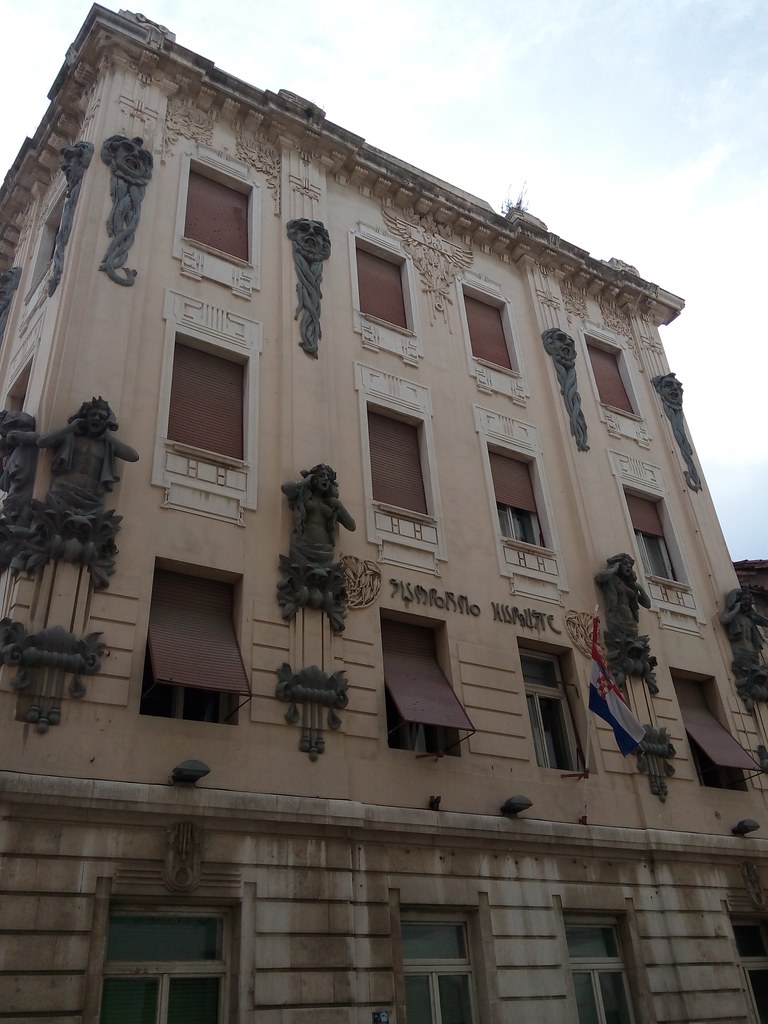
Head inland from the Riva up the strollable Marmontova street and 100m from the harbour on your right you'll see the elaborate decorated Art Deco building Sumporne Toplice. This is just before the fish market. 

The building apparently still houses / functions as a sulphur bath though there were precious little clues as to whether it was till in function other than a plaque with this text:
'This building of 1903 designed by Kamilo Tončić is an impotant specimen, with its richly decorative elevations and interiors, of Croatian Art Noveau architecture. It was built over natural sulphur springs that have been used for therapeutic purposes since the 18th century'.
The building itself is neatly adorned such as in the picture below:


Though the Vitaltourist source above mentions it still functioning, this article notes how it needs to be revived possibly to put Split on par with the German spa town of Baden-Baden.

A bit of history by Vlak (2000) which suggests that bathing halted before start of the Millennium:
'The sulphurous waters of Split have been in traditional medicinal use for a full 17 centuries, ever since the construction of the Palace of the Roman Emperor Diocletian. The "Sulphur Baths" of Split (Croatia) reached their greatest recognition and popularity at the beginning of the 20th century, when the sulphurous spring was declared to be the source of some of the highest quality medicinal mineral water in Europe. However, interest in balneology and climatotherapy, hitherto so popular in the area, subsequently declined. The "Sulphur Baths" gradually lost their importance and medical use of the sulphurous water gave way to modern forms of physical therapy. The beginning of the 1990s marked the end of commercial and every other use of the mineral water in Split'.
As could be expected, there doesn't seem to be much evidence of any action or possibility to admire the buildings interior. It does seem odd at the least that despite all the assurances of how a sulphur bath is a benefit to anyone's health, the waters simply drain into the harbour ... 
Still it could be worse. If one delves further in Splits history, where now stands the iconic Hajduk FC stadium were public mud baths with sulphuric mud (source).

Notes
Rusko, M & K. Balog (2007) Characteristics and origin of the Spilt sulphur spa (Southern Croatia). Manažérstvo životného prostredia 2007 Management of Environment ´2007 zo VII. konferencie so zahranicnou úcastou konanej 5. - 6. 1. 2007 v Jaslovských Bohuniciach. Proceedings of the International Conference, Jaslovské Bohunice, 5-6 January 2007

Vlak, T. (2000) From the history of the Split hot springs Reumatizam. 2000;47(1):25-30.

Tuesday, January 1, 2013

Dirty

Euro mud
Having previously blogged on (geothermal) mud baths in my Soaking in Southeast Asia blog, one wonders, why the need to yet again describe the essence of a mud bath?

Though mud baths exist all over the world, Europe and in particular the Mediterranean area seem to host many of the globe's known (and used) mud baths. 
And the Euro-folk like their mud baths more so than those of other continents, whether they are volcanic in origin (preferably) or not. 
What's more, the mud baths of Europe are often an integral part of the locals' wellness strategy. This contrasts with elsewhere on the globe, where mud baths tend to be functioning for the likes of tourists and the down-to-earth enjoyment has been substituted by an upmarket fulfilment scenario: how to reap the highest rewards from the visitor.

Care to join? Krinides, Greek Macedonia (Source). 

And  a final reason, since that posting, the internet has once again expanded and there is need to add / expand the original posting. 

I'll also update the list of  European (natural) mud baths, there seems to be no end of the list.

Essentials
Recapping that earlier blog entrance mentioned above, mud bath essentials are:
  • mud is healthy, 
  • anti-social, 
  • different, and 
  • mud is cheap. 
But increasingly mud and mud derivatives (clay, salt, peat) are becoming another treatment in the overall strategy of the wellness industry and thus a simple listing may need to expanded.

Harking back to the first point mentioned above (health), L Myers has an article (Jan. 12, 2011) which goes some way to understanding mud baths, at least from the point of view of the wellness industry. 
What do we learn?
Mud can be used as a bath or as an application on the body (really?). The author recognizes three significant origins of mud, those with
  • geothermal origin, 
  • that from the peat moors and 
  • those with a marine origin, with particular mention to the Dead Sea mud: 
    'The Dead Sea is located at the lowest part of the earth, 400 metres below sea level. Because of this, the rays of the sun are longer there than anywhere else and it has its own unique climatic biosphere that is believed to be particularly healthful'.
Wikipedia's entry on mud baths adds little to the above, though notes that some lake's muds health qualities are due to high salt / mineral content of the water and thus their silt (= mud). 
It divides the potential mud baths into those originating  from lakes, from saltwater seas/lakes, from geothermal origins and so-called mud volcanoes: often geothermal in origin but not necessarily so (Oddly, the entry in Wikipedia on mud volcanoes is far more extensive than that of mud baths; a win for science?).

The above seem to miss dry clay which added to (sea)water which can equally be beneficial of wearer; many a Mediterranean coast mud bath originates from here.

Despite the link with mineral content (and thus overall health benefits), muddy applications seem to be enjoyed solely by women, if I am to believe the internet. Women possibly having more faith in skin improvement qualities of mud rather than overall health benefits or it's easier to sell mud to women.

Many article will mention the fact that Queen Cleopatra already used Dead Sea mud to enhance her beauty. However, globally mud has always been used by locals, so possibly it's only for the records, that Cleo claims the first user.

Moroccan
Besides pure natural mud there are a number of other natural mineral baths / bathing options. For instance rhassoul.

Wikipedia states: 
'The rhassoul or ghassoul is a natural mineral clay mined in the Atlas Mountains of Morocco since the eighth century. It is combined with water to clean the body and has been used by Moroccan women for centuries to care for their skin and hair. Rhassoul contains silicon, iron, magnesium, potassium, sodium, lithium, and trace elements'. 
Especially, the quality that it can be purchased as a clay powder, has lead to it's widespread use within the wellness culture; lighter thus cheaper ... 
Another good source of info on rhassoul can be found on this French site. Maroque.co.uk mentions: 
'Rhassoul is also extremely rich in trace minerals: these minerals detoxify the skin by extracting a variety of skin pollutants. Two US clinical studies have been conducted on rhassoul, and in general it:
  • Reduces dryness;
  • Reduces flakiness;
  • Improves skin clarity;
  • Improves skin elasticity/firmness;
  • Improves skin texture;
  • Removes surface oil, and oil from inside and around clogged pores; and
  • Removes dead skin layers, resulting in a general smoothing of the surface skin.
...
When first mined, rhassoul clay is a brown, chunky soap-like clay.  Fine rhassoul clay is well suited for more delicate applications like facial masks.  The resulting powder is smooth and almost silky when rubbed between the fingers.  This creates a fine, smooth paste that looks like chocolate pudding and feels wonderful going on as a mask'. 
But essentially ....,  it's not really a mud bath ....

Claying
This brings us to pure (?) clay. This website has the following info:
'A clay bath is a therapeutic treatment used to reduce toxins within the body. During one of these treatments, the body is submerged in clay mixed with water. The clay works by stimulating the lymphatic system and by thoroughly cleansing the skin. It acts as a systematic catalyst, interacting with the bodys immune system. A clay bath can help to relieve any digestive burdens relating to the major organs within the body'. 
They recommend clay from Multan, Pakistan.  
Naturalnews reports: 

'Clay baths have been safely used for centuries. These days, they're used to treat everything from tired, achy muscles to heavy metal poisoning, radiation and chemical/pesticide exposure. Very recently, some surprising and encouraging results have been reported when using clay baths to treat autism.
Certain clays have the ability to remove toxins through the pores of the skin. Discussing clay baths, in his book The Clay Cure, Ran Knishinsky states, "It is a fairly simple procedure, and it can do a lot of good in a relatively short time. Because of clay's excellent drawing effect, the clay has the power to literally pull toxicities through the pores of the skin in the bath." And Wendell Hoffman, author of Using Energy to Heal, found that bentonite clay, when used in a bath, can and does draw out toxic chemicals through the pores of the skin'.
Specifically on Betonite clay: 
'Bentonite clay (also known as Montmorillonite) is an edible clay from naturally occurring volcanic ash sediments, and contains over 70 trace minerals'. 
Wikipedia though, in it's page on Bentonite, hardly mentions any health benefits, though it does mention that it combines well into a gel. Always nice for application purposes. 
What distinguishes clay from mud? Consistency? Note that for instance sand can also be used, for instance Beppu, Japan has famous geothermal sand baths.

Go organic
On peat/moor/turf Dr Lisa explains: 
'Peat is formed from organic materials and extracted from specific bogs around the world. It is high in vitamins, minerals and other substances, all of which have high biological activity.
Why does it work?
Microspores inside the structure of peat allow high efficiency temperature retention. This means it has the ability to keep the water at a consistently warm temperature. The increased heat along with the peat content allows for anti-inflammatory, anti-microbial and antioxidant effects. It can also reduce pain, elevate protein synthesis and increase circulation'. 
She also adds the following which seems to discredit her credentials: 
'Please bring your bathing suit as the more skin is exposed to the peat, the greater the benefit'.
So why not starkers?

Alive.com: 
'However, any old peat won’t do. In clinical settings, the peat of choice has often been sterilized and checked for quality'. 
The Wikipedia entry on peat baths doesn't help us much, in fact just a short paragraph, that seems to have been translated from the extensive German version. Germany seems to be the last bastion of the moor bath. 
There is also a German language wiki on Moorheilbad (peat spa baths) which includes a listing of many peat baths in Central Europe, though by no means complete.


Soaking in Southeast Asia has an interesting final paragraph on moor baths and their declining popularity ... (not sterile enough for picky people!). Der Zeit, in an article from 2011, believes that moor baths are in a renaissance. Their previous popularity was due to state sponsored wellness financing. With the gratis finance gone, the moor baths went into decline but now on the back of wellness popularity they are now regaining popularity.

Well, it may not be a natural bath, but it certainly looks like fun.
 Bad Buchau may afford you this pleasure ... 

Depending on where the peat originates terms such as turf (Ireland/England) or moor (South Germany) are used, but as many of the above, there isn't any natural occurring peat baths .... Or so it seems.

Finland adds it's own variation: turvesauna. A sauna while prior to entry the sauna entrant is 'blackened' by application of peat. This actually circumvents the need to wait for summer or heat a peat bath.

Extreme confusion
Salt soaks, not to confused with bath salts. Naturalingredient.org explains the pluses of a salt bath: 

'Salt bathing works partly because natural mineral salts restore mineral balance via the skin. Medical research has long established absorption of medicinal factors through the skin. Natural salt contains many minerals, including magnesium, which helps the nervous system, relieves stress, and can relieve water retention. It also helps bring about a healthy calcium balance, which strengthens bones and nails. The salt also contains potassium, which you need for your blood after exercise, and which you need for moist, healthy skin and all-over energy. Bromides in the salt heal and relax your muscles. And of course you need the sodium for healthy immune system as well as for appropriate fluid balance in your body'. 
This implies that any seawater might double up as a salt bath, nothing new there. However, it is in locations where salt content of water is much higher where natural occuring salt baths can be taken. Think Dead. Sea. And many a lake around the Black Sea or Mediterranean.

No Wikipedia entry on the reverse (bath salts) though they do have the following: 

'The term bath salts refers to a range of water-soluble, usually inorganic solid products designed to be added to water during bathing. They are said to improve cleaning, improve the experience of bathing, and serve as a vehicle for cosmetic agents. Bath salts have been developed which mimic the properties of natural mineral baths or hot springs'.
Listing
But as in this blog we focus on the natural, this entry also focuses on the natural enjoyment of Euro mud baths. Following is a list of known natural mud baths of Europe. Note that a list of peat baths can be found on Wikipedia, gt refers to geothermal, pt to peat and st to salt. Some of the non-qualified are from clay or I didn't find sufficient info to qualify them. Italic printed are natural baths, though not necesarily gratis.
        (note that Bulgaria is famous for it's mud. Even Hitler is said to have ordered 3 train wagons full of          mud. A great experience article).

 
     'Bulgarian mud baths' 
        (note, it seems that the only mud bath available in C.R. are peat baths ...)
        (note, mud bathing has gone into decline due to the public's preference for sun(bathing) = sand)
        (note, there are many more moor baths in Germany, see prescript above the listing)
 
 Arillas beach, Corfu (source).
 

'Mud Bath in Iceland

Hot Springs Hotel is a SPA hotel, situated in South Iceland in the middle of the activity circle and at the edge of the country´s most impressive and active volcanic area'.
#nature #sky #sun #summer #beach #clouds #cloudporn #dusk #weather #day #iphonesia #mothernature #love #tweegram #20likes #hashkeys #amazing #smile #follow4follow #look #instalike #igers #instadaily #instafollow #girl #instacool #instago #all_shots #webstagram
Popular in Spain are especially the mud (and clay) baths on the Baleric islands. Above Espalmador island near Formentera. (Photo source).
        The former link notes:
'Specific microclimate, splendid lanscape of the Donetsk Switzerland provide health recreation and keep your temper'.
So, let's keep our temper ...