Damn
Having had a blast (literally) in Iceland this March, let's look at what may or might not be making waves on the European natural hot spring topical trends.
Having had a blast (literally) in Iceland this March, let's look at what may or might not be making waves on the European natural hot spring topical trends.
Oddly when featuring Iceland, there's a lot to do about etiquette. Here's a funny entry by Averagedinks on a walk to Reykjaladur:
'Our plan now was to find a part in the river where we could go for a little skinny dip, we had the whole valley to ourselves and when else would you get a chance to do something like this. We walked and walked testing points along the way for the optimal temperature, as it turns out Mother Nature can not regulate her streams as well as we can our baths, the river was either luke warm or boiling hot. After a few soakers and a mud covered shoe we found a spot that was accessible, it was sooooo hot, I sat down and the water was almost bearable at times but the rocks on the stream floor were a little much for my manly parts. I jumped out and started running down the stream looking for another spot to bathe. I didn’t make it far before the ground turned to quick-mud and swallowed my leg, it scared the shit out of me. Once it registered that I was not in any harm, I could hear Deana laughing asking me to stay still so she could take a picture.
Ryan testing out the water temperature before Deana gets in. Quote of the day: “Hot Dog” – G. CoxfordI cleaned my naked self off and went to grab a towel when I heard Deana say that we were not alone, 4 guys were coming around the corner, Damn! Our private part/valley wasn’t so private anymore, I put my shorts on'.

And thus ends what could have been their slice of heaven if only they would have been more comfortable with themselves and less worried about others ...
Here are another two recent experiences on much the same theme.
Maya Seaman has a nice blog entry (December 3, 2013) on American experiences of Swedish sauna's. It gives good insights into how relaxed Europe is, how uptight the US is and how to adapt:
'What I do know is that after four weeks of being naked in a Swedish co-ed sauna (excluding the American ogle-fest that was week three) I learned that it is possible to like my body, and for men to appreciate it without sexualizing it—two statements I never thought I’d hear myself say—which is really the saddest part of the story'.
An entertaining entry on a visit to a true Turkish bath by pegsonthline (November 23, 2013) in which the author is flabbergasted by what is the right way to experience a hamam and what will come next:
'I sat on the stone stool, filled the plastic bucket and threw it over my head for the last time. I wrapped myself in the fluffy towel and plodded back to the changing areaI don’t think I’ve ever been this clean.I was scrubbed, washed and massaged all over'.
And before we head over to the country entries, just take a note that Fodors published (January 7, 2014) a list of Europe's best hot spring spa's
France
Very few real natural soaks left here, so it's surprising when a European natural hot spring photo pops up on instagram. This is from Rennes les Bains by leucatois:

Greece
On rappler.com an entry from AFP's Sophie Makris, which supposedly was somewhere on AFP's own site in French on April 8. It's a very interesting article on the perils of business operations and hot springs in Greece:
"We have an exceptional product but it is poorly used," sighs Markos Danas, secretary general of the union of Greek spa towns.He notes that across the country less than a dozen sites offer acceptable tourism infrastructure."Hot springs are mostly run by local communities, and this has limited the scope of development," he adds....For years much of the clientele were Greek pensioners on state-funded curative tours.However, in the wake of the economic crisis gripping the country for the past five years, demand has fallen dramatically.The union of spa towns reports a 50-percent drop in paying customers since 2009.The spa towns are now hoping an EU directive that authorises reimbursing citizens taking hot baths in other member states will revive interest.Greece's state privatisation agency last year also offered four hot springs in central Greece, including Thermopylae, for sale to private developers.But there were no takers ...'.
LA Swimming crossing the borders, to the Pozar hot springs of Loutra, Greek Macedonia. Great photo's.
Earlier this month Emily visits the hot springs on the island of Kos:
'Welcome to Therma Beach! These hot spring were discovered by the Italian archeologist Laourentsi in 1934. The hot water runs straight down to the ocean, where a pool is carved out for soaking.When we arrived, there was just one Russian couple getting ready to leave.Rob and I soaked in the water for over an hour as cool waves splashed over the rocky barrier. We had the pool to ourselves the whole time. The hot spring contains potassium, sodium, magnesium, sulfur and chlorine that are "ideal for rheumatism, arthritis" and many other ailments. The smell isn't as sulfur-y as the hot springs I'm used to in California'.
Greece is still a great country to find dreamlike hot springs, take this one from the Spanish website of furgovw from the island of Samothrace:
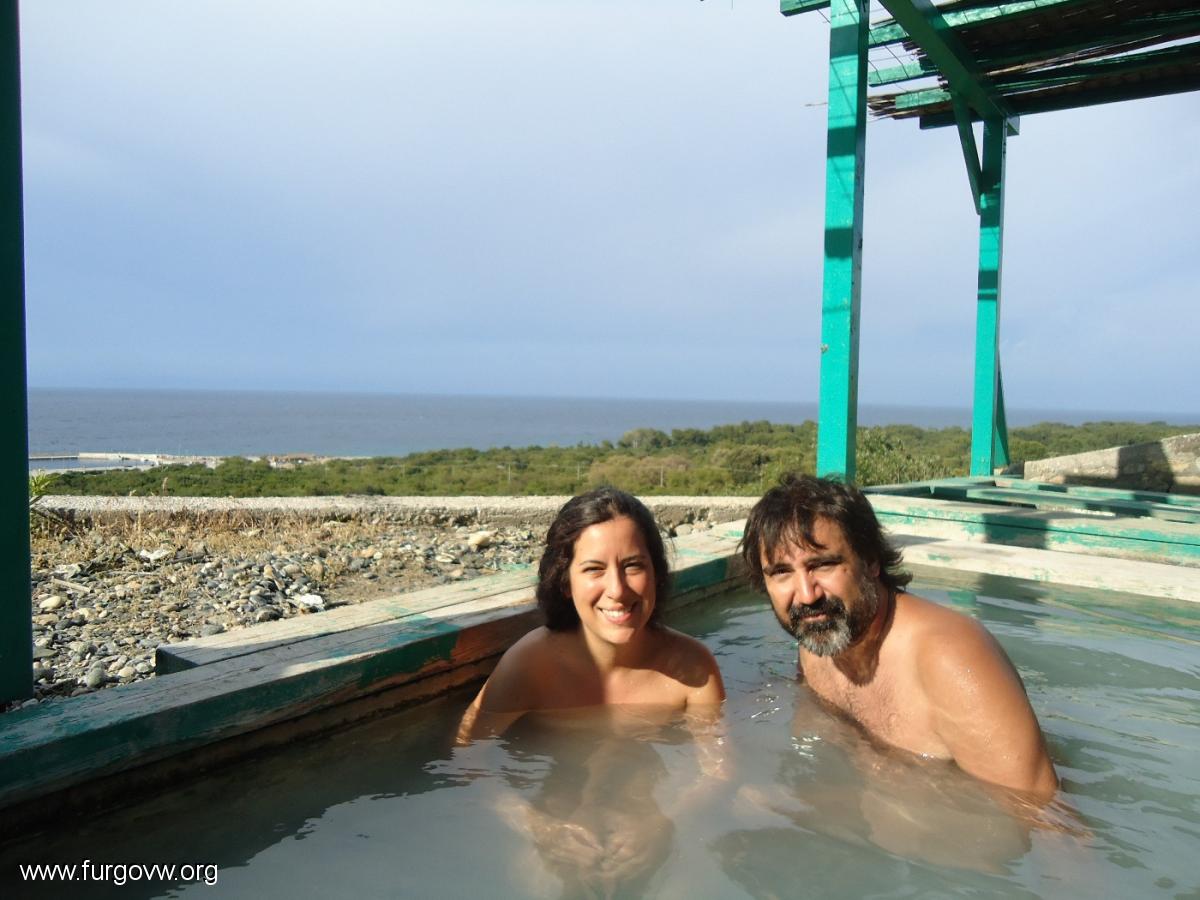
'Y en Termopilas también está esta maravilla'.
Italy
In Italy they are developing environmental friendly geothermal energy (think geoenergy, January 29). And here we were thinking that geoenergy can only be eco-friendly. The article fails to mention why it's environmental friendly, low impact?
Meanwhile Maremme Tuscany wishes us a Happy 2014. Thank you. Then it let's us in on a secret:
Head over to the website and it will reveal the secret ...'A lot of love for the Maremma was given to Saturnia and her magnificent hot springs. The Lonely Planet listed it as one of the top 20 hot springs in Europe. Not bad for a tiny, obscure town in Southern Tuscany.Saturnia is practically in my backyard, so it’s only fitting that I share my secret for experiencing Saturnia’s hot spring like a local'.
Spain
Termatalia is an international trade fair promoting the spa industry between Europe and Latin America. the upcoming meeting will take place this October in Termas de Rio Honda in Argentina. Heavy sponsorship comes though from Galizia and especially the city of Ourense (see the Eurosoak entry on ourense and it's hot springs), which has a fair claim to being one of the worlds capitals of hot springs. One of the web pages has a lot more info on the hot springs of Ourense.
A good French blog entry on the hot springs of Zujar / Granada complete with photo's:
'Eté comme hiver, il fait bon se prélasser dans des bains d'eau chaude sulfureuse à ciel ouvert dont la température moyenne avoisine les 40°C.Cette source située en montagne est un petit endroit privilégié.Aucune structure n'est construite pour s'y baigner ou y accéder.Les petits bassins formés naturellement par le débit de l'eau sont composés d'argile et de petits graviers.Sur le Jabalcon (ancien volcan), il est possible de randonner, de voler en parapente, de se baigner dans le lac Negratin et de s'offrir une petite trempette insolite en eau chaude'.
Meanwhile nearby (Santa Fe / Granada, I presume) more exposure:




