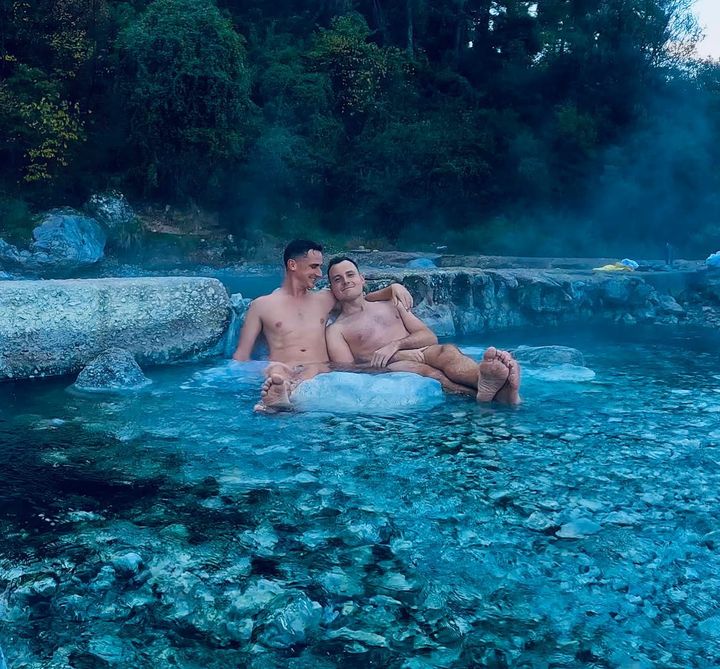
Geen zwembroek?🩳🙅🏻♂️ Geen probleem! Net een heerlijke duik genomen in ons privé zwembad 😌 Hopelijk gaat dat zonder zwembroek even #Trefzeker als TONZON isolatie!Would you dip with or without? 😏👙🩲#EventrefzekeralsTONZON #Linkinbio #hotpool #hotsprings #hotspring #hotpools #hotpoolparty #relaxtime #thermalbaths #thermalbath #thermalbad #letsgetnaked #nakedheat #thermalwater #thermalspa #thermalsprings #freespace #thermalpool #nakedtruth #nakednature #nakedfeet #nakedtoes
A more serious post this time round. More on what's topical and basically what I have come accross and feel the need to share.
We're starting off in the lost and found section. A small discovery, The Guardian (Nov. 28) has an article about a Roman villa in Rutland (central UK) with a steamroom:
'Archaeologists at the site of a Roman villa complex in the east Midlands have discovered that its wealthy owners converted an agricultural timber barn into a dwelling featuring a bathing suite with a hot steam room, a warm room and a cold plunge pool....The main feature of the dwelling was a Roman-style bath suite with sophisticated underfloor heating and heating ducts built into the walls. A tank outside the building may have been used to collect water from the roof'.
More significant though has been the extensive global attention given to the archeological dig in San Casciano dei Bagni and what it delved up from its past. Again the Guardian (Nov. 11):
'Since she was a child, Martina Canuti has been venturing down the steep hill flanking the Tuscan town of San Casciano dei Bagni, known by residents as “the sacred mountain”, to take a dip in the two ancient hot springs famed for their therapeutic benefits.Little did she know that just a few metres away lay a sanctuary built by the Etruscans in the second century BC, containing a trove of treasures that could now reverse the fortunes of this relatively isolated town of 1,400 inhabitants near Siena....Agnese Carletti, the town’s mayor, was curious too. Supported by funding from the government and private donors, she helped to set in motion an archaeological project that led to the discovery of 24 bronze statues, mostly dedicated to the gods, buried by mud and boiling water in the ruins of a network of thermal springs that had been a place of worship for both the Etruscans and Romans.“It’s as if we found oil,” Carletti said. “Maybe all these gods are now bringing us some good fortune.” She said she hoped the find would trigger a tourism boost in a town facing economic challenges because of depopulation....He [Dr Jacopo Tabolli, an assistant professor at the University for Foreigners in Siena] said the sanctuary, which was made more opulent during the Roman period, when it was frequented by emperors including Augustus, remained active until the 5th century AD, before being closed down, but not destroyed, during Christian times. The pools were sealed with heavy stone pillars while the divine statues were left in the water, which was rich in minerals, including calcium and magnesium.“This water was considered great for the liver, for treating facial pain, for helping with fertility,” said Tabolli. “There was a lot of ritualistic practice connected to pregnancy, so the theme of natality was extremely important. But this was definitely not drinkable water, as it’s poisonous.”Etruscan and Roman inscriptions have also been found at the site, and Tabolli said the artefacts uncovered so far represented an important testament to the transition between the two historical periods, with the baths being considered a haven of peace....Bathing in the thermal springs under the light of a full moon on Thursday, the existence of the adjacent cordoned-off archaeological delight also came as a surprise to Sabrina Lepri, a visitor from Perugia.“I was wondering what was behind the fence,” she said. “I’ve been coming here for 25 years, I love the springs for their natural wildness. Every time I emerge from the baths my skin feels incredible, as if I’ve had a massage. I hope the newfound fame doesn’t change things too much.”

One of the findings of San Casciano dei Bagni. Credit : Ministero della Cultura
Prescription
A bit more explanation from the period as well as explaining why soaking is so enhancing. From SOS-SenseofSelf (Sep. 27):
'We can intuitively feel that bathing in hot water is good for us: whether a restorative two hours at the bathhouse or simply a long soak at home after work, it feels instinctual and somehow just right for our bodies and minds to be drawn to bathing. The idea of water being an ingredient of wellbeing is thought to have its origins in the word spa, or sanus per aquam in Latin, which beautifully translates as ‘health from water’ or ‘the health that comes from water.’The hot springs of Europe have been associated with healing for centuries. The Ancient Greek and Roman spa cultures saw a connection between water and health. Some sources describe how the Ancient Greeks used clay and epsom salts, infused baths with bay laurel leaves and lavender-scented water, which doesn’t sound too different from many aromatherapy and spa treatments in the modern day. The Greeks also used thalassotherapy (saltwater bathing), while the Romans prescribed hydrotherapy that included not only immersing the whole body in water, but also drinking it in large quantities....While it all sounds dreamy and magical, what draws many to spas and natural hot springs around the world is a wish to feel better. Rather than expecting miracles, the healing elements of bathing are one ingredient in a more holistic way of caring for the body and mind. This view can also recognise the fluid, changeable, cyclical nature of our bodies and that how we feel is bound to fluctuate. Challenging the idea of health being a singular destination, and notions of being ‘fixed’, we like to think about meeting the body where it is, connecting with it in some way, doing what feels good - a more natural and realistic concept of feeling well, and healing'.

THE PURIFICATION
From the L'ultimo Paleologo - Emanuele Rizzardi (Apr. 7), the answer to the question why we stopped using public hot springs and public baths during the Middle ages:
'Some say that it was Christianity, with its puritanical view, that forced citizens not to attend those places'.
Mention is made how once Roman empire imploded, the management costs of running public hot springs was simply unaffordable. A bit unclear.
Moving up the history ladder then. During my recent focus on soaking in Switserland I came accross info on the Büvetta Tarasp which was built in the 1860's. From Engadin.com came this:
'The two mineral springs Lucius and Emerita bubble up in the Büvetta Tarasp drinking hall. They are the richest mineral springs in the Lower Engadin and the Lucius spring is even considered the strongest mineral spring in Europe. Also the building itself that shelters both springs is a special feature'.
The beautiful drinking hall has fallen into disrepair though here too are activities to get it back up and running. In the milestones:
'2021Receipt of an NRP grant within the framework of the «Mountain Areas Programme Graubünden 2020-2023» in the amount of CHF 24,686.00 to develop the conceptual foundation'.

Büvetta Tarasp: Die Mineralablagerungen (Quelltuffe) an der Stelle, wo früher das Mineralwasser in den Inn geleitet wurde, sind gut sichtbar.badekultur.ch - Badetücher für das Wasserschloss Schweiz#retro #swissdesign #swissdesigners #serviettedebain #segeln #rudern #societenautiquedegeneve #schweiztourismus🇨🇭 #tourismswitzerland #suissetourisme #regionaleprodukte #produitslocaux #regionduleman #vaudtourisme #badekultur #badekulturinundennetbaden #sommeramzuerisee #sommeramzuerisee #leaulairetmoi #rhiischwümme #basel #baselswitzerland #rhyschwimme #engadin #büvettatarasp
Not entirely to do with soaking, but still encouraging as we seem to be moving forward by heralding the past. The town of Bath has opened a two century old lido swimming pool. The Guardian (Sep. 30):
'Built in 1815, the Grade II-listed Cleveland Pools is the UK’s oldest public outdoor swimming pool. The country’s many revamped lidos were mainly built in the 1920s and 30s, so are whippersnappers compared with this one. Hidden from general view, the pools (there are two – a main 25m pool and a children’s splash pool) are set within a walled garden and reached via an unassuming footpath between two houses on a quiet residential street. The feeling of otherworldliness is enhanced by a caretaker’s cottage and changing cubicles shaped like Bath’s Royal Crescent in miniature, and the pools’ lagoon-like position along the River Avon'.
Unstable
A couple of shorter snippets of info.
Les Bains de Taccana (southern Corsica) are receiving a long overdue renovation, considering they have been closed for 15 years. Ongoings easy to keep up to date with on Instagram.

Petit bain dans une source thermale à 38 degrés pour se détendre de cette journée éreintante 😉😉😉 #caldane #sourcethermalecaldane #vacances #corsica #detente #sourcethermale. @sourcethermalecaldane
More faded glory though with a bright spot for soakers. The low levels of the various artificial lakes in Spain, leave excess to forgotten hot springs.
El Cado do Chorche (Nov. 21, 2021, but only recently updated) on the termas of Tiermas (Navarra / Alto Aragon) has the last word. Translated:
'Although most of the time it lies under the waters of the Pyrenees Sea, as it is known due to its colossal dimensions, in times of great drought the ruins that mark the place where it was located are discovered. Then the miracle arises and the hot springs spring from the rubble'.
He notes that for centuries bathing was possible, up unto WWII, when fire wrecked havoc on the bathing facilities which eventually became submerged when the hydropower lake came about in last century's fifties.
Recent levels have brought back a Medieval bridge:
'Currently the Yesa regrowth expansion works are being carried out, controversial due to the administration's commitment to carry them out with the justification that it is the expansion and consolidation of irrigation as well as the water supply to Zaragoza capital. However, its cost is very high, and it increases day by day due to the technical difficulties of building the dam on unstable slopes that create an unaffordable security risk. With the work finished, the level of the reservoir would rise and the remains of the spa would possibly be submerged ta cutio*'.

chaverocampanom (at Tiermas):
Esculpiendo M❤️More Spain.
The ever excellent Tierras sin Fronteras provides (Oct. 22) it readers of all the ins and outs concerning Termas de Arnedillo, Rioja country, again northern Spain. Their tips (translated):
'The first and most important piece of advice: I recommend visiting the Arnedillo pools during the week or at unusual times, at dawn or at night. On weekends this is a place very frequented by people and what should be a relaxing and quiet activity can become the complete opposite. This does not happen on weekdays or non-holidays....It is important to respect the atmosphere of tranquility and relaxation that is created in these natural baths. Avoid talking loudly, making noises, eating or drinking inside the Arnedillo bathrooms, smoking, leaving garbage....If you are not capable of behaving in this way, it is better not to visit them. People will thank you!'
HolyandHealingwells has travelled abroad for the summer. There's an entry (Aug. 19) on Catalunya's Caldes de Malavela. Again lots of ancient history.
'All around the town can be found three natural hot mineral-medicinal fountains: La Mina or Raig d’en Mel, Sant Narcís and Bullidors. In some cases such as La Mina these waters were utilised for safareigs or municipal cloth washing areas and indeed I was informed at the museum that people still use them although generally it was around the 1960s that they generally fell out of favour. However, the Font Raig d’en Mel arises at the base of a large wall of rubble and feeds quite modern looking washing areas'.
The Malavela located Balneari Prats still has thermal wellness on the menu, as does the Vichy Catalan.

Green
Back to Italy with bathing news from Viterbo.
In early summer 2022 (Jun. 23), Tusciaweb reported on that the court case which sees the indefinite closure of the Bagnaccio thermal park. The article sets out to clarify why the appeal was knocked down. Either the case is very difficult or we have literally lost the giss of the story in translation.
Still on Viterbo, relevant or not to this everlasting tug of war concerning public access to the local hot spring water. Tusciaweb (Nov. 9) and translated:
'The judge ruled definitively declaring: “The cessation of the matter of the dispute between Free Time and the Le Masse di San Sisto association – reports the sentence – with full compensation of the costs of the litigation.It partially accepts the request proposed by Free Time and therefore prohibits the Antiche Terme Romane from any form of cultivation, pumping, capture, collection or use of the hydrothermal waters from the San Sisto well and condemns the removal of all works connected to the direct use of such waters".Fulfillment already carried out: "Acknowledges that the execution has been carried out".It is the final chapter, even if the story has yet to be written in the area, with Freetime engaged in the construction of a spa facility in Paliano, with the modified project in progress also due to the constraint imposed by the Superintendence.So the closure of the San Sisto bathing facilities has been formally approved'.
Earlier in the month (Nov. 2) Tuscia Times noted how many visitors the Viterbo (and mostly free) hot springs were attracting. Translated snippet:
'The clear sky and the pleasant sun have invited many bathers, eager for relaxation and well-being, to immerse themselves in the monumental swimming pool and in the other Viterbo thermal baths that have always been appreciated by the inhabitants of the City of Popes'.

Mi consiglieresti di visitare i Bagni San Filippo? 😊Se ti va di dare un’occhiata o seguire la mia pagina ne sarei felice! 🤙🏻
Then something different. ThinkGeoenergy concerns (Sep. 2) itself with Italian geopower generation, Green Power versus environment:
'Italy Prime Minister Mario Draghi has given the green light for a 10-MW binary geothermal power plant in the industrial area of Val di Paglia at the foot of Mount Amiata in the Abbadia San Salvatore (Siena) municipality, Tuscany. The project was proposed by Sorgenia and will be the first geothermal power plant in Italy that is not operated by Enel Green Power.The decision of the PM overturns the rejection of the project by the Superintendencies for environmental reasons. After unsuccessful mediation between the Superintendencies via the Ministry of Culture and the Tuscany Region, the decision fell at the hands of the Council of Ministers who ultimately decided in the affirmative.The proposed power plant will also be the first in Italy to use binary cycle technology. Those who support the project have highlighted the lack of emissions of this type of power plant. It is expected to go online not earlier than 2027. According to the forecasts of the project, it will supply the power needs of 32,000 families and will help avoid emissions of up to 40,000 tons of CO2.According to the regional regulations, Sorgenia will need to conduct geological investigations with focus on the subject of subsistence. The company will also need to provide a report on the compensatory reforestation effort including details on the choice of plant species, density, plant spacing, and care'.
Rubbed
A couple of various country specific finds.
Over on medium.com an article (Nov. 6) on a visit to the Kaiser Friedrich Therme in Wiesbaden (central Germany):
'When in Germany, do as the Germans do. Did anyone recoil at seeing my naked body? A little disappointingly, no one even looked....So, what was the price he [author's partner] paid for not coming into the therme with me?Well, he missed out on meeting two lovely American girls but more than that, he was so upset at me going naked in front of other people that he walked into a solid glass door, almost concussing himself. He developed a massive headache that lasted all the way back to England'.

Wanderingcarol (Nov. 1) has a look at Fairytale Czech spa towns:
'Spa towns in the Czech Republic have history, style and water in abundance. Even if you’re not interested in spa treatments, the spa culture here is so much more: grand architecture, tradition, scenic locations and incredible hikes'.
A very thorough intro to the subject. Some more:
'Don’t Be Scared of Medical spas in Europe. They’re Not What You ThinkWhat’s a European Spa Cure?It’s a spa package that is several days long, and generally includes treatments that are traditional and organic in nature such as thermal water baths, mud or peat wraps, and massages.When you take a ‘spa cure’ in a Czech spa town you start out with a visit to the spa doctor in either your hotel or at a central spa.Seeing a Spa DoctorSeeing a spa doctor is common in other European countries too, including France, Italy and Hungary. While the thought of seeing a doctor on my holiday used to fill me with fear, now I look forward to working with the doctor to plan a custom-made medical spa holiday.What are Medical Spa Treatments in Europe?In North America we might refer to medical spa treatments as ‘wellness’ treatments. They’re more focused on healing than pampering.In general, Czech medical-based spa treatments (medical wellness) revolve around organic therapies based on natural resources. Think spring water, mud, and natural CO2. They include things like mud packs, massage and mineral-water baths.So when we’re talking medical spa therapies, we’re not talking plastic surgery – though in some expensive high brow spas that might be an option.This traditional type of medical wellness goes back hundreds of years in Europe, and the area of Bohemia in the Czech Republic is one of the best places in Europe to dive in....Here’s something that may surprise you. Franzensbad is also famous for treating gynaecological disorders, including infertility.In fact it’s such a well-known Czech spa for treating infertility that one of its main attractions is the bronze statue of a boy named František in the main park. It’s said that rubbing either the statue’s private bits or the nose (I’m not sure which, because I don’t dare go near it) will give you a leg up (pardon the pun) on bearing children'.
Akbartravels.com poses (Nov. 25) the question of whether there are natural hot springs in Georgia. A.:
'Natural Hot Springs in Georgia have been part of life and culture since the fifth century, and the bath houses gained prominence in the 13th century. They were mostly for everything, not just beating. Georgians would love to socialise and debate the day’s issues, and mothers would even use these to assess the bride’s suitability for their son. Workers from the different unions would travel to Georgia to visit the thermal bath during the Soviet era. They are exercising their rights to rest as afforded by the constitution'.
From the above you'll already note that the English language is set to expand with new expressions. On Tiblisi:
'The majority of the bathhouses offer public and private options and kissy scrubs besides massages'.
With the query answered comes a detailed list of where. Though I stick with our own recommendations on this blog.
Youcouldtravel has an updated (Dec. 2) guide to Caciulata (Romania).
'Caciulata is a mountain town in Romania in the country of Valcea. It is located by the Olt River, by the Southern Carpathians. Caciulata has several thermal springs, hence it is mostly known by locals as a spa town'.

Bains Naturels Sauvages de Prats Balaguer #bath #hotwater #nature #mist #pyrenees



