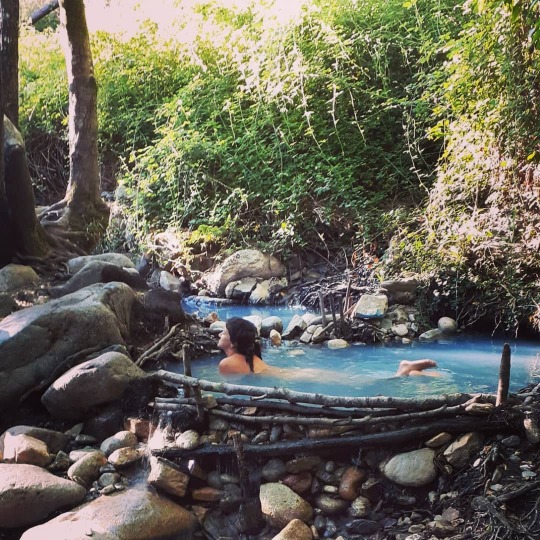
Spending a day in nature can give you a totally different view on things. No better way to start the week 💚#naturelove #maibachl #friendshipgoals #positiveliving #happymonday #justkeepswimming #hotandcold
Traversing the continent with photo's; autumnal, wintery and / or some left over from the summer.
Starting with the outliers. Above the seasonal Maibachl (Karinthia, Austria; usually only in spring), following Rupite (Bulgaria), Pyatigorsk (Russia) and a report from Slovenia's Klevevž warm spring.

Those who have been following us from the beginning on might know this place: more than 2 years ago we already took a hot bath at sunrise in the hot springs near Rupite. This time we needed a shower, 🚿 so it was just a quick Stop to wash hair with our „tea-mug-shower“. Did you know that Bulgaria has nearly as many thermal springs as Iceland?#hotsprings #heißequellen #hotspring #thermalquelle #thermalquellen #hotshower #outdoorshower #thermalsprings #thermalspringwater #thermalbaths #thermalbath #vanlife #vanlifegermany #realvanlife #vanlifereality #vanlifeeurope #vanlifemovement #vanlifeideas #vanlifeliving #travelove4u #bulgaria #bulgarien #bulgarienreise #bulgariatourism #lovebulgaria #balkan #rupite #bulgariatravel #thermalsprings #hotbath #badegumpen

Бесплатный сероводородный горячий источник. На горе Машук

Ana on the Run (Sep 16) translated:
What could be nicer than a morning bath. And not just any bath, but in a natural pool of thermal water. Although locals say that about a year ago this pool was hidden from tourists, this has changed this year. Klevevž has become a real tourist stop. We hoped that when we got to the pool, there would be no crowds. We were lucky, there was only one family there, but they were just leaving the pool and we were alone for a while. The water is really crystal clear and beautiful in color. It had a good 24 ° C and it was a really nice awakening. We soaked for quite some time until a whole bunch of people showed up all of a sudden. We dried up and slowly made our way towards our next stop, to the next place we were going to explore.
Package

I love this hot spring near our house. I hope that people will start to appreciate nature and these beautiful places again 💨🌊#iceland#hot#hotsprings#hotpools#swim#relax#nature#vegan#Vegangirl
Iceland then, lest we forget.
Above Hrunalaug, below Landbrotalaug, then the hot river of Reykjadalur.

You can get out BUT AT YOUR OWN RISK.😂 Either the wind will blow you away to the other side of island orrrr... people see you being naked. Choose your package!💁♀️ #travel #iceland #icelandroadtrip #hotpoticeland

PathwayWish I was flashing Iceland right about now.#reykjadalur #reykjadalurhotsprings #iceland #iceland🇮🇸 #iceland #icelandair #ringroad

Enero 40°C#termasdesantafe #granada
Spain; above Andalucia's Santa Fé (Granada), then below Prexigueiro (Ourense, Galicia) while the last in this paragraph is just north of border in France, Prats Balaguer.

🦎RECTA FINAL🦎.Ya nos quedan pocos días para salir de #Galicia. Y lo hemos disfrutado taaaanto.Sabemos que no hay que comparar, pero es inevitable pensar en el #vantripEspaña parte 1, en el que fuimos desde #Catalunya hasta #Huelva y donde, vimos un montón de cosas chulas, pero fue un viaje de estrés y momentos malos.En este hemos tomado nota de los bien que lo hicimos en #Indonesia. Y hemos ido con la calma. A nuestro ritmo y parando cuando nos lo pedía el cuerpo.Y sí, ves menos cosas. Grabas menos. Pero y lo relajados que estamos... Y si no, mirad la foto. Solo le falta el Hashtag de #AquíSufriendo jaja..¿Cuál ha sido vuestro mejor viaje en todos los aspectos y por qué? Contadnos vuestras experiencias viajeras.....#thewalkingtravel #twt #Ribadavia #Prexigueiro #norteEspaña #españa #spain #northspain #couple #termas #termasdeprexigueiro #aguastermales #termasnaturales #termasgatruitas #vantrip #roadtrip #viajarenfurgo #vivirenfurgo

Si preguntan diles que me fui, que cogí el primer sendero que vi, que solo quería intentarlo una vez más, volver a ser feliz.
Earth

El calor emana de la tierra, tiermas, #navarra #spain#spain🇪🇸#travel #travelphotography #travelgram #traveltheworld #travelblogger #pamplona #pamplonamegusta #pamplonairuña #paisajes #paisajesnaturales #paisajesespaña #tiermas #termas
Getting muddy; above Tiermas, (Navarra Spain), then Mar Menor (Murcia, likewise Spain) while we wash off the mud with Greek Macedonia's Krinides.


#wildsoul 💚🍃Il paradiso dietro casa#adventure #nature #happy #freedom #wild #wildlife #sound #green #greenlife #amazing #happiness #life #aroundtheworld #love #siciliangirl #sicily #siciliabedda #crazyfriends
Italy; above on Sicily, the thermal springs of Segesta. Following Bagni di San Fillipo (Tuscany) and then finishing with the Pozza di Leonardo (Sondrio, Lombardy).

What a marvelous experience went back to one of the most powerful and gorgeous, hot spring of the world...Toscana have many places really beautiful, and so is always nice to stop by, and enjoy wild hot springs! San Filippo hot spring is a really magic place, thank u family to thrive all together in a better reality 🦄🧬🌈💖🚀#hotsprings #bagnisanfilippo #toscana #gorgeous #fantastic #italy #lovefamily #family #cosmicbaby #lovemylife #bellissimo #termal

🔥Hot Springs - what could be better after a tough week of training then a warm water session?.@bormio.info is well know for their warm water and famous @termebormio but there is also a unofficial hot spring right in the valley. Located next to the river it's just unique..Feels a bit like being back in Colorado. @justin_reiter.#hotspring #water #spa #livemorenow #relax #outdoor #outside #nature_perfection #naturelovers #mountainview #waterpool #relax #enjoy #nevergrowingup.