
terzian.artin at Ankavan (Armenia)
Or just an overview of some soaking news from Europe.
Starting off with the general info. Wildcamping.tips tries to make a database of
'... free accessible natural hot springs from all over the world'
Most are from Iceland and mainland Europe, not much beyond apparently (?).

laraluksic at Grič pri Klevevžu (Slovenia):
🌿❄️ #placeformysoul #winter#ididit #andilovedit #hotspringThe Guardian (Dec. 4) has European affordable spa's on it's roster: Istanbul to Iceland, Turkish baths in Harrogate and palatial banya's in Moscow.
Mastering

We found hot springs that came from the ground in this little Cove next to the ocean on our ATV exploration. @becomingyou modelling here although the water was very hot! Apparently the hot springs have been used since Ancient Greek times by nobility as therapeutic waters.#greece #kythnos #happyplacefound #hotsprings #travel #wander #wanderlust #worldshotz #travelphotography #travelphotographer #nikon #vsco #exploreeverything #exploregreece #passionpassport #instapassport #travelgram #bikinigirl #bikini #prettyinpink #vacation #summer2017
Rediscovering Eleftheron hot springs. In Transit (Feb. 24) tours northern Greece and comes across this excellent hot spring:
'Turning off a regular looking coastal road in Kavala, Greece and with little civilisation around, we pulled up to Elefteron (Ελευθερών). Our first thoughts? This place is SUPER. CREEPY. In fact, we actually spent a few minutes debating whether or not it was too creepy to stay overnight... then Alice saw friendly stray dogs, so the decision was made (as it often is where dogs are concerned). After consulting our good friend Google, from what we can gather, this place was a working thermal spa resort up until as recently as 2009. Now, it seems to be mostly characterised by dilapidated buildings; many dilapidated buildings. Despite that, it was actually quite a social hub, and we watched for a while as people would come and go.
...
On the second day, I plucked up the courage to go for a soak. The water was around 40 Degrees Celsius with rich sulfur sources - which I was happy about since it basically made my eczema disappear. Whilst I was in there, I couldn't help thinking about how incredible nature is. I thought back to my previous couple of blog posts where I had been down on the weather, and it reminded me that regardless of how inconvenient nature might be... It's still incredible, and something that we should really appreciate and protect. I couldn't help feel sad and wonder why this beautiful place had been abandoned. After doing some research, there seems to be a 'stand-off' in regards to the future of Elefteron. In 2012, the government planned to allow investors to buy the site and turn it back into a spa resort. These plans were called into question by a Citizen's Initiative who wish to protect the archaeological significance of the site. Due to, I assume, the economic climate of the country, the abandoned thermal spring seems to have been forgotten about (formally at least). Meanwhile, it appears to be enjoyed by locals, tourists and travellers a like. An unusual find, and certainly a memorable overnight stop'.
vantast1cvan at Eleftheron:

We found an another wild hot spring. Thank you Greece for the great memories and wild camping friendliness. We sure are going to miss You 🇬🇷🚐🍾🍺 Tomorrow brand new country ahead! #hotsprings #greece #roadtrip #homelesschic#wildhotsprings #braineatingameba#goodtimes❤️Coincidentally, ThinkGeoenergy (Dec. 8) notes that greedy hands are eyeing the non-development:
Lesser'"the municipality is in the process of developing a master plan for the optimal utilization of the municipal area combined with the exploitation of the geothermal field”.
The geothermal field of Akropotamos is located in the coastal zone of the Municipality of Pangeo between the area of Loutra Eleuthera and the beach of Karyne on the main land of Greece'.
Rough Guides (Feb. 28) notes 6 reasons why to visit Iceland in 2018:
'4. You can take a dip in Iceland's newest hot springs...Now, however, you can soak the day away at Krauma, a sleek and sophisticated geothermal complex ninety minutes northeast of Reykjavík. Its five pools are fed by Deildartunguhver, Europe's most powerful hot spring, and are cooled to a temperature that's suitable for bathing by glacial meltwater from the Rauðsgil river'.

abbijayne at Hrunulaug
Cheers to #iceland!
The hot springs of Iceland are the backdrop of a Playboy shoot (Fappeningblog, Jan. 10).
Less glamour, the Reykjavik Grapevine (Mar. 5), for reasons unbeknownst to us, notes the following and attributes the subscript:
'Icelandic life ain’t easy. Here are [one of] the latest works from Grapevine cartoonists Elín Elísabet and Lóa':

Seven reasons to visit Iceland? A slightly older blog entry (Dec. 28, 2016) by Holidayfromwhere.
'Less people:

I have only really seen photos of this place kind of crowded or with at least a few groups of people here. We didn’t see anyone the entire time so we took the chance to enjoy it el natural'.Regulated
'We went to another free hot spring /thermal bath, this time in Arnedillo, Spain.
After midnight, under the stars and the moon. Cold air, nice hot water and we have the pools for ourselves ❤️'.
We decided to stay for a few days here in Arnedillo. The weather is great, we found a great vanlife spot and we have the thermal pools just a few meters away.
Taking hot baths every day isn't something we're used to'.

The Iberian island of Espalmador, just off the coast of Ibiza and home to the famous mud baths is not for sale anymore according to the Guardian (Mar. 18):
'The spokesperson told Spain’s Efe news agency the new owners had bought it for their own use and were fully aware of regulations that protect it as part of the Ses Salines natural park'.
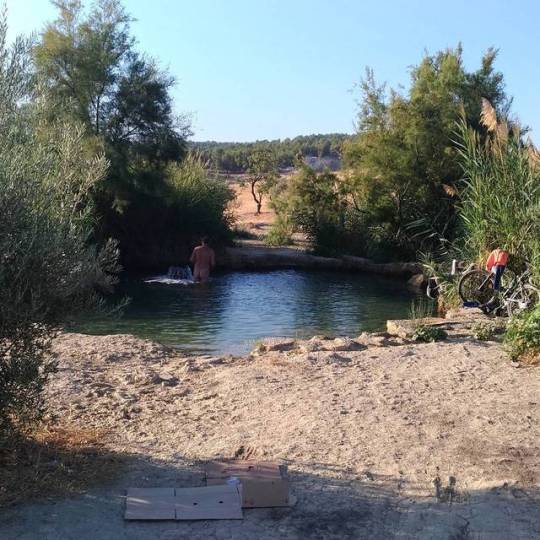
robertvasicek in south Spain
#termas de #santafe #termasdesantafe #thermal #basin #swimmingpool#andalusia #spain #espana #spanelsko
Mingling
Hot on the heels of the Irish seaweed baths, I learnt that Ireland also had it's own homegrown sweatlodges. Irishmegaliths:
'Irish Sweathouses are small, rare, beehive-shaped, corbelled structures of field-stones, rarely more than 2 metres in external height and diameter, with very small "creep" entrances which may have been blocked by clothing, or by temporary doors of peat-turves, or whatever came to hand. Most of those which survive could not have accommodated more than three or four sweaters. They resemble the small 'caves', built into banks, in which many Irish natives were reported to live in the seventeenth century.
Some have chinks to let out the smoke, but they were necessarily cleared of fire and ash before use - so any chinks (deliberate or otherwise) in the rough construction would have served as ventilation ducts in a cramped space. Where these were too big, they were stopped with sods or with mortar.
They were often covered with sods of earth to counterweight and stabilise the corbelling, and these would also have acted as insulation after firing. That they were fired is certain, for soot remains on the Thus they are different from North American sweat-lodges or ceilings of some.
They are different from the North Anerican sweat-lodges ot inpis, which were rarely if ever stone-built, and were heated by carrying hot stones from a nearby fire. Northern European saunas and bath-houses are a modern variant, with an enclosed stove upon or around which stones were placed. Stone retains heat very well'.
There seems very little info; for instance it's unclear if these were early nineteenth century or from much early. What is known is that the Irish have discontinued this practice. Amayodruid:
'Sweat Houses were used in Ireland from the earliest times down to early in the 19th century for the cure of rheumatism; it was also reputedly a cure for temporary madness.Experiencing seaweed baths in Enniscrone. Justin+Lauren (Mar. 19):
Many Sweathouses’ were round structures with a corbelled roof very similar to the beehive huts. Some had a hole in the roof to allow smoke to escape and this hole would be covered with a flat slab of stone prior to sealing the naked person using the sweathouse inside. It has also been recorded that mixed groups of men and women used sweat houses, again entering naked
They are generally sited next to or near water (a stream, river or Lough). The surviving examples are usually about seven feet in height and about the same in diameter with a low lintel covered door through which you must crawl.
Archaeological evidence suggest that a large turf fire was started inside the house and kept burning until the temperature inside became hot, after which the embers and ashes were swept out. Rushes or other plants were then placed within the house to form a cool surface on which to stand or sit.
There is also evidence to suggest that instead of lighting a fire within, some sweathouses used hot rocks heated outside the sweathouse and then placed inside, very similar to the Native American methods. Then the person who wished to use it, wrapping themselves in a blanket crawled inside and sat down. The door was closed up and the person would remain within for an hour or so until a state of complete perspiration had been attained.
Then crawling out you would plunge straight into cold water (nearby stream etc) after which you would be rubbed down until you became warm. This process would be carried out a number of times. After several baths at intervals of some days the person commonly got cured.
It has been suggested that sweathouses were generally used around autumn; this is around the same time as the Celtic festival of Samhain with its associations of mingling with the dead and communing with the ancestors and of travelling between the worlds.
Although we would not have used certain mind altering substances that some may find available today the use of magic mushrooms and other commonly found plants which appear at this time would and were used. This would enable the users of sweathouses to produce a consciousness altering experience in which people could interact with the spiritual forces through visions. This may have been of use to any religious faction, Pagan or Christian. So now we have both a healing function and a spiritual one making these structures extremely important to the local community.
By the eighteenth and nineteenth centuries the accepted use of sweathouses may have become part of the folklore of a community, a way of placating the faerie folk in case some disaster may happen. If anyone doubts the strength of belief in the Sidhe here in Ireland I would suggest you read the article I have posted concerning the case of Bridget Cleary. In the early twentieth century this poor unfortunate woman was burned to death because people believed that she was a changeling'.
'When I was ready, I was instructed to strip down and soak in the tub. From there, I could alternate between the tub and the cedar sauna box.
Though it might not look like a fancy day spa, this was one of my favourite spa experiences of all time. There’s nothing better than what nature provides.
I perched my body inside the wooden cabinet, while my head stuck out of a hole in the top. The wooden cabinet filled with fresh seawater vapour, enveloping my entire body and opening my pores.
The oils from the seaweed formed a velvety layer on the surface of my skin. It felt a little bit slimy, but very moisturizing and nourishing.
My skin felt so amazing after this natural therapeutic treatment. While I might have smelled a little bit like seaweed or the beach, I was willing to take the risk of smelling a little bit pungent for the overall sensation of the treatment.
I’ve visited many day spas in the past, and nothing truly compared to the long lasting effects of the seaweed bath. When I was in the bathtub, my skin felt like a layer of oily ooze penetrated the surface. But, my skin felt so soft and moisturized for days following this traditional Irish seaweed soak. The tension left my aching muscles, and I felt energized to continue my road trip'.
A seabath is to open near Dublin (Irish Times, Feb. 21):
'The 132-year-old Clontarf Seawater Baths, Dublin, will open to the public next week following the granting of a full seven-day publican’s licence on Wednesday at the Circuit Civil Court.Publican and hotelier David Cullen was in court before Judge Doirbhile Flanagan to hear the finalisation of his 25-year-long dream to re-open the baths.
The development consists of an open seawater swimming pool, bar and restaurants which will be managed by Mr Cullen’s son David'.
Dieing
Nearby, the source of Petriolo (Firenze Repubblica, Mar. 8) has been closed after the water went dark. Google Translate:
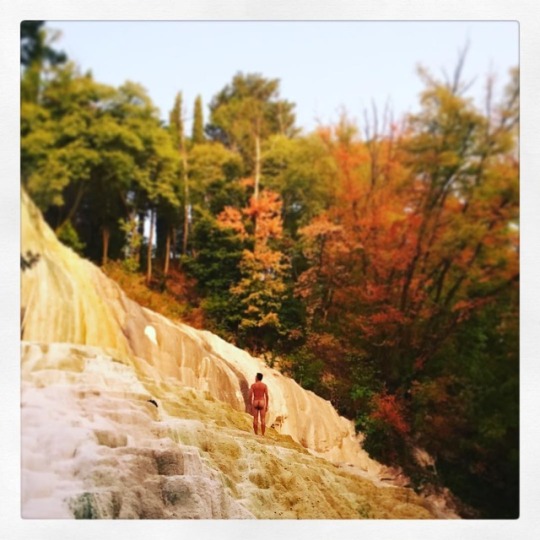
romerome at Bagni di San Filippo (Toscana):
🤗#nature #birthdaysuit #hotsprings
Viterbonews24 (Oct. 10) notes the difficulties concerning the allocation of thermal waters to public and private concerns. retedellereti (Nov. 14) likewise explains the difficulties while there are more recent articles by IlMessaggero (Feb. 19), NewTuscia (Feb. 13) and IlMessaggero (Feb. 20).
'The representatives of the 'Amici dei Bagni di Petriolo' association were the first to notice the anomalous coloration of the thermal waters of the Terme di Petriolo, in the Siena area, which "flowed black from the adduction plant, staining the tanks and dyeing the 'river water ".Slightly more info from Sienafree (Mar. 10).
...
The association hopes that the results of the analysis on the waters of the Terme di Petriolo, "do not highlight dangers to human health", and "that there is a way to monitor the situation by verifying that all the laws and precautions of the law have been adopted and for the protection of the environment ".

tata_the_freedom_giver, somewhere on the coast of Languedoc (France):
Shower can be challenging when living in a van without one, so we become more open to alternatives.. Here is a nice one that we found on a hidden small beach in a lagoon.Maan, there should be hot springs everywhere!!!✌ 🛀🏊🐳🐠 #vanlifers#vanlife #showertime #projectvanlife#homeiswhereyouparkit #vans #traveling#hotsprings #borntobewild #nature #pool#naturalpool #roadtrip #dreamlife#livingthedream #lagoon #frenchreviera#french #טיולים #טבע #מקלחת #מעיין #צרפת
Eagles na Cestách (Nov. 3) visit France's Prats-Balaguer. Unfortunately the report is in Czech, though what I make up is that it was not too hot (28C).

marina.b.m at Bains St Thomas / Prats Balaguer:
El secreto no es correr detrás de las mariposas .. es cuidar el jardín para que vengan ellas hacia ti#holidays #vacaciones #france #termes#nature #hot #natura #bosque#mountains#nieve #tattoo #tattoogirl #smalltattoo#mariposa #butterfly#butterflytattoo#espalda #blonde #blondehair #shorthair#francia #cascadas#piscinasnaturaisLater on in November they are at the Ourense hot springs (Galicia, Spain).

ulyana_hohlushka at Pyatigorsk (southern Russia):
Горячие источники в горах Пятигорска под чудным названием «Бесстыжие Ванны»😉 P.S.У каждого свои шалости🙈#бесстыжиеванны #пятигорск#горячиеисточники #модель #model #girl#itsabeautifullife #lifeisgood #iamhappy#mountains #moscow



